
Preparation continues for county bridge work
TONY BROWN/DAILY FORUM
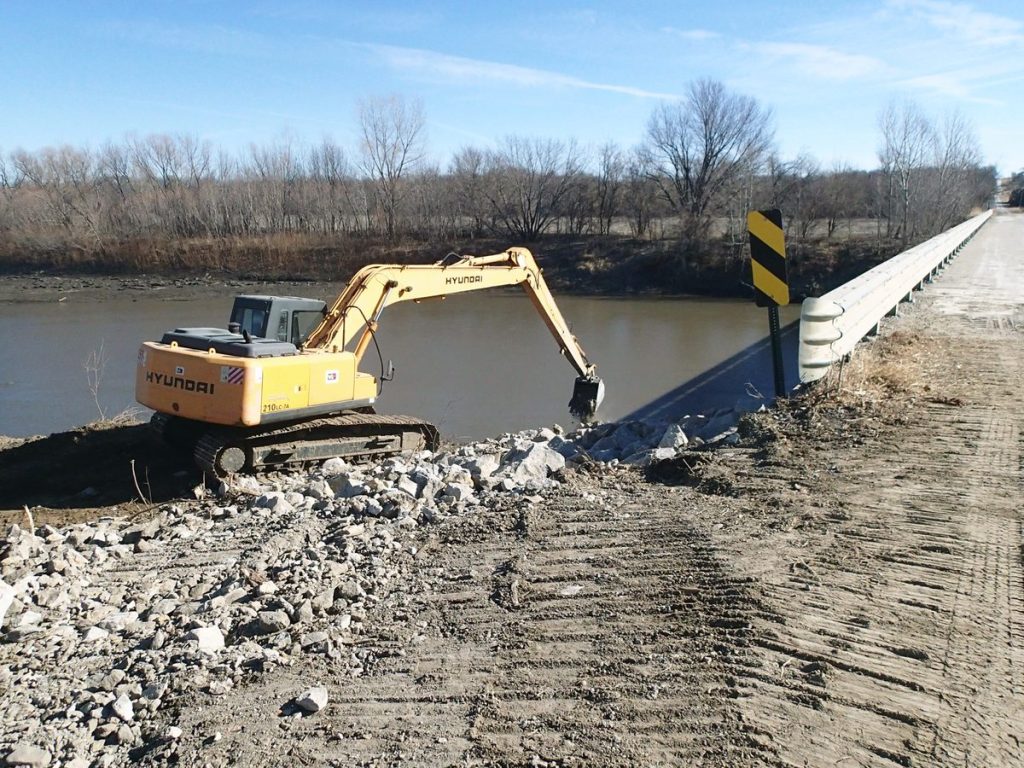
A heavy equipment operator uses a tracked excavator to spread rip rap along the western abutment of a bridge spanning the Nodaway River at 240th Street in western Nodaway County. Unseasonably warm winter weather has allowed the county’s road and bridge crew to keep working outside while preparing for this year’s annual round of bridge construction projects.
It’s shaping up to be a mild winter across northwest Missouri, which means Nodaway County Road and Bridge Supervisor Ed Walker and his construction team are ratcheting up efforts to prepare for the annual round of rural bridge rebuilds.
During its regular session on Wednesday, the County Commission held a bid opening for the shortest of seven county-funded bridge projects planned for this year.
The $44,500 contract for precast concrete decking and beams was awarded to sole-bidder Oden Enterprises of Wahoo, Nebraska. Forty-six feet in length and about 25 feet wide, the bridge will replace an existing wooden structure on 220th Street near its intersection with Mahogany Road about two miles east of Mozingo Lake.
One of three decades-old spans in the same general area, the bridge is the only one short enough to qualify for pre-cast decking, which is less expensive than structures built using poured concrete.
South District Commissioner Robert Stiens, who acts as the county’s lead official for transportation matters, said the total costs of the span, including new pilings and labor, should come to around $100,000.
In addition to the seven county-funded bridges, the commission also hopes to complete an eighth span this year using federal “off-system” dollars near the intersection of 365th Street and Galaxy Road over Jenkins Creek just east of Graham.
Originally no federal bridges were planned this year because the county thought it had used up its “soft-match” credits — local labor and material that can be counted as a match for off-system grants through the U.S. Department of Transportation.
However, approval for the extra bridge arrived unexpectedly in January, along with an influx of funding that raised the county’s total bridge budget from a little more than $1 million to around $1.7 million.
On other fronts, Walker said the county’s transportation crew has taken advantage of the warm weather to address various outdoor chores that generally have to wait until later in the year.
For example, workers recently spent about three days installing riprap along the west bank of the Nodaway River to protect a bridge abutment on 240th Street.
Working in the field, however, has slowed some construction preparation tasks, such as wiring together grids of metal bars used to reinforce poured concrete bridge decks.
Walker said the job is generally performed on cold, snowy days when his workers are limited to tasks that can be performed inside. But such days have been in short supply so far this winter.
Of the locally funded bridges on the list for rebuilding over the spring and summer, only three — the cluster of spans east of Mozingo Lake — are on gravel roads.
Walker said earlier those bridges will likely be the first projects undertaken when construction begins, since the structures should be easier to reach with heavy equipment during what is normally wetter weather in the spring.
The remaining four structures on the county’s list are all on dirt roads, three of which are currently closed to traffic.
Closed spans to be replaced include a 100-foot-long bridge in Hughes Township near the intersection of 350th Street and Fairway Road northeast of Graham, a 90-foot bridge in Atchison Township near 120th and Hallmark, and a 100-foot bridge in Union Township near 180th Street and state Route FF.
Stiens said it is important to replace closed bridges as quickly as possible because, after a certain amount of time, the Missouri Department of Transportation will remove them from its rural transportation inventory.
The remaining crossing is an 80-foot bridge in Polk Township north of Maryville in the vicinity of 220th Street and Hawk Road.
Estimated construction costs range from around $100,000 for the pre-cast slab bridge bid out this week to around $225,000 for the Hughes Township project.
As Missouri’s fifth-largest county in terms of geographical area, Nodaway maintains one of the state’s biggest rural transportation networks, a system that embraces more than 360 bridges, 1,000 miles of gravel roads, and nearly 200 miles of dirt roads.




