Consultant: ‘Cool factor’ key for downtown
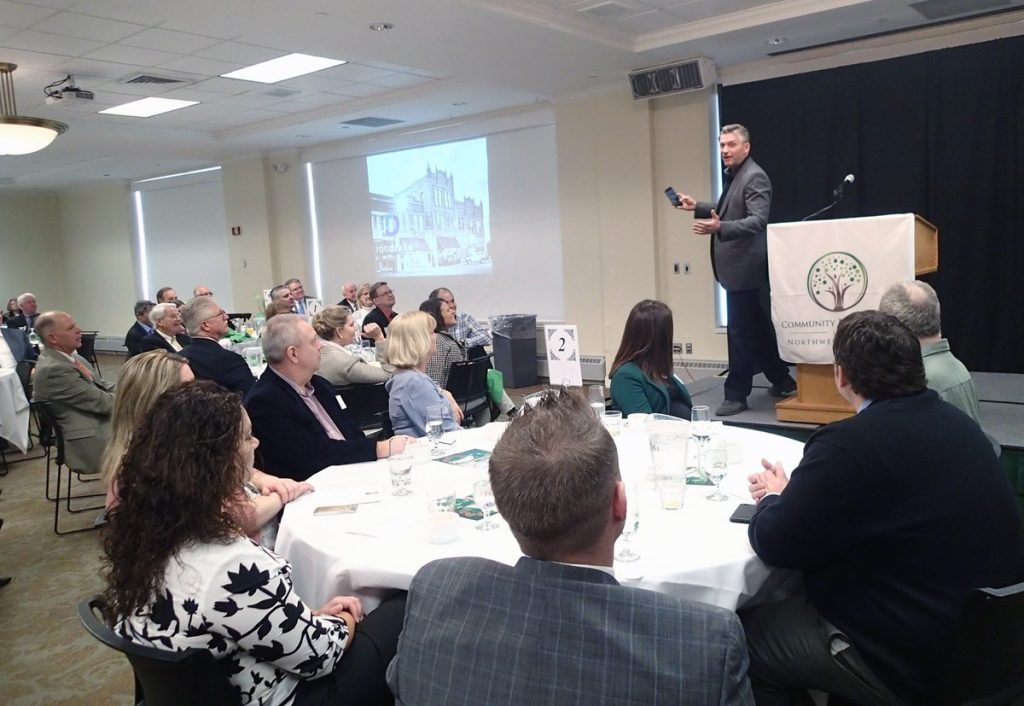
TONY BROWN/DAILY FORUM
Downtown revitalization consultant Ron Drake addresses a crowd of more than 200 regional officials and civic leaders Friday during the sixth annual “Annual Event” hosted by the Community Foundation of Northwest Missouri at Northwest Missouri State University.
More than 200 of northwest Missouri’s biggest stakeholders — businesspeople, mayors, council members, property owners, farmers, civic leaders, educators, and politicians — gathered in the J.W. Jones Student Union Ballroom Friday morning hoping that some of Ron Drake’s magic would rub off on this region’s struggling downtowns.
Drake, who spent three days in Maryville last week at the invitation of the Community Foundation of Northwest Missouri, is forging a growing reputation in the nation’s heartland as a Main Street fixer.
Over the past several years the author of “Flip This Town: Preservation Made Practical on Main Street USA” has won accolades for using his hands-on construction skills and knack for creating partnerships to revitalize his adopted hometown of Siloam Springs, Arkansas.
Having stepped away from that effort, Drake, a former contractor, is now in the business of telling other small cities how it’s done.
So on Friday, during the foundation’s sixth annual “Annual Event,” the tall, handsome native Californian, who looks a little like a young Joe Namath, offered what amounted to a Downtown Revitalization 101 course in a room packed with eager listeners from rural communities filled with crumbling brick storefronts, blighted streets, and shuttered shops.
While much of Drake’s presentation consisted of sloganeering — phrases like “It is what it is but it’s not what it seems” and “vision is a mental picture of what could be fueled by a picture of what should be” — he also offered advice obviously rooted in experience.
In essence, his message was one of encouragement that emphasized the importance of hometown developers becoming aware that old buildings can be repurposed and used in new ways — or maybe even in old ways tweaked a bit to accommodate new attitudes.
As an example, Drake cited Fong’s Pizza in Des Moines, Iowa, which opened in 2009. For years, in fact since 1908, the building housed King-Ying-Low, Des Moines’ oldest Chinese restaurant, which Drake said had become dated and even a little seedy.
But through minimal decor upgrades, and an emphasis on craft beers and Chinese-style pizza, Drake said a new generation of owners has managed to transform the eatery from “something old and dated into something new and funky.”
Drake repeatedly told his audience that while money is essential to downtown renewal, the creative use of inexpensive, recycled, trashed, and dumpster-ready materials can go a long way toward transforming old buildings into trendy lofts, creative coffee shops, hip boutiques, and congenial public spaces.
In one example, he told of using “the world’s cheapest plywood,” coated and buffed to an exotic sheen, as flooring in a second-story loft above a refurbished retail space.
“It’s the first thing people noticed,” he said. “Hey, what a great floor! We just said, ‘Thanks, it cost fifty bucks.’”
One theme Drake returned to several times during his presentation was the importance of the “cool factor,” a concept he said was especially important in college towns where the quartet of upper-story lofts, clothing stores, restaurants, and boutiques is essential to downtown revitalization.
Student apartments, in fact, are proving a key to renewal efforts in Okmulgee, Oklahoma, Drake said.
The home of Oklahoma State University’s Institute of Technology, Okmulgee itself, according to Drake, has been in a state of decline for decades following its heyday as an oil boomtown in the 1920s.
While the college has an enrollment of about 3,000 students, Drake said, few live in Okmulguee itself because it is “such a depressing little town.”
However, the city has a number of architecturally significant buildings erected during its early 20th century era of prosperity, and one of those, under Drake’s guidance, was transformed into a residence space so “cool” and contemporary that local residents rented the apartments before students had a chance to move in.
Sensing opportunity, the campus has gotten involved and purchased two downtown buildings that are to be renovated into apartments housing at least 75 students.
“Students don’t want to lived in a junkie rental house,” Drake said. “They want to live someplace cool.”
Creative residential options downtown are a key part of Drake’s strategy, since he believes that “the best way to bring life downtown is to bring lives downtown.”
Too often, he said, cities try to recruit businesses in order to attract people when they should focus on attracting people in order to recruit businesses.
Successful downtowns, Drake said, offer an environment that invites any number of uses from shopping to dining to surfing the Internet to hanging out with family and friends.
He added that arranging streets and parking areas so that there are fewer cars and more pedestrians is a plus as well.
In closing, Drake compared a downtown to a city’s heart, saying that if the heart capable of running a marathon the rest of the community will be healthy as well.
“The heart of your town is probably not Wal-Mart,” he said. “The heart is downtown.”