
University hosts annual MLK celebration
TOM PINNEY/DAILY FORUM
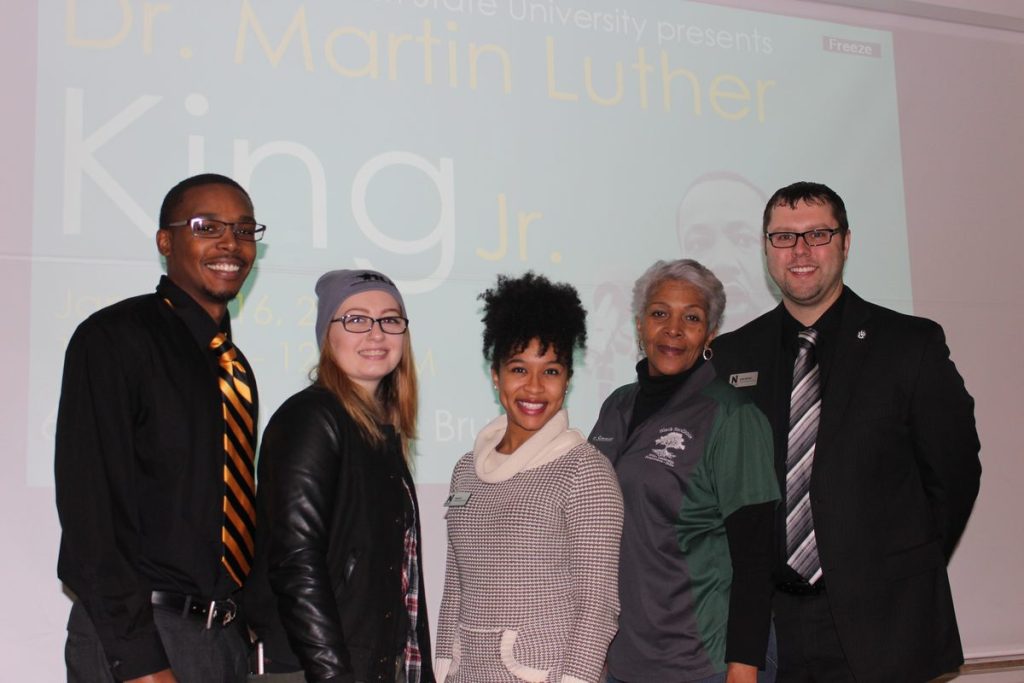
All smiles Members of the Office of Diversity, Equity, and Inclusion pose with smiles before the Peace Brunch for Martin Luther King, Jr. Day at Northwest Missouri State University. Pictured are, from left: coordinator Edward Gibson IV, office assistant Rhiannon Wolfe, coordinator Gabbi Ray, vice president Dr. Juanita Simmons, and director Steven Bryant.
While the icy and rainy conditions halted the traditional march to the courthouse, the Martin Luther King, Jr. Peace Brunch took place as planned Monday morning at 11 a.m. in the Ballroom of the J.W. Jones Student Union at Northwest Missouri State University.
Close to 100 faculty, staff, and students attended the brunch to celebrate the legacy of Martin Luther King, Jr., as well as to kick off a week of events surrounding the Civil Rights leader.
The event was coordinated by the Office of Diversity, Equity, and Inclusion. Vice President Juanita Simmons praised the event’s attendees.
“I’m not surprised at the turnout, because the community has been supportive of us,” Simmons said. “I’m very impressed by how the university and community work together here.”
The keynote speech was delivered by 2013 Northwest alumnus Carl Stafford, who now runs Kansas City-based nonprofit organization Speaking It Real Communications, which he founded in 2015. Due to the weather, Stafford was brought in via Skype to speak on the legacy of Dr. King as an activist.
“Why do we continue to do something that could hurt us?” Stafford asked. “Have we lost the light of the civil rights movement?”
Stafford’s speech touched on three key components of Dr. King’s activism, the first being his own views on activism.
“We have to look past the iconic ‘I Have a Dream’ speech to see where Dr. King’s passion truly lies,” Stafford said. “Dr. King lived into his 30s and participated in over 750 marches and protests – that’s activism.
“In 1964, Dr. King also donated his earnings – around $54,000 – to the civil rights movement and the things that civil rights leaders were doing to advance the cause. It’s one of the biggest reasons he’s so well-known: his sacrifice.”
Stafford said that activism, at its roots, is all about perseverance through sacrifice: “It’s about falling down 50 times and getting up 51.”
Stafford then moved on to discuss other civil rights workers and their sacrifices which, even though they aren’t as popular as Dr. King’s, are just as important.
“For them, activism was neither inevitable or automatic; it took sacrifice, struggle, and suffering,” Stafford said. “These are people who did so much but don’t get a page of our history books.
“Richard Allen founded the African Methodist Episcopal Church by staging a massive sit-in of the colored members of his congregation in the 1800s. Reverend George Lee went to the press to push for civil rights and was killed in cold blood, his murder still unsolved to this day. Bayard Rustin marched right next to Dr. King, and he was asked to secure more than 5,000 toilets for the March on Washington. Harry Moore founded the NAACP, and he was killed by a bomb planted beneath his house on Christmas, 1951.”
Stafford called the audience to “reach deep and ask yourselves: are you ready for that kind of commitment?”
Stafford’s third point was about abolishing the exclusion of inclusion.
“When we make a conscious decision to say that we are the only ones who need liberty, we have made a big mistake,” Stafford said. “Dr. King said ‘Injustice anywhere is a threat to justice anywhere,’ and that is always true.
“Anyone can be an activist for change, whether you are a member of the privileged or disadvantaged population. Just because you can’t empathize with them doesn’t mean you can’t sympathize with them.”
Stafford also charged the audience to consider the reason they are getting active.
“If you give so that people recognize you, you’re hurting the overall cause,” Stafford said. “We need people who are selfless and sacrificial, because that is true activism.
“You have to ask yourself what you’re doing to help the country overall.”
Because the march was cancelled, the three speeches for the end of the march were added to the brunch. Jordan Whiters, Northwest senior and vice president of the Minority Men’s Organization, spoke briefly about the progress being made at Northwest with the addition of the Office of Diversity, Equity, and Inclusion.
Marlon Oliver, Northwest senior and president of the Association of Black Collegians, spoke next on the value of the Black Lives Matter Movement. He clarified that it had nothing to do with an either/or mentality.
“We’re not saying that all other lives don’t matter, because every life is important,” Oliver said. “However, history shows that black lives in America are worth less, that we’re profiled, that we’re incarcerated at a higher percentage.
“America established the system of class and race where it didn’t exist elsewhere before we came in, and it’s hard to rise above the system we created. But we need to in order to truly see progress in this world.”
Freshman Tubias Johnson followed, speaking of a childhood memory.
“One of the lessons I got from watching the movie My Friend Martin as a child was that children don’t see race until they’re taught race,” Johnson explained. “As kids, we would see everyone as the same, as equal, and we need to go back to a time like that.”
Coordinator of Diversity and Equity Edward Gibson IV said events like this were important for the community as a whole.
“It brings people together to see a common goal,” Gibson said. “It’s sometimes easy to forget that we need to keep working toward those goals day in and day out.
“It’s not necessarily something that’s one-and-done. Things like this remind us that working toward equality is a daily task.”
TOM PINNEY/DAILY FORUM
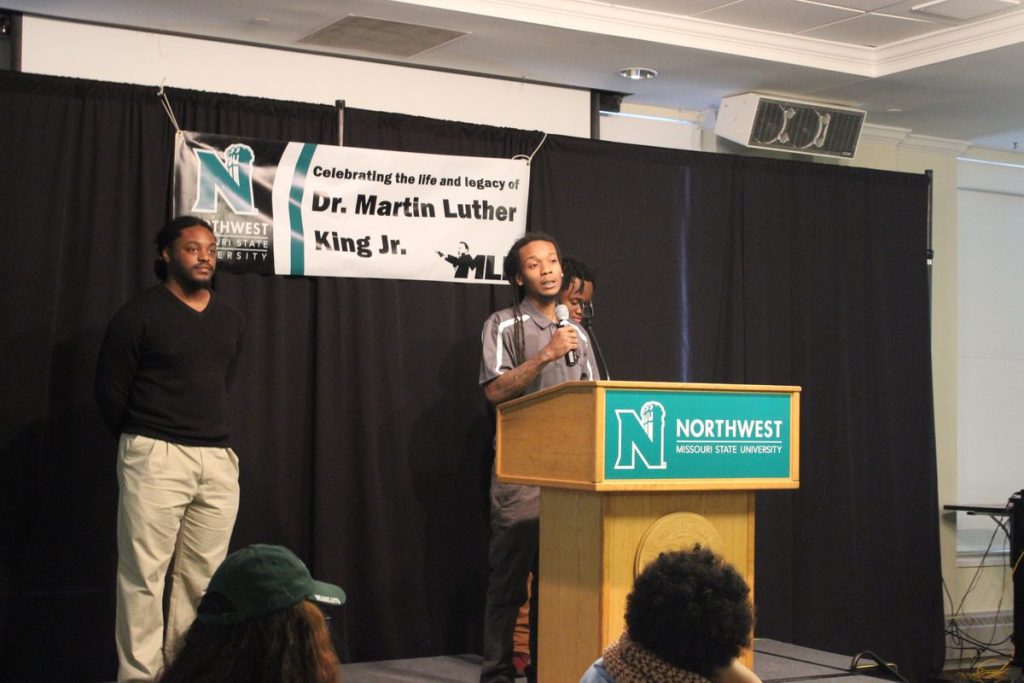
“Keep conscious about progress …” Minority Men’s Organization vice president and Northwest senior Jordan Whiters addresses the crowd in the Ballroom on the third floor of the Union, flanked by senior Marlon Oliver and freshman Tubias Johnson. Whiters discussed the need to give credit where credit is due and keep Northwest going in the right direction when it comes to diversity and inclusion.