
Lawmakers bristle over refuge name change
CRUNCHYSKIES PHOTO
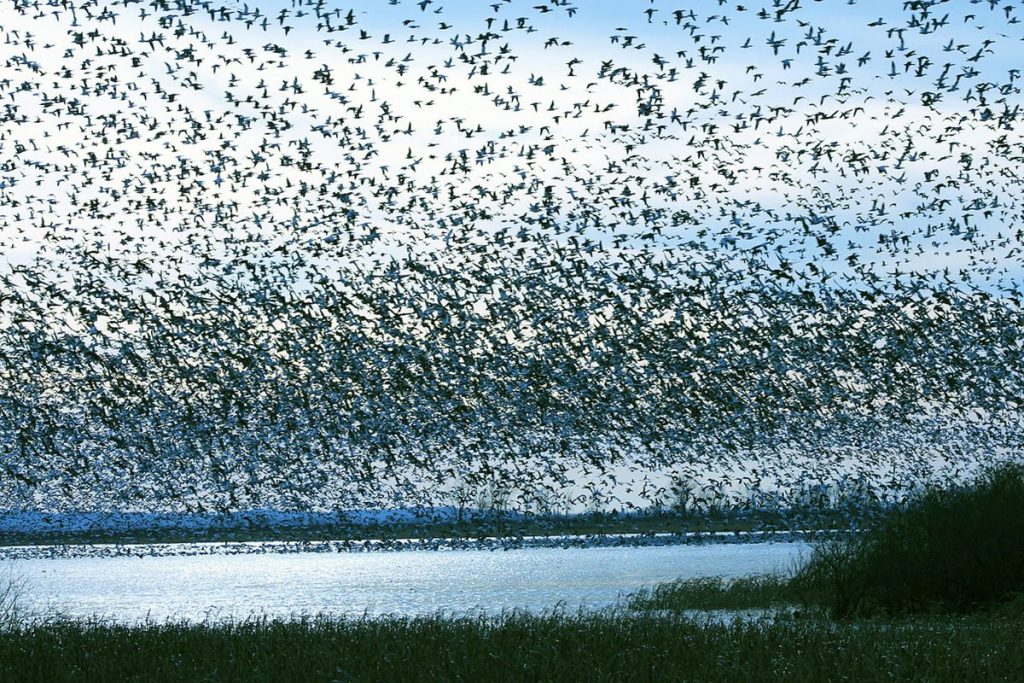
A massive flock of snow geese rises above Bluff Pool at the Squaw Creek National Wildlife Refuge near Mound City. A U.S. Fish and Wildlife Service proposal to change the name of the refuge — the term “squaw” is considered offensive by some Native Americans — has met with opposition from Republican lawmakers who say the switch is being made without adequate input from local residents.
North Missouri lawmakers are weighing in on a reported attempt by U.S. Fish and Wildlife Service Director Daniel Ashe to change the name of the Squaw Creek National Wildlife Refuge, a large federal nature preserve near Mound City about an hour southwest of Maryville.
According to news reports, Ashe has proposed the name Eagle Flats National Wildlife Refuge, a move that drew a terse response from U.S. Rep. Sam Graves, the Republican congressman in whose 6th District the refuge is located.
During what was described as an “invitation only” meeting earlier this week, refuge manager Lindsey Landowski reportedly said the name Loess Mounds National Wildlife Refuge has also been proposed.
However, neither option apparently sets well with Graves, whose office stated Wednesday that the congressman feels the change is proceeding without sufficient input from local residents.
“This entire process has been rushed through the back rooms of government offices, and FWS has intentionally kept people in the dark because they knew how those affected most would react,” Graves was quoted as saying.
The name Squaw Creek comes from a creek that runs through a portion of the refuge, which is noted for its large flocks of waterfowl, annual Eagle Days celebration, and the Loess Hills, a geographical feature consisting of scenic, mound-like ridges formed from wind-blown dust.
Established in 1935 by President Franklin D. Roosevelt, the preserve was meant to serve as a breeding ground for migratory birds and other wildlife. It comprises more than 7,000 acres along the eastern edge of the Missouri River floodplain in Holt County.
As for the word “squaw” in the current name, the term has long been considered offensive by some — but not all — Native Americans.
The Merriam-Webster Online Dictionary defines the word as “often offensive: an American Indian woman” and “usually disparaging: woman, wife.”
Strictly speaking, “squaw” is an English “loan-word” taken from the Algonquin language and meaning simply “woman.” It has various renderings, including “esqua,” “squa” “skwa.”
Graves staffer Wesley Shaw said Wednesday that the congressman’s office sent representatives to Monday’s meeting about the change and had known about the proposal for several days.
“But we haven’t been consulted or involved in the decision-making process at all,” Shaw said. “They’ve (the Fish and Wildlife Service) kept all of that very close, and they’ve kept everyone in the dark — no doubt intentionally.”
Shaw added that Ashe, as head of FWS, apparently has the legal authority to change the preserve’s name, but that Graves and his staff were discussing the best way to prevent the move.
“We’re going to do whatever possible to stop it,” he said.
Graves himself said he sees the name-change proposal as last-minute politics on the part of the outgoing administration of President Barack Obama.
“This is nothing we’re surprised to see at the end of President Obama’s administration,” Graves said. “Bureaucrats who’ve spent the last eight years growing the federal government are clawing at the last bit of power they have until it’s gone. No one’s benefitting from this. No one in Holt County is asking for this. It’s purely political. We’re going to make sure they know how people really feel, and we’re going to make them back off.”
Though the matter is a federal issue that doesn’t involve state authority, Missouri Rep. Allen Andrews, R-Grant City, posted a message on his Facebook page stating his opposition to the change, which he said was scheduled to take effect Jan. 6.
“The local citizens were not included in the discussion and will be forced to adhere to this change unless the process can be halted,” Andrews wrote. “This is an example of dirty, backroom politics …”
Acknowledging the controversy is a federal matter, Andrews said he nevertheless felt that “as a voice for the people in northwest Missouri I needed to get involved in any way I could.”
The lawmaker said he had contacted both Graves and Ashe to learn what could be done to “halt the process.”
“This is just one more example of the federal government continuing to force through mandated changes without the consent of the people,” Andrews said. “The Obama administration is notorious for this. It’s one more thing they’re trying to get through before the Trump administration takes office.”
Andrews said he had no objection to the change if a significant number of citizens believe the current name is offensive. What he opposes, he said, is action by the government without public input.
“The angle I’m coming from is that people need to be entered into the discussion,” Andrews said. “The federal government shouldn’t be able to steamroll something over the consideration of the people.
“The citizenry of our country should be running the country instead of a few people at the top of our government departments making these decisions.”




