Advent: Prepare to share Christmas presence
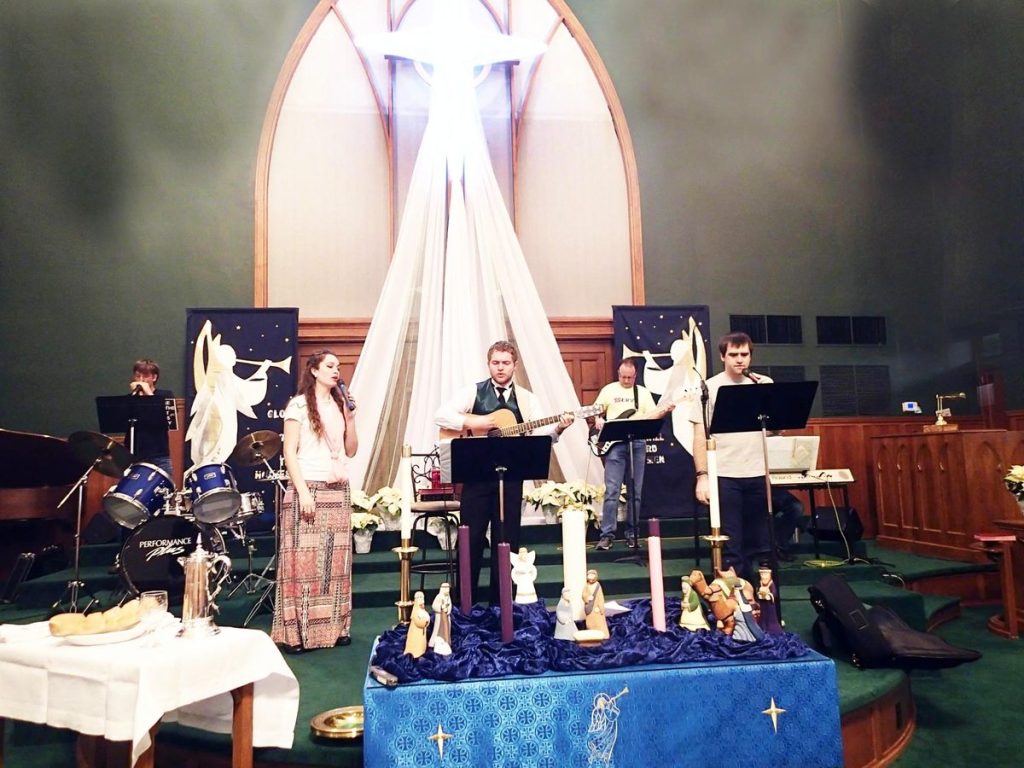
TONY BROWN/DAILY FORUM
A praise band plays in the sanctuary of the First United Church of Maryville earlier this month behind an altar decorated with Advent candles and other symbols evoking traditions associated with the approaching birth of Jesus Christ.
For many Christians this Sunday marks the last week of Advent, a four-week season on the church calendar that is set aside as a time to prepare one’s heart for the Nativity of Jesus Christ — the holy celebration known as Christmas.
Some churches bring Advent to life through the practice of various traditions, like decorating the sanctuary with evergreen boughs, setting up Christmas trees, or displaying crèches (Nativity scenes) and special ornaments like wreaths and colored candles.
But these are the mere signs of Advent. Behind the greenery and the soft lights and the mangers — often kept empty until Christmas Day — what is all this really about? Why is Advent celebrated, and what does it mean?
The Rev. Scott Moon, pastor of the First United Methodist Church of Maryville, said he wishes more people would take the time to find out, because in his view truly understanding Advent can be a good way, and maybe the best way, to make Christmas itself richer and more meaningful.
“Here’s a realization,” Moon said. “The word ‘Advent’ is off-putting to many people.”
The veteran minister went on to speculate this is because the word itself is a little strange sounding to many Americans. It’s not a term one hears or uses very often, and to some it might even sound a little fancy or inflated.
But in actuality, Advent is derived from a Latin word with a very simple meaning — “coming,” as in the coming of Christ.
“Advent is the first season in the Christian year,” Moon said. “It’s a time of preparation before celebration. And since we’re creatures of habit, preparing might mean that, before you rush into the day, you focus on a thought, a reading, or a bit of music. Advent lets you center yourself.”
As Christmas draws nearer, lives that are already too full, too choked with care and responsibility, can become even more hectic, Moon said, because people try to accomplish more than anyone reasonably can.
He further suggests that adding to life’s burdens is not necessarily the best way to ensure that you and yours have a merry Christmas.
And that’s where, Moon said, the power of Advent lies. Properly kept, it can be a season during which people stop trying to do things that don’t matter very much and instead take time to think about things that do.
Work on living in the moment, Moon said. After all, Christmas is a time of joy, so take time to enjoy it. Concentrate on Christmas presence, not Christmas presents.
“Advent is the time to empty your cup before the feast of Christmas,” he advises.
Moon also offers the following list, in essence a series of thought exercises designed to help people prepare for the “coming” of the Christ child. His how-to guide for building a successful Advent includes:
• Practicing patience. When you’re in line at Hy-Vee or Wal-Mart, and you’re in a hurry but the person in front of you is really slow, take a moment and remind yourself to say something kind, ether to them or to the cashier or preferably both.
• Practicing empathy and generosity. If you’re out at a restaurant, think about the person serving you and imagine the stress they may be under struggling to make ends meet or having to work through the holiday season. Then tip extra.
• Cutting people some slack, especially those you love. “We never know for sure what difficulties someone else is facing,” Moon said, “and we are usually the hardest on those closest to us.”
• Anticipating the predictable challenges presented by your family and friends at social gatherings and parties. Be prepared to respond with kindness when the inevitable rude word is uttered or the offending action taken.
“In faith terms, this is what a developed prayer life involves,” Moon said of the way he himself tries to prepare for the miracle of Christmas.
“We need to be attentive to the needs being faced by those around us. God taking on human form is the most relevant thing imaginable that he could do. During Advent we prepare ourselves to be as relevant as we can be — to be as human as we possibly can.”