County declines city’s TIF revenue request
TONY BROWN/DAILY FORUM
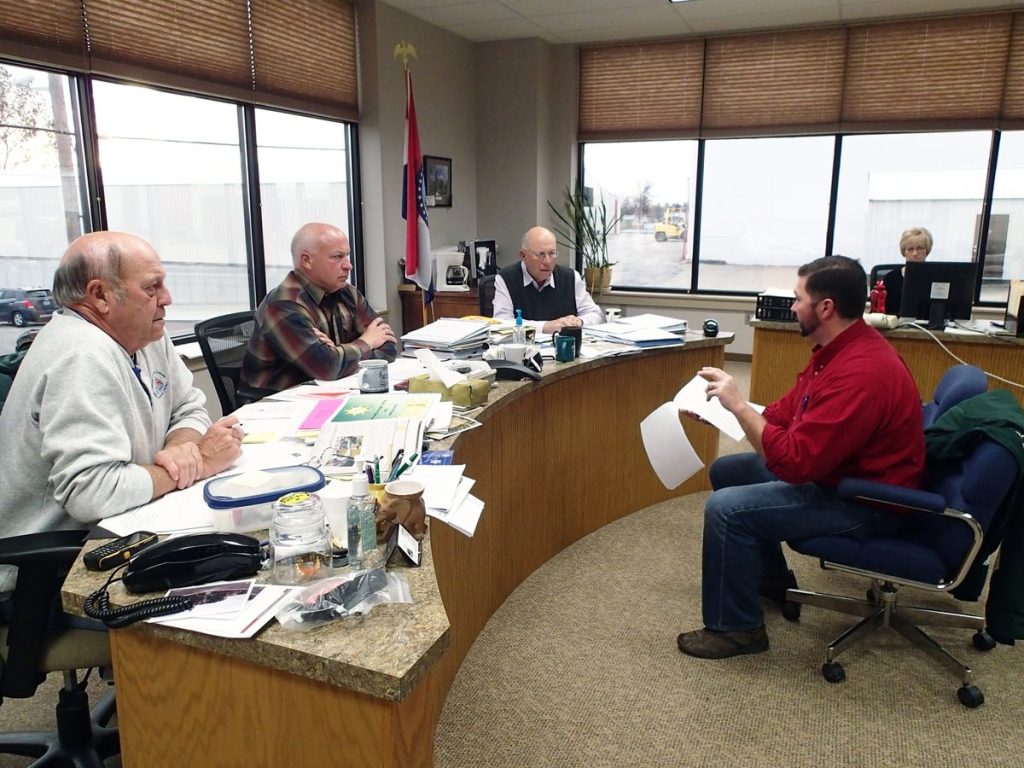
Nodaway County Prosecuting Attorney Robert Rice, right, appears before the Nodaway County Commission last week during a discussion on the City of Maryville’s request that the county hand over a portion of its road gravel sales tax revenues in order to help pay off tax increment financing debt associated with the development of Town Center, a Maryville retail complex anchored by the Hy-Vee supermarket.
Responding to complaints by voters and acting on a tentative recommendation by Prosecuting Attorney Robert Rice, the Nodaway County Commission on Friday declared its intention not to hand over a portion of the revenue from the county’s half-cent on the dollar road gravel sales tax to the City of Maryville, which would use the funds to help pay off tax increment financing debt.
The TIF debt was incurred in 2005 to pay for infrastructure improvements associated with the Town Center retail complex near the corner of South Main and South Avenue, which is home to the Hy-Vee supermarket, a restaurant, and a couple of small shops.
During a meeting of the County Commission on Nov. 30, City Manager Greg McDanel told the commission that, under state law, the gravel tax is classed as an “economic activity” levy and subject to TIF requirements.
McDanel said at that time that a portion of two half-cent sales taxes used to fund general county government operations has been diverted toward TIF debt service from the beginning, and that the gravel tax should not be excepted.
However, in an apparent oversight, the city neglected to ask for its share of the tax after it went into effect two years ago. McDanel said the city was not seeking revenue already collected but only a share of receipts coming in after Jan. 1, 2017.
Before making the request, McDanel said, the city submitted the matter for review by an attorney.
The gravel tax brings in a little less than $1 million a year, and City Hall estimates that under the existing TIF formula around $30,000 of that should be directed toward tax increment financing debt service.
Tax increment financing is a form of economic development incentive commonly used by governmental entities to reclaim “blighted areas.” In the case of Town Center, Maryville sold $2.5 million in TIF bonds back in 2005 that were used to pay for various infrastructure improvements associated with the shopping complex.
The bond financing related to Town Center was originally to be repaid over 20 years. However, the bonds were refinanced in 2015 for $1.7 million, which municipal Finance Director Denise Town said could shorten the term of repayment by a year or so.
Both the City of Maryville and Nodaway County agreed to participate in the TIF district from the time of its creation.
Under the original state statute, the city would appear to have a strong argument that it is owed a portion of the gravel tax revenue. However, the Missouri Legislature complicated the matter by passing an exception to the TIF formula that exempted “economic activity” sales taxes as of August 2014.
And therein lies the root of the local city-county dispute.
Voters approved the gravel tax in April 2014, prior to the exemption. However the tax was not implemented until Oct. 2014, a bit of timing that the commissioners believe gets the county off the hook.
After McDanel’s discussion with the commission in November, the three-member governing board asked Rice to research the matter and render an opinion.
On Friday, Rice told the commissioners that while there is some existing case law regarding similar TIF-related intergovernmental disputes, he was unwilling to speculate on how the matter might be resolved in court.
He added, however, that there was “not a clear-cut case that we are obligated to pay.”
The prosecutor said he was basing his surmise on both the timing of the gravel tax’s implementation and the wording of a county ordinance, which specifies that all gravel tax revenues must be spent solely on county- and township-owned transportation infrastructure.
While state statutes trump county ordinances in the same way that federal law supersedes state law, Rice told the commissioners that the city’s claim is doubtful enough that the county should refrain from handing over the disputed revenues at least until the requirements can be clearly established.
During a brief discussion regarding Rice’s findings, North District Commissioner Robert Westfall asked, “What if we just don’t pay it?”
Rice responded that the city has the right to file a lawsuit, and that, in his estimation, both sides could mount credible arguments in court.
Westfall answered that, in his opinion, consenting to the city’s TIF request would ethically, if not legally, betray the will of the taxpayers who approved the tax in the first place.
“What they voted for was the gravel tax, not to help pay for the TIF,” he said.
Westfall’s fellow board member, South District Commissioner Robert Stiens, said he feared handing over the disputed revenue could lead to similar tax disputes in the future.
“This will not stop once it starts,” he said.
As for the city, McDanel said Friday the municipality is simply requesting revenue to which it is entitled under state law.
“The intent of the city in approaching the county to capture a small percentage of gravel funds was not to cause conflict or legal action,” he said. “The city’s intent was to follow state statutes and collectively repay the Maryville Town Center TIF debt, placing the facility back on the tax rolls and benefiting all taxing jurisdictions, such as the (Maryville R-II) school district, city, and Nodaway County.”
McDanel added that legal action on the part of City Hall is unlikely.
“The city’s intent would be to resolve this matter as partners with Nodaway County,” he said, “as any legal action regarding this issue would be a waste of taxpayer funds.”