Oak Pointe dedicates ‘Aspen Village’ memory care
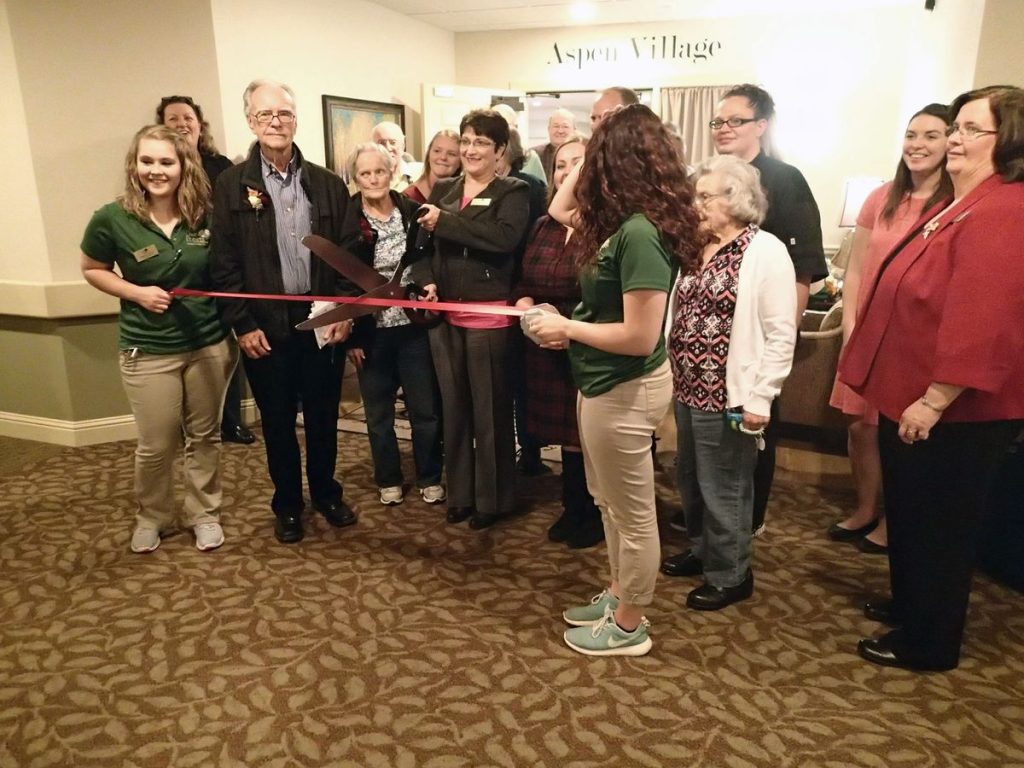
TONY BROWN/DAILY FORUM
Kim Florea, executive director of the Oak Pointe assisted living community in Maryville, cuts a ceremonial ribbon last week marking the re-naming of the facility’s memory care wing to Aspen Village. Aspen trees, usually associated with the mountain regions of the American West, have become a symbol of hope and connection for individuals and families struggling with Alzheimer’s Disease and other forms of dementia. November is National Alzheimer’s Disease Awareness Month.
November is National Alzheimer’s Disease Awareness Month, and the Oak Pointe assisted living community in Maryville took the occasion last week to officially name “Aspen Center,” a memory care “neighborhood” consisting of 13 small apartments reserved for residents battling Alzheimer’s Disease and other forms of dementia.
The event, which included a ceremonial ribbon cutting, was attended by local civic leaders, Oak Pointe staff, and the caregivers and loved ones of Oak Pointe residents.
Aspen trees, usually associated with the mountain regions of the American West, have become a symbol for individuals and families struggling with Alzheimer’s. This is because stands of aspen, though they appear to be made up of individual trees, are really a single organism sharing the same root system.
These systems, which can be thousands of years old, lend to their member trees the qualities of resilience, strength, and beauty, even under the harsh conditions of winter at high elevations.
Oak Pointe Community Relations Manager Stephanie Reed told those attending the dedication that, like aspen trees, Alzheimer’s patients, caregivers, family members, and service providers are all connected.
Referring to a large, framed print of a stand of aspens displayed at the entrance to the memory care unit, Reed said the image is meant to evoke “determination, strength of community, and overcoming fears and doubts.”
She continued: “The aspen tree is known for its strength, protection, and long life. Because of the chemical makeup of their bark, aspens can continue growing throughout the winter months. So much of this applies to dementia care. Just because someone is living with dementia doesn’t mean they can’t grow or feel or give love.”
In addition to providing care to patients living with dementia, Reed said Aspen Village also seeks to serve loved ones, family members, and caregivers.
“We are here to be your resource about Alzheimer’s and dementia,” she said, “whether it be through a caregiver support group, educational meetings, or just to offer some advice about where to find information.”
This summer, for example, Sue Myllykangas, an associate professor with Northwest Missouri State University’s School of Health Sciences & Wellness, offered a workshop at Oak Pointe during which caregivers and others were outfitted with appliances affecting their hearing, sight, and sense of touch.
The idea was to give those participating some sense of what Alzheimer’s feels like and the physical obstacles it creates.
Developed by ClearPath Senior Holdings and managed by Provision Living — both companies are based in St. Louis — Oak Pointe, located at 817 S. Country Club Rd., began accepting residents at the end of March, 2015.
The $6 million facility includes 46 single and double apartments, including 13 within Aspen Village, which is currently home to nine residents.
Reed said the remaining 33 apartments have been leased, and that there is a waiting list of potential residents. The center is currently home to 43 residents and has a maximum capacity of 50.
Oak Pointe has a full-time and part-time staff of about 50 people that includes resident associates (who provide direct personal care), nurses, cooks, housekeepers, and maintenance personnel.
A recent addition to the staff is a memory care coordinator who oversees Aspen Village in much the same way that the director of nursing presides over the larger assisted living wing.
Executive Director Kim Florea said the name change for the memory care unit is significant because it reflects Oak Pointe’s commitment to “person-centered care,” which she defined as addressing the psychological, spiritual, and social needs of residents as well as their physical well being.
When residents move into Aspen Village, Florea said, they take a cognitive assessment test that allows staff members to design an individualized activity program designed to meet dementia patients where they are.
For example, residents might take part in a bingo game that employs shapes and colors instead of letters and numbers.
Also, residents who become anxious around noise and activity are allowed to stay in their rooms, and various activities — doing arts and crafts, listening to someone read aloud, or getting their hair and nails done — are brought to them.
“We have people at all different stages cognitively,” Florea said, “and we work to accommodate that.”