Local Habitat studied as model for success
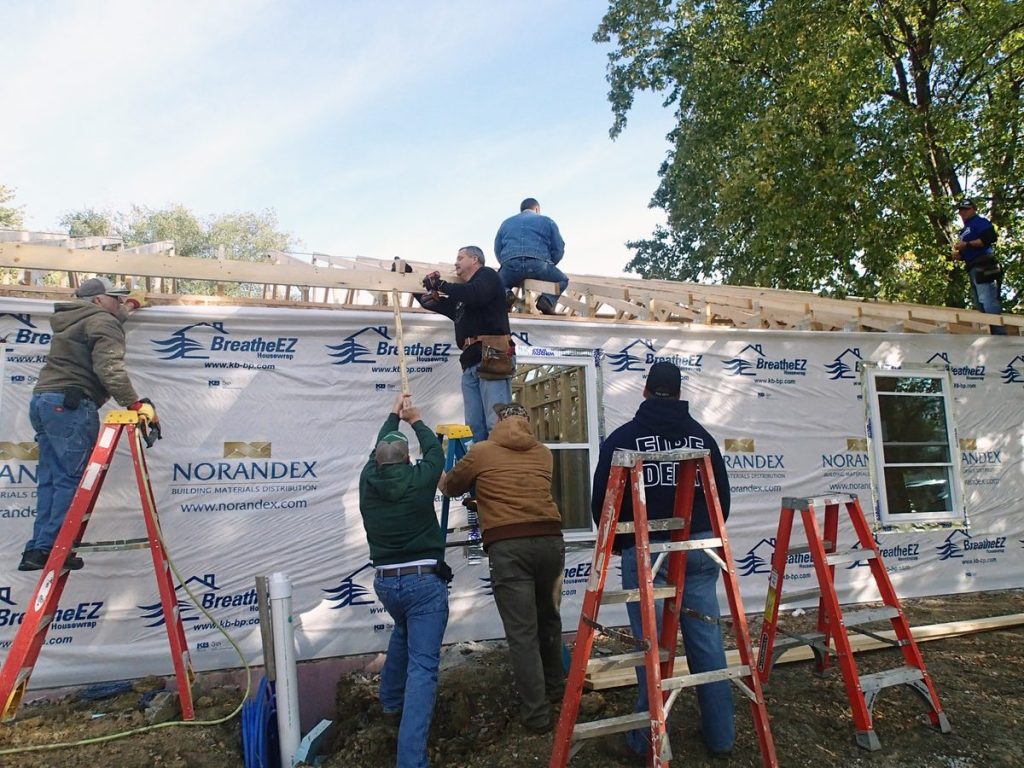
TONY BROWN/DAILY FORUM
Habitat for Humanity volunteers work Friday on the local non-profit organization’s latest single-family home project on East Jenkins Street. The four-bedroom residence is scheduled for completion sometime early in 2017. Among those on site was Aufrecht Technologies CEO Frank Centrallo of Auburn, Alabama, who met with the Nodaway County Habitat board in order to learn some of their strategies for success.
Over the years, Habitat for Humanity of Nodaway County had developed a reputation as one of this area’s most efficient, effective, and well-run charities.
With a solid core of volunteers running the gamut from local clergy, to builders and contractors, retired professionals, institutional CEOs, police officers and firefighters, teachers, bankers, and just plain folks from all walks life, the organization has managed to build a new house for a lower-income family about every two years.
In recent days the organization has poured the foundation and erected the walls and roof of its ninth residence, a four-bedroom house at the east end of Jenkins Street that, if all goes as planned, should be ready for occupancy shortly after the first of the year.
This year’s client family, the Mullinses, will acquire the home by taking out a no-interest mortgage and contributing “sweat equity” during the construction process. Former missionaries to Argentina, Josh and Alea Mullins currently live in a small, two-bedroom house just north of Maryville. The couple has three children and is expecting their fourth child this fall.
Josh works as a science teacher in Fairfax. Alea is a stay-at-home mom.
The family was on the job site late Friday morning, as were local homebuilder Eric Couts and his crew, several local firefighters and law enforcement officers, and a number of other volunteers and Habitat board members.
But that was all normal and familiar for a Nodaway Habitat construction project on a clear, chill early autumn day. What was a little out of the ordinary were a couple of visitors from out of town.
It turns out that the local Habitat organization has caught the attention of folks in other parts of the country who want to adopt what might be called the Maryville Model to their own communities.
One of the strangers was a big, smiling man with faultless manners and just a trace of the Deep South in his voice.
Frank Centrallo, who drove through the night to Maryville from his home in Auburn, Alabama, is CEO of Aufrecht Technologies, a sustainable and renewable energy solutions company specializing in such things as “mini-grids.”
In the simplest terms, a mini-grid is a standalone power system serving an office building, corporate or university campus, or a residential subdivision that relies solely on sun, wind, and other forms of clean, alternative energy.
Centrallo has not previously been involved in Habitat, but he plays golf with someone who is, and during a recent outing his buddy mentioned that a Habitat affiliate in a small Alabama town was not doing very well, having built a single home in the past 10 years.
“What can I do to help?” Centrallo asked. Find out how it’s done, his friend answered.
So Centrallo, in the way of connected, successful people, did some looking around and made a few calls. Where, he asked, can I find a really good Habitat affiliate? The answer, “Check out Nodaway County.”
That’s why, after doing some more research to find out where the heck Nodaway County was, and missing an airline connection in Atlanta, Centrallo made the long drive to north Missouri in order to meet with the local Habitat board and visit the Mullins house construction site.
Aside from a number of organizational details, Centrallo said he was returning to Alabama having learned two essential lessons: the importance of choosing the right client family for ownership of a Habitat home and the importance of recruiting a corps of volunteers that truly buys into Habitat’s core mission.
“It’s probably the best conceived program of its kind,” he said. “What some people need is not a handout but a helping hand.”
Centrallo said the Nodaway County organization has managed to master both those principles, with the result that it has been successful.
“They’re a great group,” he said. “Very open, very willing to help.”
Also at the job site Friday was Don Jahnke of Extreme Panel, a small business based in Cottonwood, Minnesota, that manufactures the “structural insulated panel system” components — SIPS for short — used to construct the last two Nodaway Habitat projects, the Mullins home and an earlier residence in Ravenwood.
The snap-together exterior wall panels essentially consist of a pair of plywood squares with insulating foam pancaked between them. SIPS panels are rated 60 percent more efficient than traditional frame construction and allow builders to erect a single-family home in about half the time.
Jahnke’s company is dedicated to Habitat and participates in 15-20 initiatives with the international non-profit each year, providing components to affiliates at discounted cost.
Last year, Extreme Panel was involved in construction of an 18-home Habitat project in River Falls, Wisconsin, in which all the houses were incorporated into a mini-grid powered with a combination of solar and solar/thermal energy.
“We’re all about energy efficiency,” Jahnke said, noting that the Wisconsin build was named the Habitat for Humanity Project of the Year for 2015.