
City Council adopts downsized budget for 2017
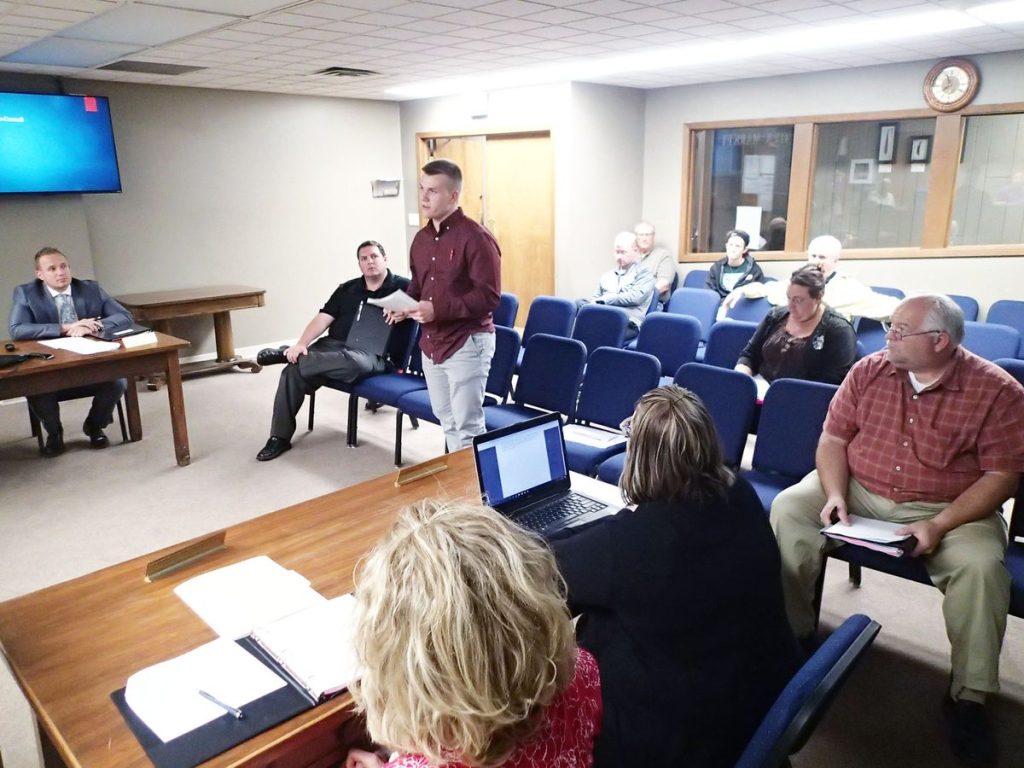
TONY BROWN/DAILY FORUM
Northwest Missouri State University student Jacob Barnes addresses the Maryville City Council during its regular session this week. Barnes, a sophomore mass media and broadcasting major from Liberty, has been appointed to serve as the university’s student liaison with City Hall during the 2016-2017 academic year.
Having done the heavy lifting decision-wise during a series of goal-setting and special budget review sessions over the summer, the Maryville City Council on Wednesday moved with almost no debate to quickly approve a spending plan for the new fiscal year, which begins Saturday.
The 2017 budget totals $24.1 million, which is about $3 million less than the expiring year’s mark of $27.2 million. Reasons for the reduction include a relative lack of high-dollar capital projects compared to recent years and near-exhaustion of discretionary revenue from the city’s half-cent on the dollar capital improvements sales tax, which expires in 2018.
Remaining income from the tax is mostly earmarked for debt service related to already completed projects. City Manager Greg McDanel has labeled voter renewal of the levy as one of the city’s main priorities for next year, when the issue will likely appear on the April 2017 municipal election ballot.
But though Maryville is undergoing a period of austerity, significant funding is still being set aside for infrastructure improvements, especially underground.
The Water/Sewer Fund portion of the budget contains $500,000 for continued work to stem the “inflow and infiltration” of storm water into the sanitary sewer system, $250,000 for improvements to the southwest lift station, plus another $200,000 in incentives for homeowners the city is hoping will reroute downspouts and foundation drains that allow rainwater to flow into sewer pipes.
Other sewer upgrade expenditures include $350,000 for replacement of a large-capacity trunk line on the east side of town that carries effluent to the city’s newly constructed mechanical treatment plant.
As for the General Fund budget — which along with the Water/Sewer Fund contains core spending for facilities and services that have a direct impact on taxpayers — significant line items include $25,000 for planning associated with a proposed new Maryville Public Safety police and fire headquarters, $300,000 for asphalt street overlays, $52,000 for a street-striping machine, and $10,000 for a 911 dispatch consolidation study proposed as a joint project with Nodaway County.
Additional spending in 2016-’17 will embrace a 2 percent cost-of living raise for the city’s approximately 80 full-time workers plus a 2.5 percent merit pay increase based on the outcome of employee reviews.
At least two budget revisions are likely in the near future. The first will account for spending related to construction of a new conference center at Mozingo Lake Recreation Park, which is being financed largely through a voter-approved eighth-of-a-cent sales tax. Contractor bids for the center are to be opened at City Hall Oct. 11.
The second anticipated change is in connection with a water meter replacement project city officials say will be paid for through elimination of inaccurate meters that allow some customers to use more water than they are billed for.
Since funding schemes are in place for both initiatives, the amendments are not expected to have a significant impact on the city’s bottom line.
In other business this week, the council approved a one-year contract with the New Nodaway Humane Society, which will receive a $60,000 operating subsidy in exchange for providing the city with animal control services. The agreement reflects a $20,000 reduction in municipal funding for the society’s no-kill animal shelter compared to fiscal 2016.
The governing board also approved a similar contract with Nodaway County Economic Development, which increased the non-profit agency’s level of city support from $60,000 to $62,000.
McDanel said the organization has played a vital role in several major projects during recent years, including completion of the West Fourth Street pedestrian corridor, recruitment of the Boulders Inn & Suites hotel at Mozingo Lake, construction of the Watson 9 junior golf course, and the Kawasaki Motors plant expansion.
“NCED almost serves as a city department for us,” McDanel said of the agency’s work to recruit and retain Maryville-area business and industry.
Also adopted was a new ordinance setting up an “alternative community service” program for offenders found guilty of violations in Municipal Court.
The measure is in response to a recently enacted state law that encourages municipal courts to offer community service as a sentencing option for offenders who can’t afford to pay fines.
Maryville Public Safety Director Keith Wood said the statute was passed in the wake of racial unrest in the St. Louis suburb of Ferguson, during which news reports revealed that a number of Missouri cities were using court fines as a major revenue stream.
In other business the council:
• Slightly revised 2016 property tax values related to new construction. The change was in response to a computer software error that affected calculations conducted by Nodaway County.
The original new-construction assessment was changed from $1,054,840 to $1,091,490, which resulted in a revision to the city’s General Fund tax rate from $0.3555 to $03556 per $100 of assessed valuation. The Maryville Public Library levy increased from $0.1606 to $0.1607.
The recalculation will generate an estimated $132 in additional revenue for each fund.
• Awarded a three-year contract to Mozingo Sanitation for trash removal services at Mozingo Lake for $18,717, or $6,239 a year.




