Firefighters hone bus wreck response skills
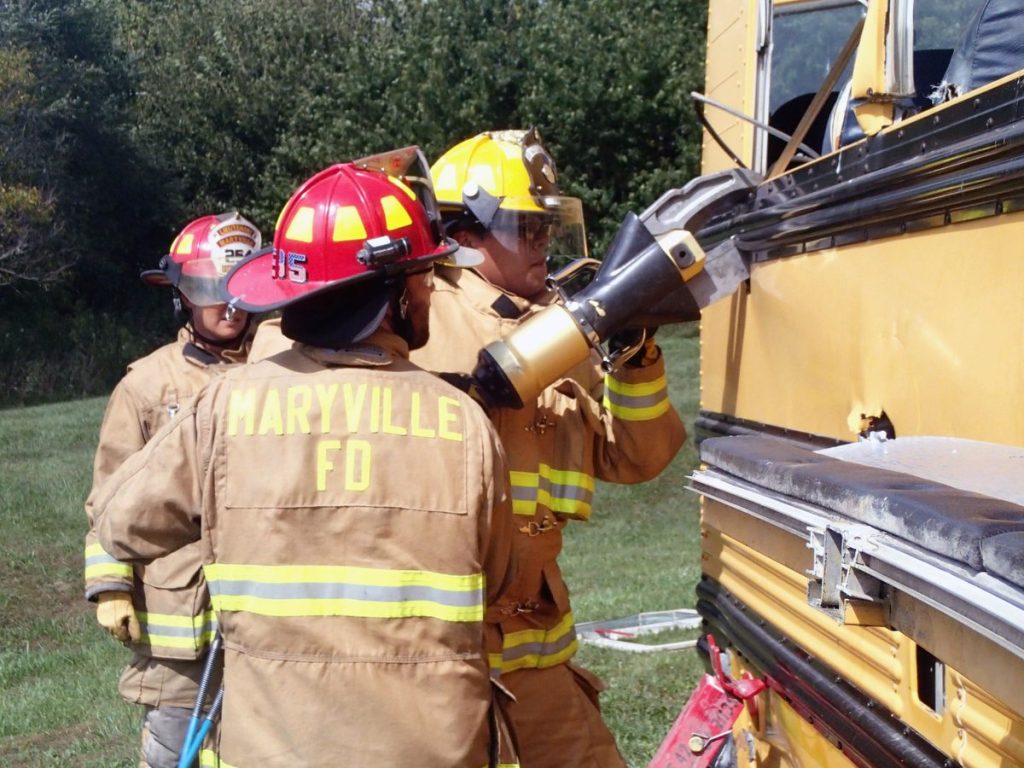
TONY BROWN/DAILY FORUM
Drew Garrett, a firefighter with the 139th Airlift Wing at Rosecrans Air National Guard Base, uses a pair of hydraulic shears to cut through the metal body of a junked school bus Saturday during a training exercise at the Nodaway County Ambulance District headquarters in Maryville. The shears Garrett is wielding are capable of exerting about 10,000 pounds of force.
Firefighters from a half-dozen area departments, including Maryville Public Safety, spent about eight hours Saturday participating in a special course designed to prepare them for the kind of call every first responder dreads — a catastrophic school bus accident.
But while the thought of a bus full of children trapped and possibly injured inside 20,000 pounds of twisted metal is enough to give even the most seasoned firefighter pause, the job description is clear —function at your best by training for the worst.
Saturday’s course was one of three or four such exercises hosted for area firefighters every year through the Missouri Fire and Rescue Training Institute, an organization that operates under the auspices of University of Missouri Extension.
State funding for the daylong workshop, which for local firefighters augmented twice-monthly training sessions staged by Maryville Public Safety, was provided by the Missouri Fire Education Commission.
After spending the morning doing tabletop exercises at the Nodaway County Ambulance District headquarters on the south end of town, the firefighters headed outside, where an arsenal of special tools and equipment awaited them along with a couple of junked buses.
The next three hours or so were spent applying lessons learned in the classroom by using an array of bars, picks, axes, saws, and other implements to shatter glass, rip through metal, and pry up seats as efficiently, effectively, and safely as possible.
Among the more impressive devices deployed during the “tool time” portion of the workshop were powerful sets of hydraulic shears and spreaders capable of exerting 10,000 pounds of force while prying apart or slicing through steel panels like a table knife through warm butter.
That kind of power is simply what is required for school bus passenger rescues, said MU-certified instructor Ron Walters, a firefighting veteran from the city of Troy north of St. Louis.
Walters explained that buses, due to their heavy-duty construction — designed precisely to protect young passengers — ironically present rescue crews with special challenges.
“A school bus is the safest vehicle on the road,” he said. “There is a lot more metal and a lot more structural integrity, but it’s like cutting into a tank.”
With that in mind, Walters said his goal for the day was to send participating firefighters, most of whom are volunteers, home with enough knowledge to respond effectively should a severe school bus wreck requiring passenger extrication ever occur in their service areas.
“It’s different than cutting into an automobile,” he said.
In addition to saving others, Walters and fellow instructor Roger Meyers of Concordia, also emphasized the importance of firefighters themselves avoiding injury in an environment filled with chaos and confusion, not to mention sharp-bladed power tools and clutter underfoot consisting of power cables, generators, air compressors, and vehicle debris.
A false move or a thoughtless moment can easily result in serious injury, but Walters said the most dangerous hazards first responders face are created by others.
“Traffic is the number-one hazard,” he said, “the second thing is parents and onlookers. Now that every child has a cell phone, sometimes the parents start getting there before we do, and that can be a problem. People need to remember that it’s important to do what firefighters tell you to do — to stay out of the way and let them do their job.”
Other lessons covered during the weekend exercise included techniques for dealing with spilled fuel, battery acid, and similar hazards created whenever a large vehicle comes to distress on a street or highway.
Firefighters were also led through procedures associated with multiple serious injuries, a situation first responders, in the grim vocabulary of their profession, refer to as “mass casualties.”
Among those participating in Saturday’s exercise was Capt. Phil Rickabaugh, supervisor of the Maryville Public Safety fire division and one of only two professional firefighters on the City of Maryville payroll.
Rickabaugh said his main goal for the day was to make the most of yet another opportunity to tell his people how important it is to stay safe.
“Safety is always our top concern,” Rickabaugh said. “We have to stay safe or we can’t do anything.”
With school bus response training under their belt, area firefighters are to receive yet more state-funded instruction this year during a December tabletop exercise designed to teach ordinary firefighters how to act as “incident commanders” should they find themselves first on the scene following a disaster or emergency.
Other planned workshops to be offered as funding becomes available will address hazardous material spills, farm machinery accidents, LP gas responses, and grain bin fires.
Besides Maryville Public Safety personnel, firefighters attending Saturday’s workshop included first responders from St. Joseph, Union Township (Pickering), Jackson Township (Ravenwood), Rosecrans Air National Guard Base, and King City.
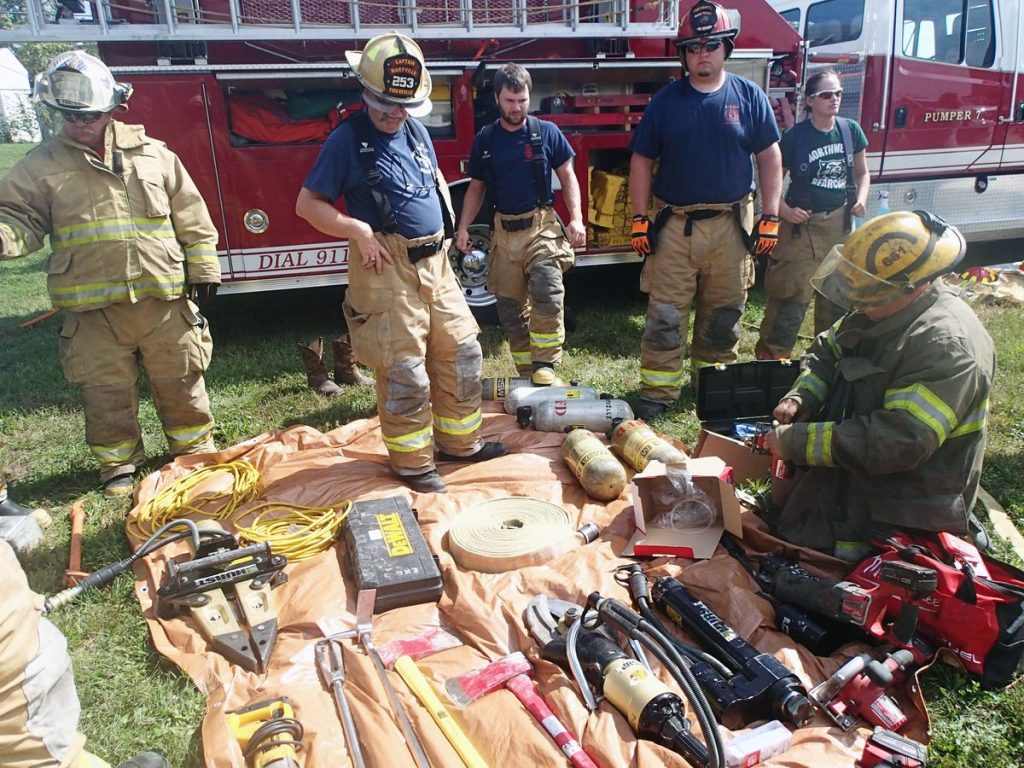
By TONY BROWN Staff writer
Maryville Public Safety Capt. Phil Rickabaugh, second from left, looks over various pieces of equipment prior to a school bus wreck simulation Saturday at the Nodaway County Ambulance District headquarters in Maryville. Rickabaugh said his main goal for the day was to make the most of yet another opportunity to tell his people how important it is to stay safe. “Safety is always our top concern,” Rickabaugh said. “We have to stay safe or we can’t do anything.”
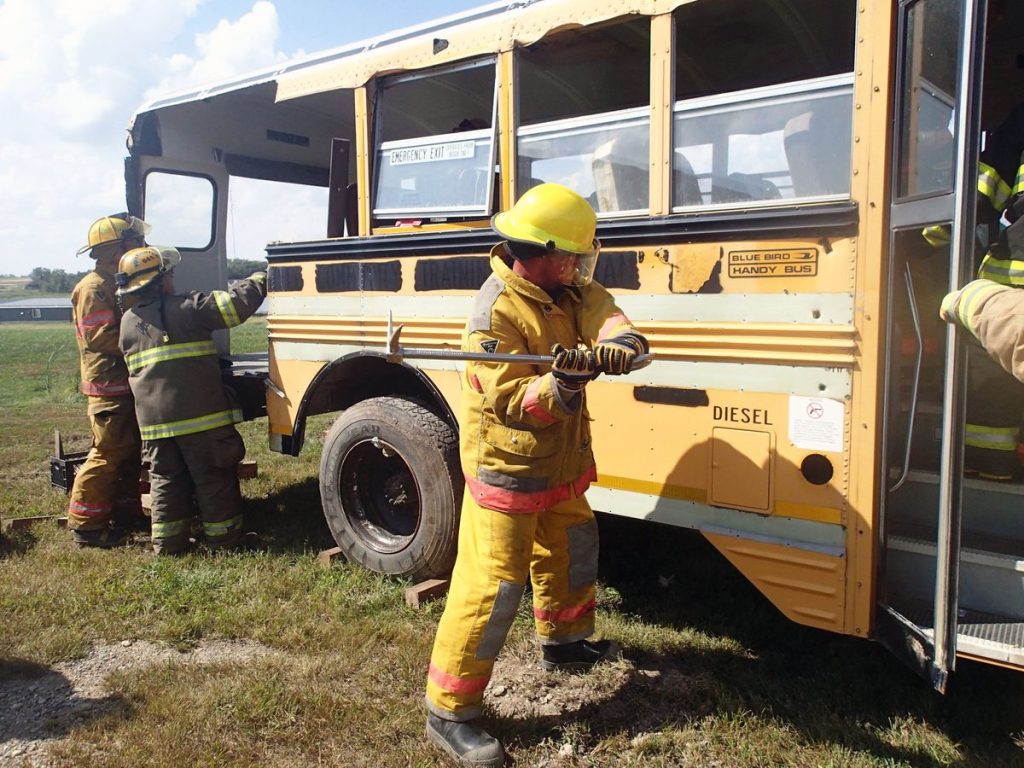
TONY BROWN/DAILY FORUM
Firefighter Chuck Spiking uses a “Halligan bar” to punch holes in the side of a junked school bus Saturday during a training exercise in Maryville. In a real emergency, the holes would be used as starting points for hydraulic cutters and power saws, tools firefighters use to cut away portions of vehicles in order to extricate victims trapped inside.
TONY BROWN/DAILY FORUM
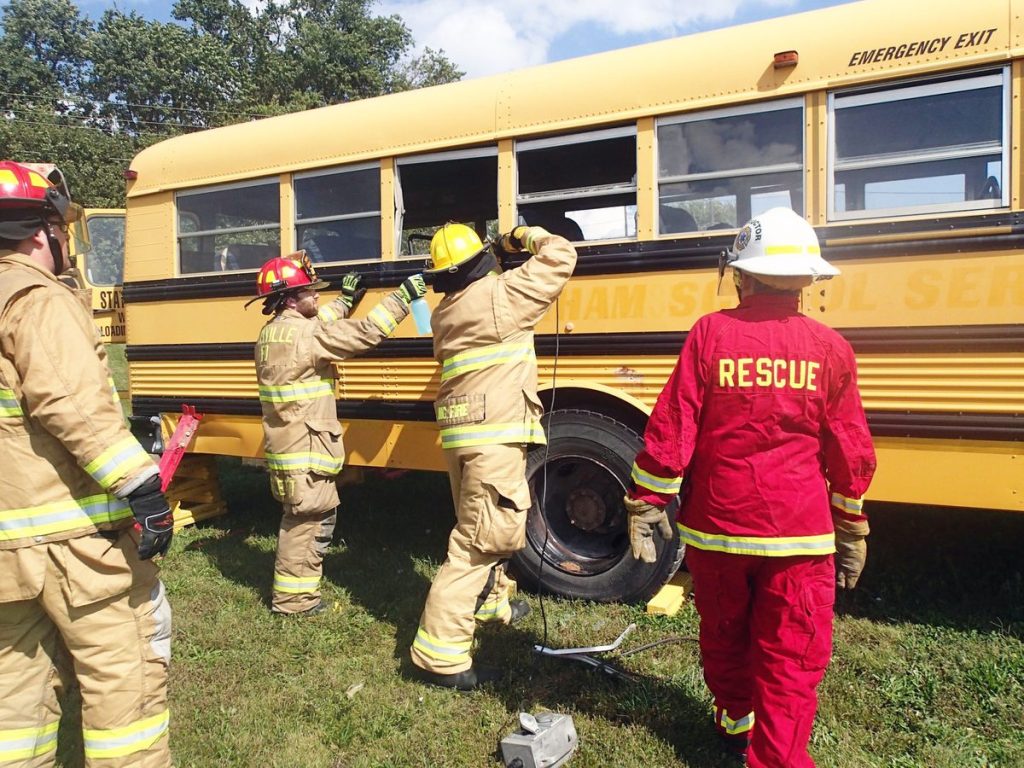
A firefighter uses a reciprocating saw to cut through a school bus window frame Saturday while his partner, standing at left, sprays soapy water from a plastic bottle on the rapidly moving blade in order to keep it cool and lubricated.
TONY BROWN/DAILY FORUM
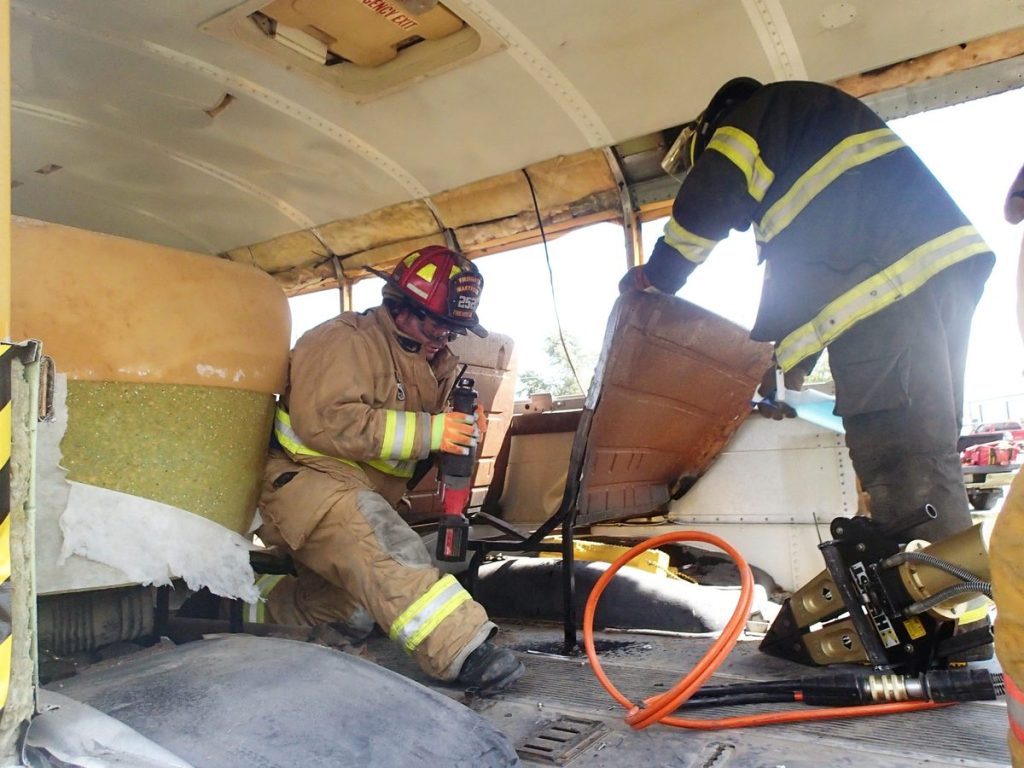
A pair of firefighters remove seats from a junked school bus Saturday during a daylong first responder workshop sponsored by the Missouri Fire and Rescue Training Institute. The class focused on the extrication of victims from a wrecked bus. Other programs offered by the institute, as funding becomes available, are to include hazardous material spills, farm machinery accidents, LP gas responses, and grain bin fires.