Learning comes natural during conservation days
TONY BROWN/DAILY FORUM
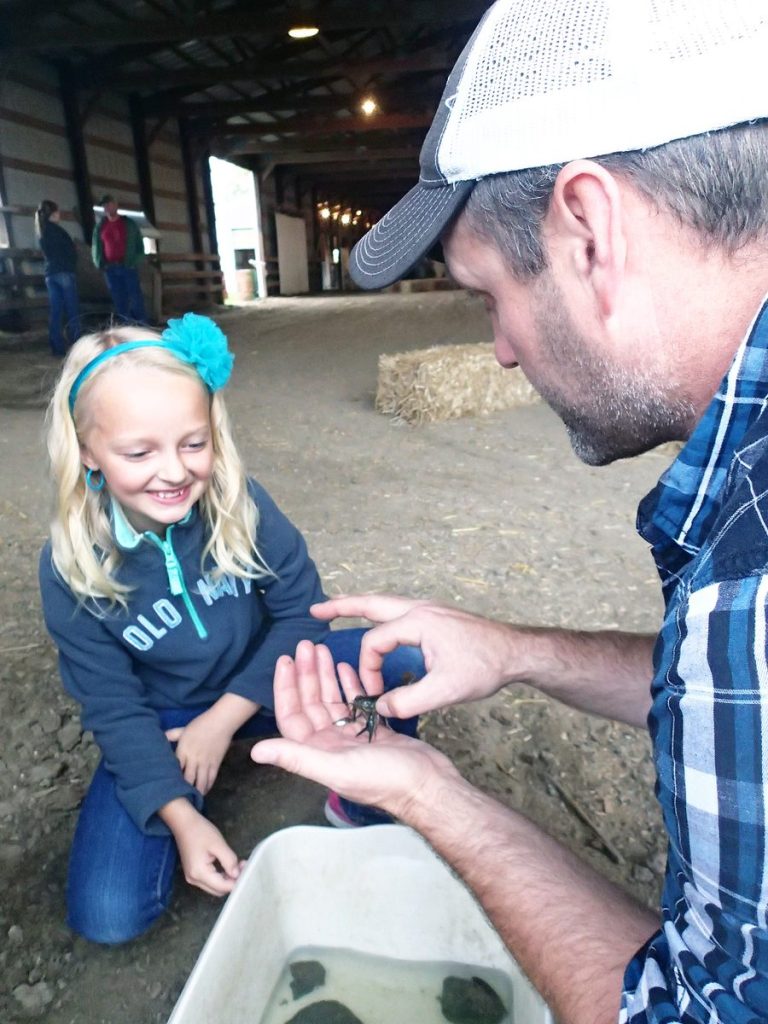
Eugene Field Elementary School fourth grader Ashlyn Long checks out a crayfish held by Randy Buck, a resource conservationist with the local Natural Resources Conservation Service office.
Rainy weather may have forced a change in location this week for a pair of fourth-grade conservation field days hosted by the Nodaway County Soil and Water Conservation District and the Missouri Department of Conservation, but that didn’t dampen the enthusiasm of children eager to learn about the natural world.
Hosted by local Natural Resources Conservation Service and MDC staff members, the two-day event was switched from Nodaway Lake to the Nodaway County Community Building west of Maryville, but the half-dozen presenters did an admirable job of moving the great outdoors inside with a series of hands-on displays and activities.
This year’s stations offered youngsters an interactive look at the principles and concepts governing such environmentally related topics as forestry, wildlife, aquatic biology, soil science, stream bank conservation, and bee culture.
NRCS staff member Colton Coffelt, who organized the event, said each of the exhibits and activities was designed to reinforce classroom units on ecology and the environment recently covered by fourth-grade teachers in participating Nodaway County schools.
Fourth graders taking part in field days held Wednesday and today included youngsters from Eugene Field Elementary School, St. Gregory’s School, Nodaway-Holt, West Nodaway, Northeast Nodaway, North Nodaway, and Horace Mann Laboratory School. A group of home-schooled children and their parents participated as well.
As in past years, the field day was long on activity and observation and short on lectures and electronic media, the idea being that science young people can see and touch is science they can understand.
Soil conservationists Nathan Bilke and Ramon Salazar, for example, set up a rainfall simulator, a device consisting of three dirt-filled gutters that showed how runoff affects bare soil, soil that has been covered with straw and other organic matter, and soil protected by live vegetation.
Water collected in jars placed at the foot of each gutter grew progressively clearer depending on the type of soil cover used.
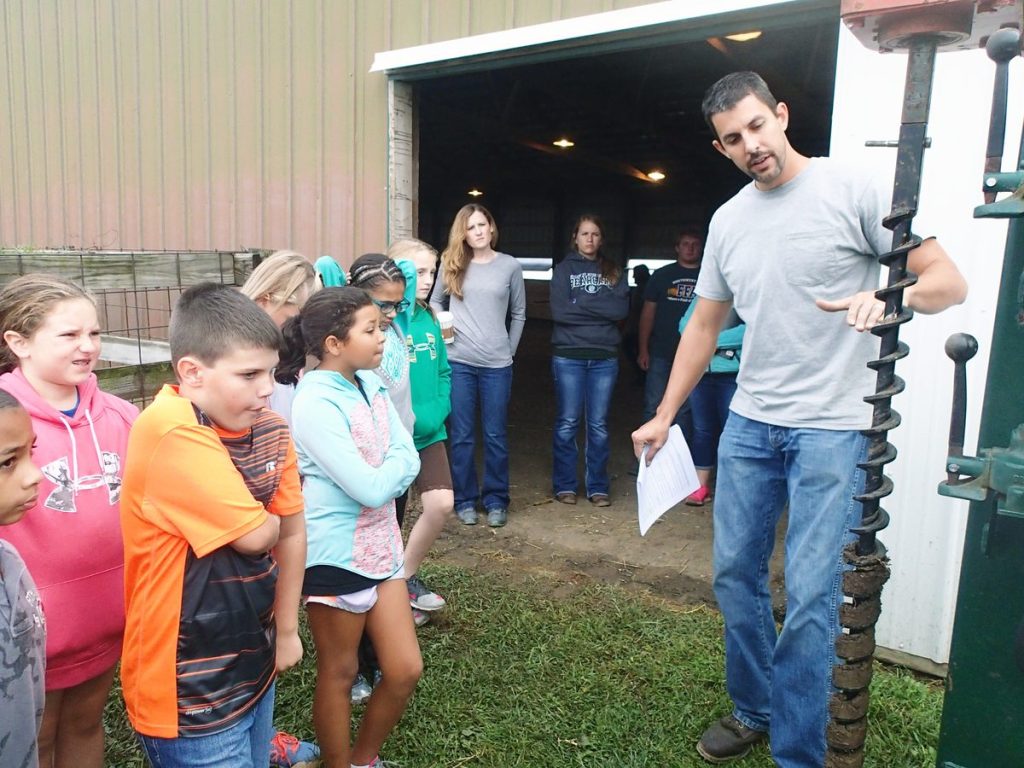
Bilke also demonstrated a large drill used by soil scientists to take core samples at various depths in order to study the characteristics of topsoil, subsoil, and the clay-like “parent material,” in which little or nothing can grow, and which can be all that remains in instances of severe erosion.
“We want (the children) to know how important our soils are,” Bilke said, “and that they are not a renewable resource. Human beings need food, fiber, shelter, and fuel in order to survive, and all of those things stem back to the soil.”
Once wind and water wear soil layers down to the parent material, whether clay or rock, “there’s no way to recover it,” Bilke said, “at least not in our lifetime. What we screw up we might be able to fix somewhat in 50 to 100 years — maybe. We never want to take for granted what’s under our feet.”
That same lesson was brought home in a different way at another station, an “erosion table” set up by MDC fisheries experts Tory Mason and Joe Lawler.
The table was essentially a small model of the Missouri River, which rises as a clear, rock-filled stream in the Rocky Mountains of western Montana, then winds east and south for more than 2,300 miles before flowing into the Mississippi River just north of St. Louis.
Mason and Lawler used their display, essentially a large sandbox with a small stream of water running through it and model farms and woodlands lining the “banks,” to show how trees and vegetation — along with man-made structures like riprap and wing dikes — can slow erosion, conserve fish and wildlife, and maintain water quality.
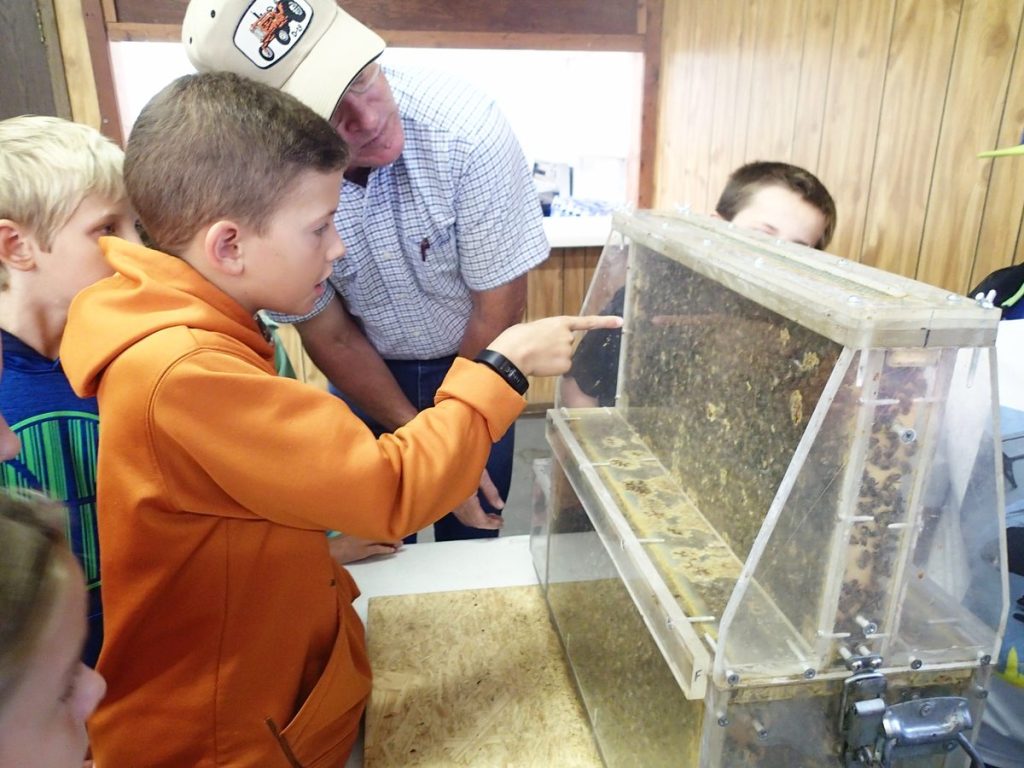
Not far way from Mason and Lawler’s station, Ed Wohlford, president of the Northwest Missouri Bee Busters organization, set up an active beehive and talked to youngsters about the importance of bees for crop pollination and honey production.
Wohlford, who keeps several hives on his farm south of Maryville, is an advocate for honeybee culture and has spoken out on how the advent of super-efficient herbicides and pesticides poses challenges for beekeepers by weakening bee health and eliminating pollinizing plants such as wild clover and forbs.
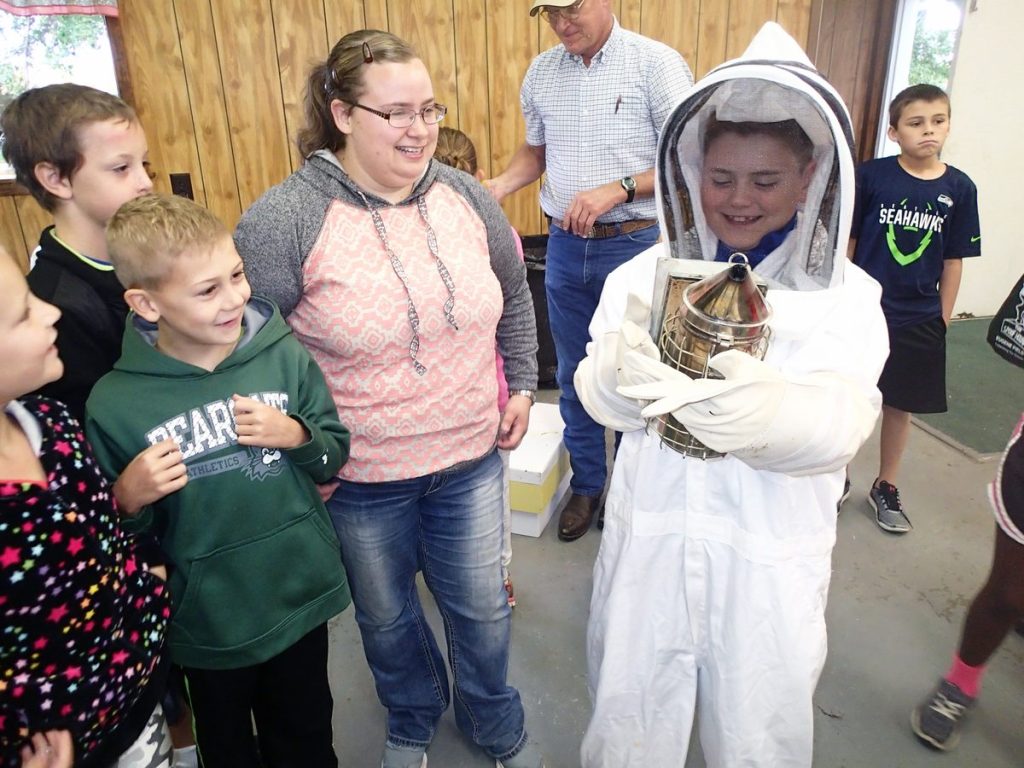
In addition to watching Wohlford’s bees in action through a clear plastic hive cover, several of the children got to dress up in full beekeeper regalia and handle various pieces of gear, including a “bee smoker.”
The smoker, as its name implies, is a device that emits smoke produced by smoldering fuel, which for reasons not entirely understood has a calming effect on the insects. Smoking a hive gives beekeepers the opportunity to open it and perform various tasks while the colony’s defensive response is interrupted.
Fourth-grade teacher Kati Hornickel, who like her colleagues has been teaching a unit on ecology and the environment, said the field day is a valuable learning experience for children on a couple of levels.
“It’s so important for kids to know how to protect our resources,” Hornickel said. “And if we start (teaching environmental awareness) early, that is hopefully something that will stay with them their entire life.”
She added that the hands-on exhibits offered at the Community Building this week help reinforce lessons about the natural world in a way that classroom lectures, or even videos and Internet simulations, cannot.
“This makes it real for the students,” Hornickel said. “It’s more believable because they are actually seeing it and touching it.”
TONY BROWN/DAILY FORUM
Brandon Wilmes tries on a beekeeper suit for size at one of the stations set up at the Nodaway County Community Building during this week’s fourth-grade conservation field days hosted by the Nodaway County Soil and Water Conservation District and Missouri Department of Conservation.
TONY BROWN/DAILY FORUM
Bradley Deering, left, points at a beehive while talking to beekeeper Ed Wohlford during a conservation field trip Wednesday at the Nodaway County Community Building. Wohlford’s bee display was one of a half-dozen stations set up for the event, which also included presentations on forestry, wildlife, aquatic biology, soil science, and stream bank conservation.
TONY BROWN/DAILY FORUM
NCRS Soil Conservationist Nathan Bilke explains to a group of fourth graders what to look for when examining various soil strata brought to the surface using a special drill. Bilke said his presentation was designed to make the point that viable soils are essential to human life and that “they are not a renewable resource.”
TONY BROWN/DAILY FORUM
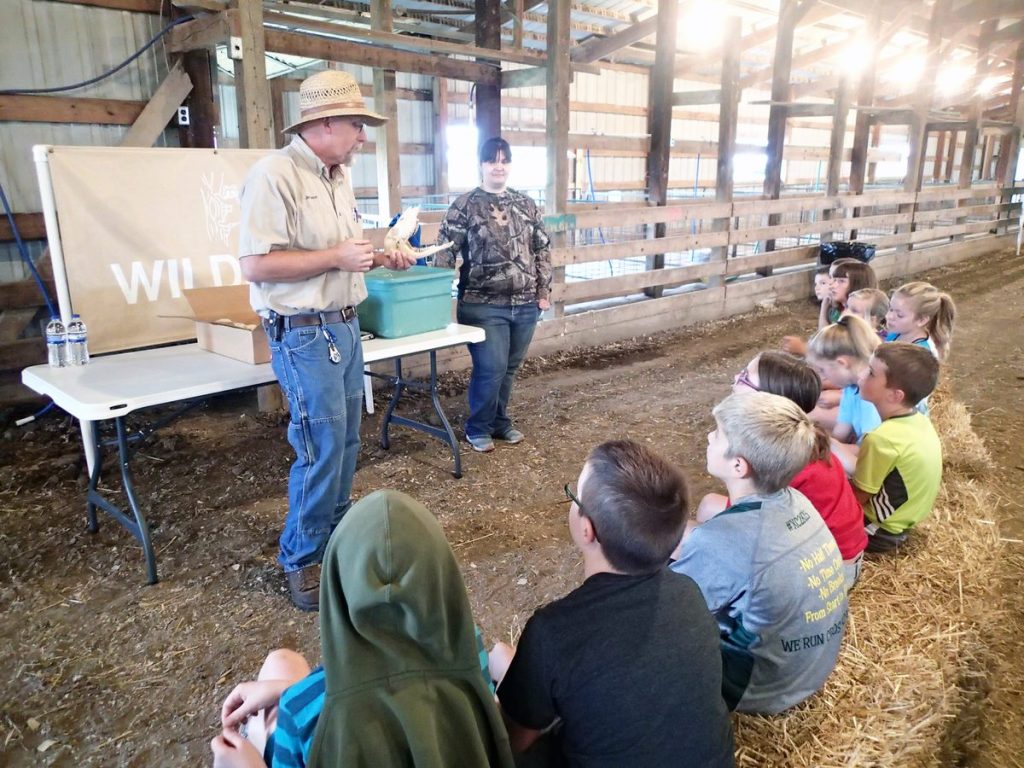
Jim Pierson of the Missouri Department of Conservation displays a deer skull during a presentation on wildlife during Wednesday’s conservation field day at the Nodaway County Community Building. Fourth graders taking part in field days held Wednesday and today included youngsters from Eugene Field Elementary School, St. Gregory’s School, Nodaway-Holt, West Nodaway, Northeast Nodaway, North Nodaway, and Horace Mann Laboratory School.