Sheriff’s K-9 Unit: No day is ‘routine’
TOM PINNEY/DAILY FORUM
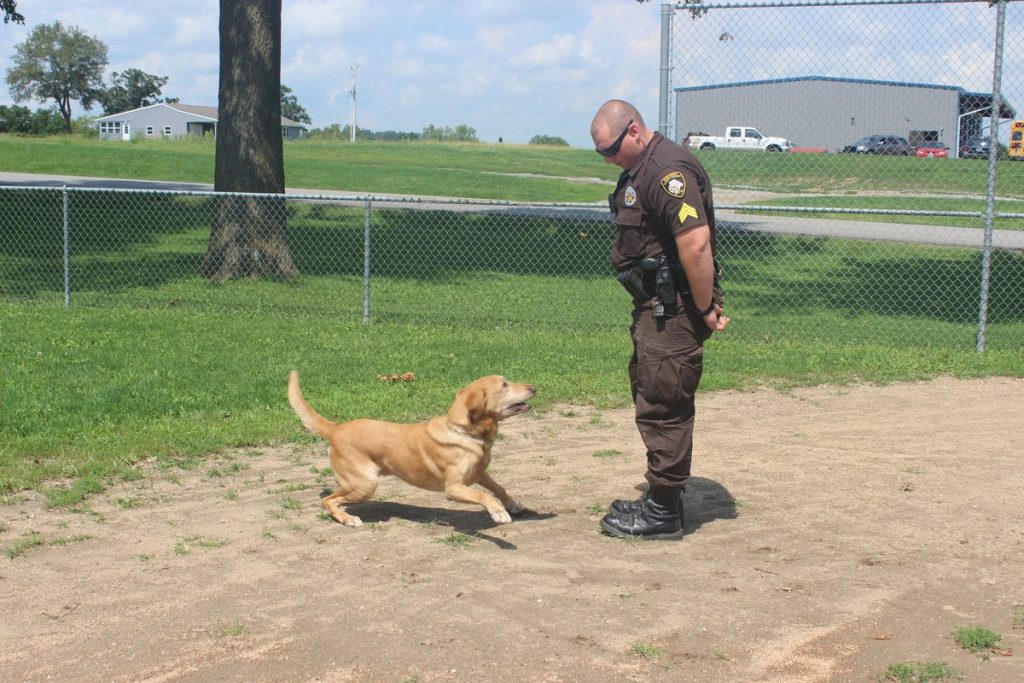
Some work, some play Sheriff Deputy Sergeant Austin Hann takes Jerik out to exercise during their patrol shift. Hann and Jerik have been working together for just under two years.
Editor’s note: This story is part of a weekly series highlighting “Everyday Heroes.” Over the next several weeks, the Daily Forum will take a look at people who work tirelessly in the day-to-day operations of Maryville, in many varied facets of life. If you have a suggestion for someone we should highlight, please e-mail [email protected] or call the Forum at 660-562-2424.
While still attending Northwest Missouri State University in 2010, Austin Hann started as a dispatcher for the Nodaway County Sheriff’s Office.
Hann graduated from the university in 2011, then the police academy in 2012. He has been a deputy with the Nodaway County Sheriff’s Office ever since.
Having recently been promoted to the rank of Sergeant, Hann explained the life of a sheriff’s deputy is anything but ordinary or everyday.
“My day really varies. When I get into the office, I check emails, go through reports filed overnight, and look at who was booked in the jail,” Hann said. “After that, it’s pretty much up to me how I spend the rest of my shift.
“I serve papers, answer calls from the office, conduct traffic stops, pretty much a little bit of everything.”
In January 2015, Hann officially took over as the handler of Jerik, the office’s trained narcotics dog.
“I hate narcotics use,” Hann said. “It’s part of the reason I really wanted to take over the K-9 program; this is my passion.”
Taking over as Jerik’s handler was no easy task. The transition started in November 2014, when Hann began training with Jerik.
The training covered a multitude of topics, from canine behavior patterns to handling Jerik during staged exercises with drugs.
By January, Hann was certified to be Jerik’s handler. Every year the pair has to go through a much lighter re-certification process.
During this interview, Hann had to make two “routine” traffic stops. Hann said he takes issue with that particular term.
“There’s really nothing ‘routine’ about traffic stops because anything could change at any minute,” Hann explained. “Sometimes you pull someone over for speeding, the next minute you’re arresting them for drug possession.
“You can’t allow yourself to become comfortable with traffic stops, because the second you become comfortable is when you get a traffic stop that’s out of the ordinary.”
That’s why Hann couldn’t pinpoint an example of an out-of-the-ordinary traffic stop: “After awhile, the things you come across don’t really shock you; they all just become part of the job.”
Hann says there is a large divide between law enforcement officials on the county and city level.
“When you deal with one city, like Maryville, you’re dealing with one community,” Hann explained. “That’s one single community identity, one single sense of pride.
“Working at the county level, I’m dealing with multiple communities, multiple identities. There’s a different sense of community and pride in each one.”
Hann also acknowledged a problem that is very unique to Nodaway County.
“Nodaway County is large and mostly rural,” Hann explained. “Sometimes I’m called from one part of the county to another to respond to a complaint.”
Case in point: during the interview, Hann answered subsequent calls in Burlington Junction and Graham.
However, none of these deter Hann from enjoying his job.
“I love what I do,” Hann explained. “I don’t ever see myself leaving this position. I’m passionate about the K-9 program, and I’m happy with where I am and what I’m doing.”
There was one other myth Hann debunked.
“There’s no such thing as a ‘ticket quota,’” Hann said. “We don’t do that, we don’t even keep track of how many tickets we write.
“For us, it’s not about getting money out of people or getting numbers, it’s about making a difference. Tickets are supposed to make people think twice about doing something before they do it again.”
Hann said the impact the officers have on the community is much more important than writing tickets.
“If I’m out and about in the community,” Hann explained, “I could have the same impact as when I’m writing a ticket.”