
Peach Creek work raises environmental concerns
TONY BROWN/DAILY FORUM
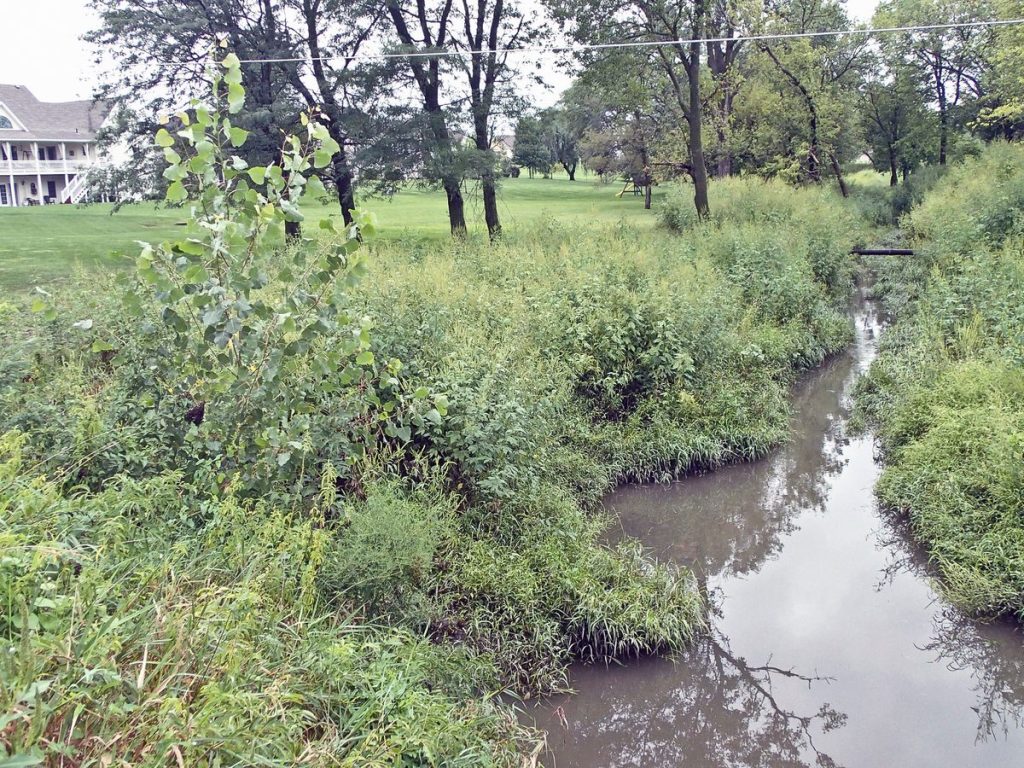
Municipal efforts to straighten and widen Peach Creek north of Route V at the south end of Maryville have caught the attention of federal and state environmental agencies. No one has said yet exactly what the city did wrong, if anything, but Public Works Director C.E. Goodall has been put on notice that some type of mitigation will likely be required.
On a 1-10 scale of ecological disasters, it’s probably about a minus five, but the natural “habitat” along the Peach Creek watershed — a sometimes concrete, sometimes underground, and sometimes mud-banked stream that runs through most of Maryville from north to south — has turned into a headache for City Hall.
According to municipal officials, a citizen complaint — no names were released — about the city’s efforts to improve drainage along the creek has drawn the attention of no less than four government agencies, two state and two federal.
Public Works Director C.E. Goodall said Wednesday the agencies’ concerns revolve around work done over the past three years or so to straighten and widen the creek north from Route V.
The effort was undertaken in response to homeowner complaints about the creek flooding into yards after heavy rains, especially along the back end of a new south-end subdivision that runs along the stream’s west bank.
It was also hoped that speeding the flow of water rushing down the stream after a storm would reduce incidents of flooding further north.
City Manager Greg McDanel told the City Council earlier this week that the Peach Creek project has had the desired effect, and that residents have reported fewer problems related to high water on or near their property.
However, about two weeks ago officials from the state Department of Natural Resources, Missouri Department of Conservation, U.S. Environmental Protection Agency, and the Army Corps of Engineers called for a meeting with Goodall, saying they wanted to talk about the impact the flood control effort was having on the Peach Creek drainage basin.
Goodall said the upshot of the subsequent discussion was that the agencies have concerns about the loss of 250 linear feet of shoreline habitat.
The “loss,” he said, occurred because the creek has been straightened, meaning that the distance from point A to point B is less than it was when the stream had more bends in it.
Goodall said no one has explained exactly why this is a bad thing or specifically described the impact on the stream’s flora or fauna.
He added that the word “fine” hasn’t come up yet, but said he is reasonably sure the city will be required to implement some sort of mitigation effort, such as planting trees or installing rock or other material designed to stabilize the stream bank.
Goodall said he hasn’t been told if the mitigation — a common governmental remedy for damage to the environment — could take place at an alternate site, Mozingo Lake or a city park for example, or will have to occur somewhere within the Peach Creek basin.
But in any event, “They seem to think it is a significant issue we have caused there,” he said.
Not that the city just plunged into the Peach Creek project without trying to clear the requisite bureaucratic hurdles.
Back in 2012 when the project was first under consideration, Goodall said, the city checked with the Army Corps of Engineers and was told no permit was needed to proceed.
Now, he said, the Corps has reconsidered, and the city was, in fact, asked to acquire a permit after the fact.
But that doesn’t mean the problem has been solved.
Goodall has been put on notice that the city will soon receive further instructions about what else needs to be done, and he is all but sure those instructions will cost the taxpayers money.
“There are going to be some numbers associated with that,” he said.




