Bareback rider follows pro rodeo dream
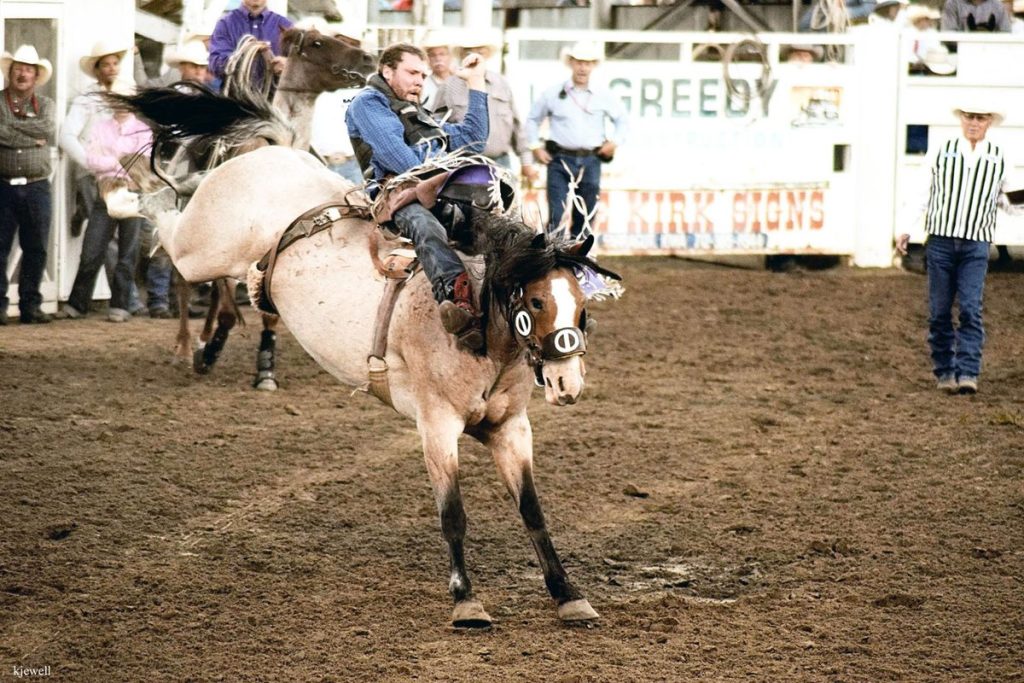
KRISTY JEWELL PHOTO
Russell Redden clings to the rawhide “suitcase” handle of his horse’s “rigging” while competing in the bareback bronc riding event during the Sidney, Iowa, Rodeo earlier this month. Redden, who hopes to become a professional rodeo cowboy after graduating next year from community college, has won about $5,000 in prize money during the current season.
At one time or another, probably every American youngster fantasizes about being a cowboy. Russell Redden, a 21year-old college student who grew up in Maryville and still lives here during the summer, is living that dream.
Broad shouldered and bearded, tanned and tough, Redden not only looks the part, the homegrown rodeo bareback bronc rider has the trophy belt buckles, purse winnings, and broken bones to prove it.
About to enter his second year at Fort Scott (Kansas) Community College, where he is studying farm and ranch management, Redden is a member of the school’s rodeo team. He will appear in action before a hometown crowd this weekend during the Ed Phillips Memorial Radio in Maryville.
As a college rider, Redden competes in 10 events a year across the Central Plains Region, which includes parts of Kansas and Oklahoma.
But that’s just for starters. Having taken up the sport as a teenager, Redden currently travels to about 50 rodeos a year and has begun taking the first serious steps toward fulfilling his core ambition — making a living as a professional cowboy.
Earlier this month, he finished in the money at a pair of pro events in Iowa, splitting seventh and eighth place at the Sidney Rodeo and finishing sixth in the Carson Community Rodeo the following night.
Life on the road, he said, is simply part of a rodeo cowboy’s life.
“I’ve ridden up to four rodeos in one weekend,” he said. “Once I did two on the same night.”
Redden’s efforts so far this year have earned him about $5,000 in prize money, a fair sum for a college kid but not exactly a fortune. And there is a price to pay as well as cash to earn. Since taking up bronc riding, the young rider has already started to accumulate the physical baggage associated with practitioners of one of the world’s most dangerous sports.
So far, he’s broken his collarbone, right-hand ring finger, and tailbone. He also had to have his chin stitched up after a horse kicked it, and more stitches followed when “I busted my head open” landing on a gate.
It’s enough to give any parents nightmares, and it probably does. But Redden’s folks, Rick and Lisa, are proud of their son and have encouraged his passion for the arena.
“They very much support me” Redden said. “They follow me to every rodeo.”
It shouldn’t surprise anyone that Redden grew up around horses and riders. His uncle Chris Redden, Ravenwood, is a national-class “extreme cowboy” racer, and his folks, Rick and Lisa, keep saddle horses and cattle on their 90-acre spread just east of Maryville.
But a gentle canter on Old Paint down a prairie trail to watch the sunset isn’t quite the younger Redden’s style.
“I can’t ride a normal horse to save my life,” said Redden, who prefers to straddle 1,300 pounds of leaping, diving, gyrating, twisting bronc with no saddle and nothing to hold onto except a rawhide “suitcase” handle attached to the bronc rider’s traditional leather “rigging,” which is strapped, somewhat precariously, around the horse’s girth.
“I don’t ride for pleasure at all,” he said. “I don’t even especially like saddle horses.”
For those who don’t follow rodeo, cowboys who ride bucking broncs do so using two very different styles, which are classed as separate competitions.
In saddle bronc, the rider uses a special saddle with free swinging stirrups and no horn. The rider grips a simple braided rein attached to a leather halter worn by the horse and attempts to find a rhythm by moving his spurred boots forward and backward in a sweeping motion from shoulder to flank.
A bareback bronc wears only the rigging, and the rider leans back and sweeps his legs up and down, again in rhythm with the horse, between the animal’s shoulder and the rigging’s rawhide grip.
Competitors draw for the mounts they will ride in the arena, and Redden said the goal is to get a bronc that bucks hard enough to score points but not hard enough to leave the cowboy in the dirt before eight seconds have elapsed, which results in disqualification.
For cowboys who complete their ride, two judges award a maximum of 50 points each — 25 for the horse and 25 for the rider. Redden said 85 is considered a solid score.
Things to look for in a good ride, he said, include a horse that kicks above its head with its hind legs while covering relatively little ground. The idea is for the bronc to buck, not careen around the arena.
Redden said he is firmly set on trying to break into rodeo’s professional ranks, adding that the twice-a-week practices he participates in at Fort Scott during the school year have helped significantly in sharpening the skills he’ll need to reach that goal.
But in the end, it’s what happens in the arena that counts.
To that end, Redden has promised himself to qualify for the Wrangler National Finals Rodeo in Las Vegas, Nevada, within three years after finishing school next year, when he hopes to join the pro cowboy ranks.
“That’s the top of the top,” he said.
And if it doesn’t happen? Well, thinking about failure just isn’t the cowboy way.
“There is no Plan B,” said Redden, who issued thanks to family members and friends for their continued support during his quest for the big-time. “This is going to be it.”
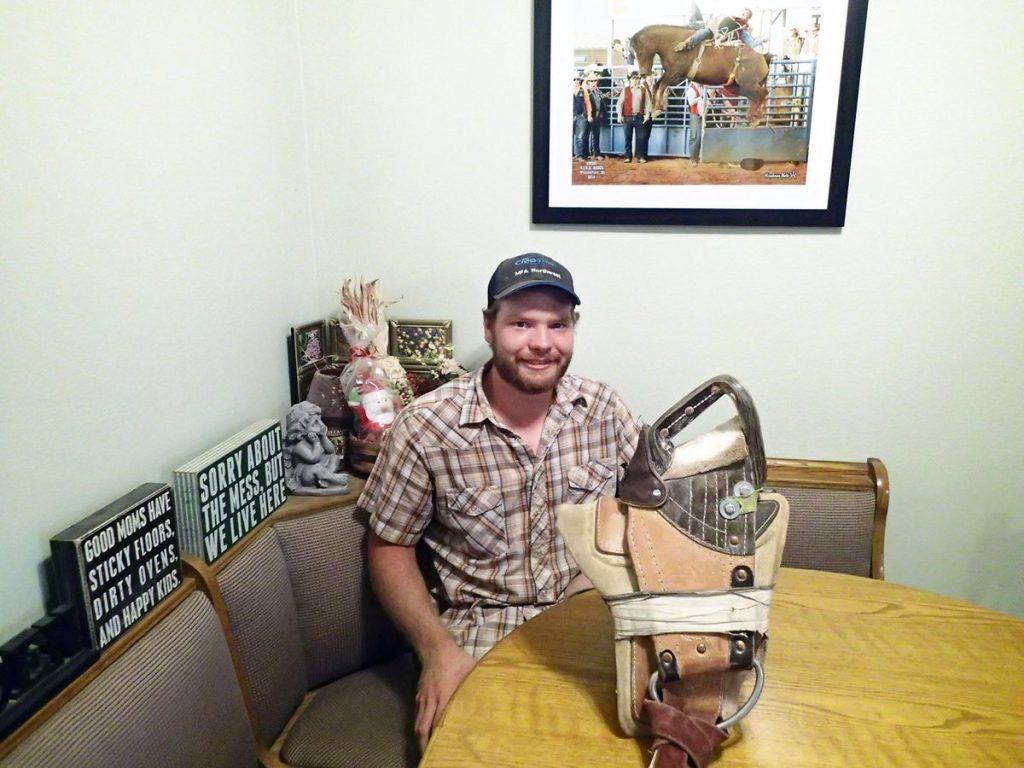
By TONY BROWN Staff writer
Bareback bronc rider Russell Redden, Maryville, displays the leather and rawhide “rigging” he uses to stay on the back of a bucking horse while competing in rodeos across five states. In addition to traveling to about 50 events a year on his own account, Redden also rides for the Fort Scott (Kansas) Community College Rodeo Team. He will compete in front of a hometown crowd this weekend during the Ed Phillips Memorial Rodeo.