Pittman’s trick riding lights up rodeo
By DAVID MERRILL Sports Editor
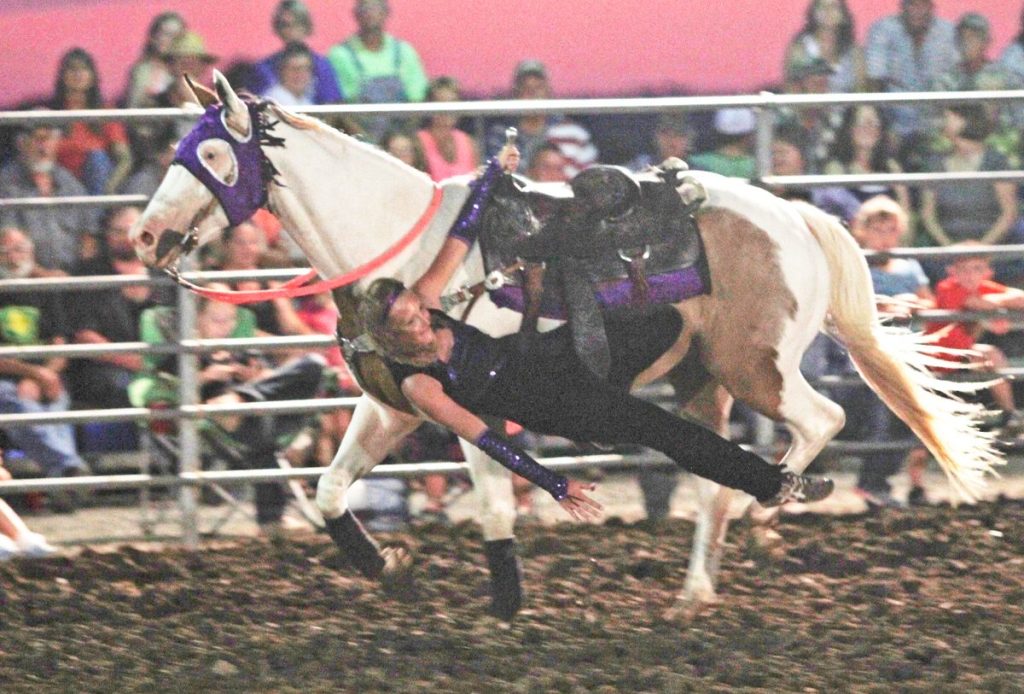
Cheyenne Pittman, a Graham native, performs a trick on her horse during the Dakota Bronc Sisk Memorial Rodeo on Saturday.
It was roughly 10 p.m. on Saturday, the last cowboy had taken his turn on a bull, and even if he had to do it from above, Dakota Sisk was smiling bigger than anyone.
For the 10th year in a row, Cheyenne Pittman (Sisk) helped with the family rodeo — only this time she took a turn on center stage. She had transformed into something she had always dreamed of and put her trick riding skills on display for all to see at the Dakota Bronc Sisk Memorial Rodeo. It was more than a sign of how far she had come in just three months. It was a sign of how far the family had come in the 10 years since the Sisk family had their lives changed forever.
Coming up on a decade ago, Dakota Sisk, Benny and DeeAnn Sisk’s middle child, took his own life at the age of 17.
As is common in suicide cases, the warning signs are hard to spot. Dakota’s case was no different. The family never settled on a reason, but Cheyenne speculates that Dakota fearing his college football dreams could have been in jeopardy due to a shoulder injury was a major trigger.
Even then, the signs were hard to see.
“Apparently some people saw it, but he was never suicidal,” Pittman said. “He had a ton of weight beforehand.”
Seeing what has become of Dakota’s vision — of the family’s vision — takes Pittman to another level mentally.
“It’s emotional,” she said following Saturday’s performance. “It’s been 10 years and as I was riding around the arena tonight I was looking around and I was like, “Oh my God.” These people come back year after year because of what we do. Tonight, it has really sunk in. Every other year, I just carry the (American) flag and this year, I’ve really just let go and done my thing.”
The original rodeo almost didn’t happen. The family had started to build the rodeo arena before Dakota passed away. What they had built settled incorrectly and the progress came to a standstill as the winter months hit. When May rolled around and Cheyenne had finished her junior year at Nodaway-Holt, they came up with the idea of having a rodeo to honor Dakota, who had an affection for bull riding.
Easier said than done.
“We had from May to September to undo all the work we had done and start from scratch on the arena and build the arena and we pulled it off,” Pittman said. “We had a rodeo that September. Leading up to the night of the rodeo, we didn’t have bucking shoots in the arena. That’s how close we were to not pulling this off.”
Her older brother Cody spent the day of the rodeo building and welding the shoots and the family put on the rodeo that night.
Pittman had always wanted to be a trick rider. Back in May, she found a path to help her accomplish that goal. It came in the form of trick riding trainer Jennifer Gatrel, who trains trick riders on her property in Cowgill. With just 12 short weeks until show time, she set to work, training for what most trick riders practice six months to a year for.
Trick riders also typically start training as children.
She trained twice a week for three months and just an hour per session. This included getting a gym membership in St. Joseph, where she commutes every morning anyway for her job at the American Angus Association.
Once the three months started, Pittman found even more obstacles. Trick riders normally stick with the same horse as much as possible. By the time Pittman performed for the crowd this past weekend, she was on her fifth horse. She was riding Saturday’s selection for just the second time.
“Three weeks ago, I got kicked by a horse, so for two weeks after that, I couldn’t ride,” she said. “Which meant I had about a week to get this act down perfectly.”
Her original training horse was one of Latrel’s, but that horse succumbed to an injury and a second of Latrel’s horses was too old to be part of a trick riding act. The third horse, Cheyenne’s own horse — Trooper — wasn’t ready for performances yet. Rooster, the fourth horse, had too much power for a rookie trick performer and Pittman finally settled on a horse owned by fellow trick rider Bailey Skidmore.
Gatrel came away from the training experience especially impressed.
“Cheyenne faced more obstacles leading up to the show than anyone I’ve ever trained,” she said. “It’s really a testament to her and how hard she worked. She really put in the time and the effort in order to be successful and pull it off.”
According to Gatrel, finding the right horse to fit the rider isn’t an easy task.
It has to have the right temperament and experience doesn’t hurt.
“The horse has to have a steady personality,” Gatrel said. “That horse on Saturday was risking a lot with the performance. It helps a lot if the horse is sure-footed.”
The acts she displayed on Saturday put various parts of her body in harms way numerous times, hanging off the horse at many different angles, much to the pleasure of the large crowd. These maneuvers require a tremendous amount of stamina, strength, and athletic ability. What makes her feat even more impressive is that she didn’t come from an athletic upbringing. Competing — the dictionary definition of which is: to strive to outdo another for acknowledgement, a prize, supremacy, profit, etc. or engage in a contest — doesn’t come naturally to her.
“I like to do things that are different,” she said. “There are so many barrel racers out there and I don’t like competing. I like doing my best and knowing that’s good enough. I’ve never been in dance, I’ve never been in gymnastics, I’ve never been in anything. When I first started this trick riding thing, I could not even come close to touching my toes.”
While she had grown up around horses and knew how to ride them going in, training made her feel as if she had never even been in a saddle.
“Everything is about timing,” she said. “If you go into a trick at the wrong time or you come out of one at the wrong time, the whole thing is off. Horses have strides, so it’s all about timing.”
Aside from the increase in size from a normal saddle, trick riding saddles feature a specialized horn and tree as well as a lower cantle and special straps that take getting used to.
Latrel also taught her how to ride bareback for the first time, which helped with timing.
Getting use to a horse moving in general is yet another challenge for a new trick rider, seeing as you don’t start out training on one.
“You start out with a saddle strapped to a barrel to learn the motions, then you transition to a horse walking, then you bring him to a trot, then you bring him into a lope (faster jog),” Pittman said. “On a barrel, they all seemed easy, but then when the horse starts moving, it’s like ‘timeout’. (There isn’t one trick that’s scarier than the others). When you come out of the saddle, they are all scary, but that is the only time you will ever have that feeling in your life. It’s literally like flying. You aren’t in control at all. You’re just doing your thing.”
Not only was she doing her thing, she was doing it right alongside veteran trick riders Skidmore and Jeremiah Eugenio, who perform at Dixie Stampede in Branson —one of the premier dinner theater attractions in the Midwest.
Pittman had no problem looking the part.
KC Ehrhardt, the Arena Director for the rodeo and also the owner-operator of Diamond E Bucking Bulls thought Pittman being added to the trick riding performance gave the show a boost.
“It’s good for her,” he said. “Everyone has been coming here to watch her and knows her. It was good for everyone in the community to see her do that.”
For Pittman, it’s all about pleasing the crowd and giving them what they want to see in the end. It’s about letting go. It’s about getting that feeling that you are flying in a circle, even if just for a few minutes at a time.
“I don’t want to pay my entry fee and waste the money for barrel racing when I know I could be the best around here, but it’s unheard of to be the best in the world. I’ll never be the best trick rider in the world, but they don’t compete. They get hired and they go in and do their job. I would rather make somebody’s day and make them smile than do something for me.”
It was roughly 10 p.m. on Saturday and Dakota Sisk was smiling bigger than them all.