Video training keeps Maryville cops on target
TONY BROWN/DAILY FORUM
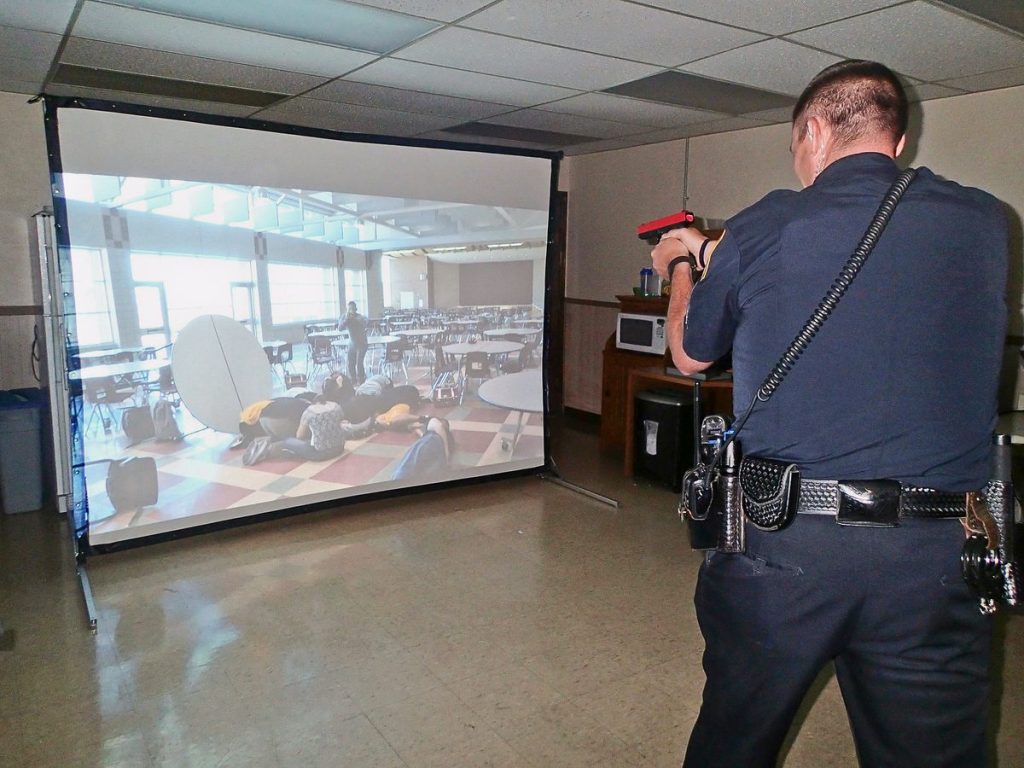
Maryville police Sgt. Jeremy Ferris uses a virtual semi-automatic pistol, essentially a wireless video controller, to fire shots at a suspect at the scene of a staged mass shooting. Taking part in the video simulation, which includes a number of violent and non-violent scenarios, is an annual requirement for all Maryville Public Safety officers. The gear and a specially trained facilitator are provided by the Missouri Intergovernmental Risk Management Association, which acts as the city’s liability insurance provider.
Maryville Public Safety officers have responded to the nightmare call — an active shooter situation at the local high school.
With his semi-automatic service weapon held firmly in both hands, MPS Sgt. Jeremy Ferris walks steadily down corridors where students and faculty lie killed or wounded. Screams ring through the building and shots echo along the hallways.
As Ferris steps into the cafeteria, chaos breaks loose. A group of students crouches in a huddle beside an overturned table, and a backlit suspect, yelling unintelligible curses, raises and aims what appears to be a handgun.
Steadily, yet quick as a snake, Ferris fires two — or is it three — evenly spaced shots. The suspect falls dead.
Then the lights come on, and the video screen goes white.
The lethal force simulation, what amounts to a life-sized video game played in deadly earnest, is required annual training for all Maryville police officers and is provided as a service by the Missouri Intergovernmental Risk Management Association, usually referred to as MIRMA, which acts as the city’s liability insurance provider.
This year’s training, which took place in the police station squad room Wednesday, presented officers with a full gamut of violent and possibly non-violent scenarios that MIRMA Loss Control Specialist Jeff Arp electronically sliced and diced in any number of ways, constantly adjusting speed, physical environment, random circumstances, level of conflict, and other factors.
In addition to the active shooter exercise described above, officers were also confronted with car stops, domestic calls, angry confrontations, and assaults. The system is interactive, so the way officers speak and react to the people they see on the large projection screen can affect the outcome.
Which means that, depending on how the officer handles things, a domestic dispute can be resolved peacefully, require the use of pepper spray or a Taser, or escalate into a situation calling for lethal force.
Afterward, Arp, who has received the same training in addition to attending numerous police liability seminars, quizzes the officers on their responses and whether or not they were appropriate.
Allowed to try his hand during a live-shooter drill, the reporter writing this story was a little surprised to hear Arp ask, “Why did you shoot him in the back?”
“Because he had a gun?” the reporter answered.
“That was a good shoot,” chimed in a policeman from across the room, possibly because the shots were justified, and possibly because the officer was amazed the writer actually managed to hit what he was aiming at.
Maryville Public Safety Director Keith Wood said the post-scenario questioning is a form of training in itself, since officers are required to give concise, accurate explanations of their actions following a violent encounter. Sometimes they are required to repeat that account numerous times over the course of several months as the incident plays out in the court system.
Wood said MIRMA has been offering the lethal force simulations for about 20 years, though the technology has changed somewhat. He added that, in his view, the exercise is at least as valuable as the practice and qualification rounds officers fire using live ammunition at the Public Safety target range east of town.
“The beauty of the system is that in addition to knowing how to hit the target, it forces you to use other skills as well,” Wood said. “There is the judgment aspect, which is just as important as whether you can poke a hole in a target or not.”
Actually wireless controllers, the “pepper spray,” “Taser,” and “gun” used during the exercises mimic the weapons they resemble in size, shape, and weight. The scenarios are frightfully realistic, and one gets a sense of just what officers face in potentially violent situations.
Your hands shake, and you feel the adrenalin rush.
“It can raise your blood pressure a little,” Wood said.
Aside from testing a police officer’s shooting skill, reflexes, and judgment, the simulations are also designed to teach the importance of attempting de-escalation whenever possible while still working to discern that often hair-trigger moment when talk or non-deadly force is no longer an option.
“We want all of our officers to have the skills to de-escalate, and, in a moment, decide whether or not to use other measures,” said Wood, who was himself involved in a confrontation with an armed suspect as a young officer in the west-central Missouri town of Clinton.
As an armed rifleman roamed the street, threatening other officers, Wood said he was in a position to take a lethal shot, but decided not to do so because the man was believed to be mentally disturbed. The standoff was resolved peacefully a couple of hours later.
After more than two decades later, the episode remains vivid in his mind.
Such decisions, Wood said, are rooted in thorough training during police academy courses and the subsequent probation young officers serve under the supervision of a seasoned veteran.
The process, Wood said, is intentionally designed to provide every man and woman who pins on a badge and holsters a sidearm with the answer to a single basic question.
“If I am ever confronted with a lethal force situation, will I be able to pull the trigger?”
It’s a question all police officers have to continue asking themselves throughout their careers. Exercises such as this week’s MIRMA simulation help ensure they remain confident of the answer.
“They appreciate it,” Wood said, of the video exercise. “For many of our officers it is the closest they are ever going to come to making that choice, and they can do that and be sure of going home to their families.”
In the real world, without the right training — and sometimes even with it — that’s not always the case.