Workshop seeks assurances of county support
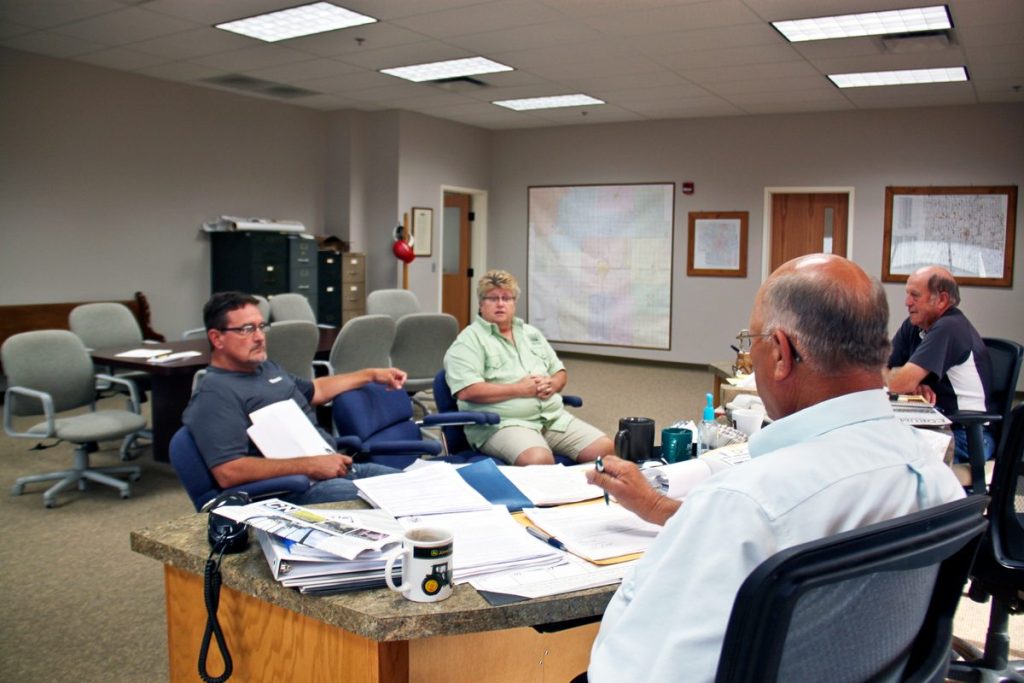
JIM FALL/DAILY FORUM
NoCoMo Industries board President David Lawyer, left, and General Manager Nicki Samson, facing camera at center, on Friday updated Nodaway County commissioners Bob Stiens, center with back to camera, and Bob Westfall on pending operational changes in store for the Maryville sheltered workshop resulting from new regulations signed into law last month by President Barack Obama. The changes are expected to have far-reaching effects on the operational practices of workshops in Missouri and across the country.
The leadership team of Maryville’s NoCoMo Industries met with the Nodaway County Commission Friday to explain potential ramifications for the local operation that could result from legislation pertaining to sheltered workshops nationwide signed last month by President Barack Obama.
“We are going to operate in Maryville, although it may be called something other than what it is now,” NoCoMo Industries board President David Lawyer told commissioners Bob Stiens and Bob Westfall.
“I am certain there were good intentions behind these changes, the problem is (lawmakers) did not understand their scope,” Lawyer said. “We just hope that between now and the two years until the changes go into effect, calmer heads will prevail.”
Lawyer and NoCoMo General Manager Nicki Samson specifically asked the commissioners for assurances about the county’s ownership of the building that houses the local workshop, which provides employment for workers with developmental and cognitive disabilities. They also wanted to know if the county would continue keeping the building insured.
NoCoMo currently occupies its building at 319 S. Newton in Maryville under a rent-free agreement with the county, which also pays the structure’s insurance premiums.
The management team’s other primary concern is the continuance of funding through Missouri’s Senate Bill 40 legislation. The law, adopted in the 1970s, allows counties to collect property taxes earmarked for the operation of services benefiting people with developmental and cognitive disabilities.
Although distribution of SB40 money is handled by a local board and not directly by the County Commission, Stiens and Westfall said they would request that Nodaway County Prosecuting Attorney Robert Rice, the county’s principle legal counsel, research NoCoMo’s funding status under the law.
Currently, the sheltered workshop receives “approximately $15,000 — $14,953 this year, to be exact” in SB40 Board funding through Nodaway County, Lawyer said.
That revenue is derived from a 5-cent per $100 of assessed property valuation collected on behalf of three area facilities, NoCoMo, the Nodaway County Senior Center, and the Nodaway County Health Center.
The SB40 measure authorized in 1975 stipulates that that tax cannot exceed 20 cents per $100.
“If we do not have funding through SB40 for a ‘sheltered workshop’ (as it is referred to in the original bill language), then down the road, we might have to go back to the voters,” Lawyer said.
Lawyer and Samson also presented to the commissioners their belief that the workshop is a viable operation that enjoys solid fiscal health.
“Six years ago, there was $82,000 owed on the building, and that has all been paid off,” Lawyer said.
He and Samson said the Maryville workshop has gone from generating less than 10 percent of its operating revenue from product sales six years ago to “about 60 to 65 percent every year since.”
“We can weather the storm for a number of years,” Lawyer said. “We are not panicking. We are exploring different avenues and hopefully making partnerships to add to our revenue stream.”
Samson said NoCoMo “is among the top 10 of the 89 operations in the state” in terms of revenue stream, “and I think we are No. 1 among rural workshops.”
She said that a coalition of workshops in Missouri is “looking to Maryville as an example of how to operate,” adding that workshop managers nationwide see Missouri as a “poster child” for employing those with disabilities in a sheltered environment.
The major concerns of the NoCoMo leaders and their Missouri counterparts is that revised federal rules require workshop employees to be paid minimum wage, and specify that such workers under age 24 must clear additional assessment hurdles before being allowed to work in non-competitive environments.
Many such workers would, instead, be required to competitively seek jobs in the private sector.
If local sheltered workshop clients are required to be paid the Missouri minimum wage of $7.65 per hour, Lawyer said, it will seriously modify their eligibility for Supplemental Security Income, Supplemental Nutrition Assistance, housing subsidies, and Medicaid.
Samson said a recent trip to Washington, D.C., by workshop supporters to discuss the situation with members of Congress clarified to her that there is a lack of understanding about the ramifications of the legislation.
“It’s not Democrat or Republican,” she said. “We’re talking about people, not politics. We are employers, not case managers, but we have to act as caseworkers.
“We aren’t making money off the backs of our employees. We are trying to build their self-esteem and give them meaning and purpose. But we can’t provide that for them if we don’t have a building to do it in.”