
In the paint: City seeks street-striping solution
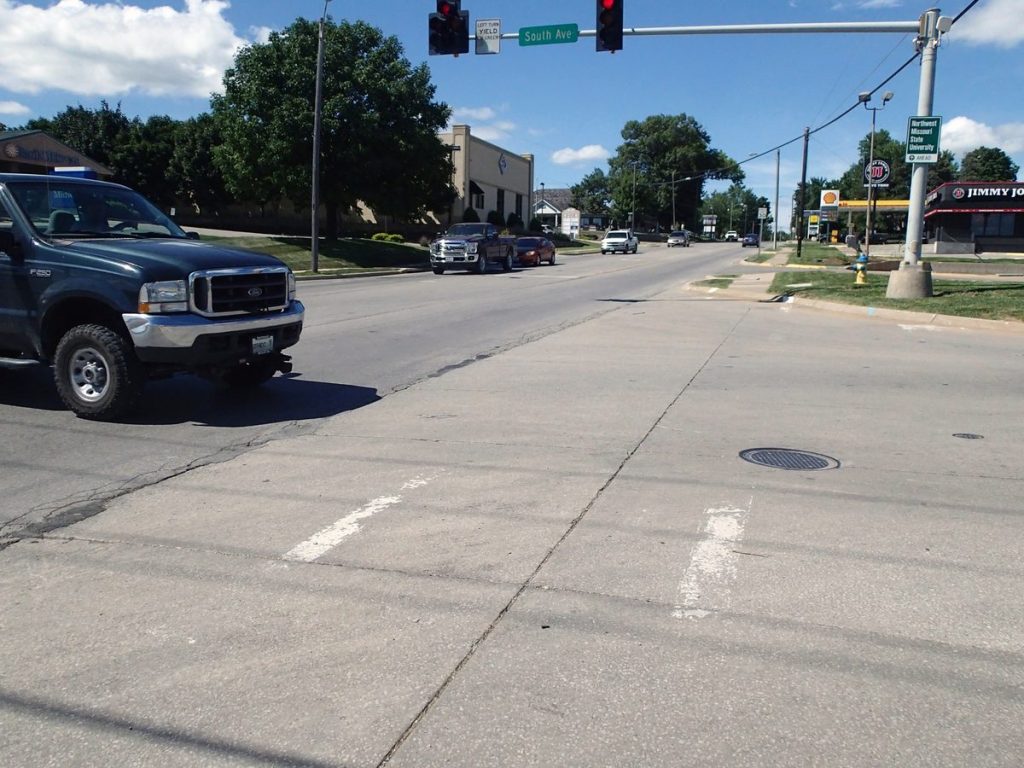
TONY BROWN/DAILY FORUM
A ghostly crosswalk at the corner of South Avenue and South Main Street is just one instance of Maryville’s deteriorating street markings. The high cost of durable marking material coupled with planned road work over the next year or so has turned normally routine decisions about street striping into a somewhat complex process that balances the need for safety against available fiscal resources.
People driving along Main Street and other Maryville thoroughfares this summer may have noticed that something that is supposed to be there no longer is.
As in virtually every other city that has to cope with the vagaries of a Midwestern climate, the centerlines, stop bars, turning lanes, and crosswalks meant to guide motorists winding their way across town just won’t stop playing hide and seek.
For a while you see them, freshly painted and shining in the sun, and then, after a couple of years of rain and snow and wear and tear, you don’t.
In Maryville, both ends of Main Street and a few other heavily traveled arteries are in especially bad shape. But sprucing them up — and more importantly, making them safer to drive on — has become an expensive problem for City Hall.
Once a routine line item in municipal budgets, street striping became a vexing problem almost everywhere about 30 years ago when state and federal regulations banned the use of lead-based paint.
The stuff looked good and it lasted great, but it also washed into storm drains and polluted streams and rivers. Lead, of course, is extremely toxic, especially to children, and can cause nervous system damage, stunted growth, kidney damage, and delayed development.
When lead paint was first banned, cities replaced it with latex-based substitutes, which simply don’t hold up as well.
Maryville City Manager Greg McDanel said last week that, depending on the weather and other factors, some types of street paint more or less disappear in just a year or so. He added that the elimination of lead-based paint has given rise to a whole new industry — thermoplastics.
Thermoplastic street markings consist of substances called polymers that become pliable above a specific temperature then solidify as they cool while bonding to a wide variety of surfaces, including several kinds of pavement.
The Bearcat paws used to add a decorative touch to the new West Fourth Street pedestrian corridor are made out of thermoplastic, and an increasing number of municipalities use these materials for centerlines, turning lanes, and crosswalks due to their resilience and durability.
Only one problem, it’s not cheap.
And in this part of the country the durability factor is still roughly the same as lead-based paint — three to five years.
In this year’s budget, Maryville allocated $15,000 for street striping and hoped to re-mark the entirety of Main Street, north to south, along with newly repaved West South Avenue.
As things turned out, the sole bidder, Twin Traffic Marketing Corp., wanted nearly $35,000 just for the Main Street part of the job and threw in South Avenue for an extra $12,600.
After digesting the sticker shock, the city council elected to stripe South Avenue with a three-to-five-year thermoplastic and put Main Street on hold.
After mulling things over, McDanel said municipal staff now plans to propose striping Main Street, and perhaps Sixteenth Street and Country Club Drive as well, with conventional paint due to safety considerations.
He added that those concerns will soon be exacerbated by the arrival of several thousand college students, many of them relatively inexperienced drivers unfamiliar with Maryville’s streets and traffic patterns.
While the city plans to put the work out to bid — pending approval by the city council — municipal crews, which have some experience doing this kind of work, may pitch in as well in an effort to reduce costs.
Using paint that will wash away in a year’s time rather than thermoplastic might seem like throwing good money after bad. However, McDanel pointed out that considerable road work is likely to occur along Main Street over the next 12 to 18 months, including phase-one construction of a proposed South Main corridor overhaul, which would essentially reconstruct the South Main/South Avenue intersection.
That crossroads is probably the busiest in town, and also one of the spots where striping, including turning lanes and crosswalks, is badly deteriorated.
So why, McDanel asked, apply expensive thermoplastic material to pavement that’s going to be torn out in a year or so?
The same problem presents itself just north of the square, where Main Street is badly dilapidated between Fourth and Seventh streets and will perhaps be repaved during next year’s budget cycle.
Of course, after striping South Avenue, Maryville only has $2,400 left in its street-marking budget. But McDanel said under-spending in other areas, and the recent decision to pull back on asphalt overlays in order to make up for lost grant funds intended for repaving a portion of North Main Street, have left the city with some fiscal wiggle room.
“We’ve got some flexibility in the budget this year,” he said, adding that the city is currently benefiting from improved sales tax revenue.
But relying on windfalls is not a perfect solution, and keeping Maryville streets clearly marked is likely to be an issue well into the future. The days are long gone when all you had to do was slap on a little inexpensive, durable, albeit very toxic, paint.
So, in this case, the normally far-thinking McDanel believes a stopgap solution may be the best response to a problem that pits the city’s duty to keep streets as safe as possible against its responsibility to spend taxpayer dollars prudently.




