Chief: Attacks heighten police gun concerns
TONY BROWN/DAILY FORUM
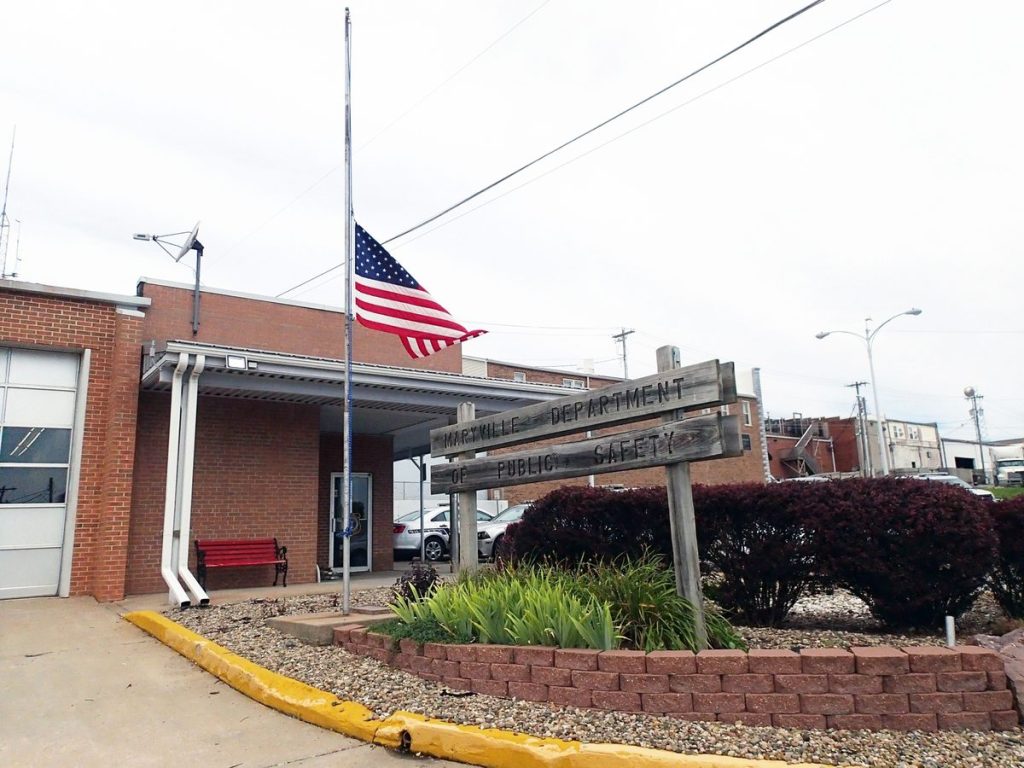
The flag outside Maryville Department of Public Safety headquarters flies at half-staff Tuesday in memory of the five police officers killed last week in Dallas. A series of shooting incidents in recent days in which officers have been killed or wounded has lead Public Safety Director Keith Wood to speculate on the possible negative impacts of proposed relaxation of Missouri’s concealed carry law and a perceived willingness by some citizens to own and carry firearms without adequate training.
It has been, by any measure, a very bloody week for United States law enforcement.
Most of the carnage, of course, occurred last Thursday in Dallas, where five police officers were killed and six wounded by Micah Xavier Johnson, an Army-trained marksman angered over police-involved shootings in which African American suspects were killed in Louisiana and Minnesota.
Then on Friday, just a day later, an officer was seriously wounded in the back with a .22-caliber weapon during a traffic stop in the St. Louis suburb of Ballwin. The suspect, 31-year-old Antonio Taylor, now in custody, was described as having “a lengthy criminal history.”
Just four days later, on Monday, two bailiffs were killed and a sheriff’s deputy wounded in the Berrien County Courthouse in St. Joseph, Michigan, when a prisoner named Larry Gordon, who was handcuffed, grabbed the deputy’s gun and began firing. He was killed by officers moments later.
While all three incidents occurred under markedly different circumstances, each has contributed to an environment in which peace officers appear targeted by those apparently willing to unleash lethal force against almost anyone wearing a badge.
Maryville Public Safety Director Keith Wood, who serves as both the city’s fire and police chief, said Tuesday he hasn’t observed any noticeable impact on the morale or behavior of the men and women under his command.
But he suspects there is one.
“I don’t see it,” Wood said. “But I can’t help but know that it’s been wearing on them to some extent.”
Wood described police officers as essentially trained to be “hypersensitive” to their surroundings, both for their own safety and the safety of others, and said the rash of gun violence over the past few days “has to be in the back of everyone’s mind every time they walk out the door.”
Contributing to the sense of wariness, he said, is a burgeoning gun culture in which legal firearms, both concealed or borne openly, are commonplace.
“It’s almost like we’ve gone back to the Wild West days,” said Wood, adding that the Missouri Legislature’s stated intention of seeking to override Gov. Jay Nixon’s veto of a gun-rights bill that would eliminate mandatory training, background checks, and permit requirements for concealed weapons “is a little bit troubling to me.”
Wood said he is not opposed to concealed carry, but simply believes that civilians, like officers, require sufficient training in order to use firearms responsibly and skillfully.
He noted that police, unlike private gun owners, are taught how to retain their weapons in the event someone tries to take them. That’s a real danger, even for officers, as the Berrien County tragedy illustrates.
Wood also said that officers use special holsters equipped with quick-release locking mechanisms designed to keep sidearms secure, while civilians are allowed to carry weapons any which way, including tucked into a waistband.
While some citizens probably need concealed weapons, Wood said, and while law enforcement has made the adjustments required to function in a gun-toting society, further liberalization of Missouri’s existing concealed carry law in misguided in his view.
“They’re being political,” Wood said of the Legislature’s veto override plans. “I don’t understand the rationale.”
However, the chief said, an overwhelming number of gun owners, including those who practice concealed carry, are safety-minded and conscientious.
“It’s that one person in 100,” Wood said. “But if you take out the training (requirement for a concealed carry license) that one in 100 becomes a larger percentage.”
And while he supports gun rights, Wood said the fact that more Missourians may soon be able to carry more guns more easily is cause for concern.
“A fistfight is one thing,” he said, “A fistfight where a gun is produced in a whole other thing.”
One problem, Wood said — as was demonstrated in the Dallas shootings — is the potential for bloodshed when law-abiding citizens take their guns to an event, such as a lawful protest, that explodes into violence.
Rather than using their guns to defend themselves, a number of armed civilians in Dallas fled the scene in order to avoid being mistaken for suspects and possibly shot by police.
“If it’s possible, Wood said, “people should try to put themselves in the mind-frame of an officer trying to do his job. They are in life-preservation mode.”
He said he has talked with officers who were on the “front line” during 2014’s often-violent racial strife in Ferguson following the fatal police-involved shooting of Michael Brown.
Police on the street, he said, sometimes knew they were facing armed citizens “but didn’t always have the authority to address that.”
A responsible gun owner, Wood said, would think twice about introducing a weapon into such a situation.
“If I’m going to an event (as a civilian), and I need a weapon, I would have to question why I’m attending that event,” he said. “Choosing to run is almost always a better choice than choosing to draw. You can stand your ground and be dead.”
Wood said the notion that guns can be effectively used for self-defense by citizens possessing little firearms training poses other problems as well.
One recurring worry for officers in a college town, he said, is the scenario of someone who’s had too much to drink walking innocently into someone else’s residence, a circumstance that happens with some frequency.
“We’re constantly fearful that one of those could turn out to be a deadly shooting,” Wood said.
While local police have learned to “cope with and live with concealed carry,” Wood said, and even possess a certain level of confidence that gun-bearing citizens have at least some level of proficiency, Wood fears what might happen if gun laws are further liberalized.
“I never feel like more weapons on the street is the answer to anything,” he said. “But I understand the desire people have to protect themselves. … Training is probably the key.”

Maryville Public Safety Director Keith Wood