
Ex-fraternity member accepts plea bargain
TONY BROWN/DAILY FORUM
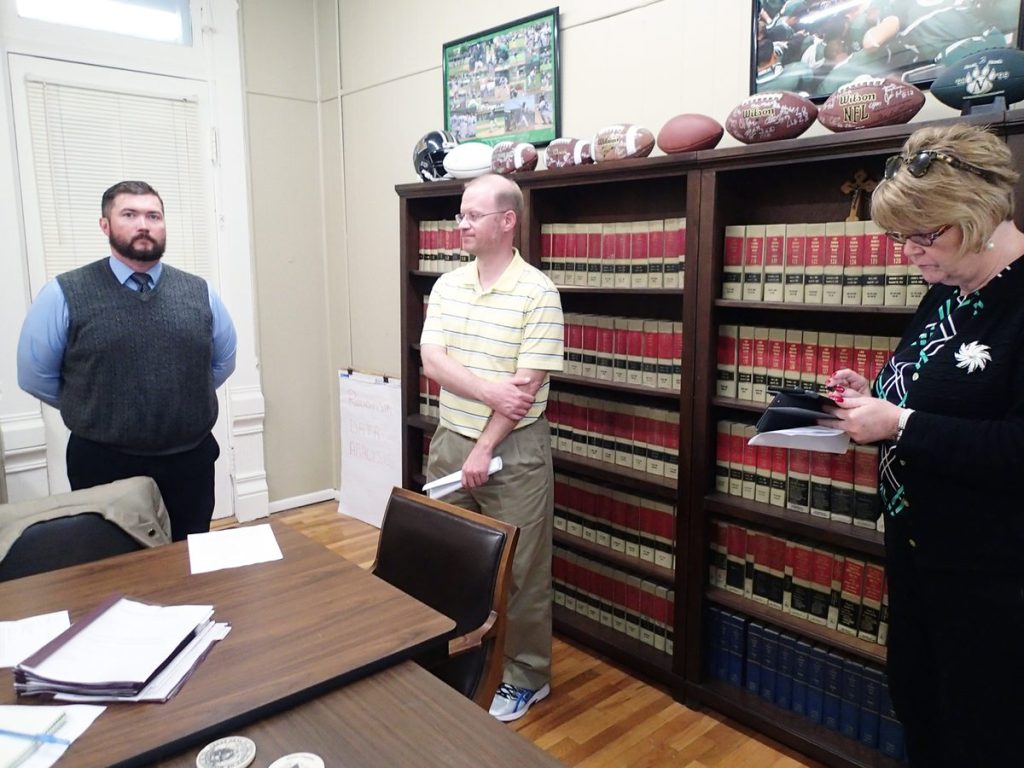
Nodaway County Prosecuting Attorney Robert Rice, left, speaks with reporters Monday afternoon following Judge Roger Prokes’ acceptance of a plea bargain in a case involving the formerly alleged rape in 2015 of a Northwest Missouri State University student during or after a party at the Tau Kappa Epsilon fraternity house in Maryville. Defendant Abraham Flores Acosta admitted committing third-degree misdemeanor assault involving a woman under the age of 21 and was sentenced to 15 days in jail.
A former Northwest Missouri State University student and ex-member of the Tau Kappa Epsilon fraternity pleaded guilty Monday in 4th District Circuit Court to misdemeanor third-degree assault in connection with a February 2015 incident involving a female student at the TKE fraternity house, located at 555 W. Ninth St. in Maryville.
The plea, the result of a deal worked out between counsel representing the accused, Abraham Flores Acosta, 23, Sibley, Iowa, and Nodaway County Prosecuting Attorney Robert Rice, was accepted by Presiding Circuit Judge Roger Prokes, who sentenced Acosta to 15 days in the county jail.
Acosta’s guilty plea means that he will not face a jury trial for rape, which was to have begun this week. Had he been convicted of first-degree rape, the defendant could have served a prison term of five years to life. An alternative charge of second-degree rape would have carried a sentence of two to seven years.
Acosta, dressed in a black suit, white shirt, and black tie, attended the proceeding with his attorney, John O’Connor of Kansas City, and was led away in handcuffs by a bailiff after Prokes accepted the plea.
Acosta was originally accused of felony rape following a party at the fraternity house, which took place on the night of Feb. 28 and lasted into the early hours.
The charge, as described by Prokes from the bench, included “offensive or provocative” physical contact by the defendant that involved touching the victim, who was under 21, without her permission while she was under the influence of alcohol.
The victim, identified only as MM, briefly addressed the court in a statement that Prokes said was intended to demonstrate any “physical, emotional, or financial” harm she had suffered.
MM, who has since left Northwest and enrolled at another university, said that Acosta, in assaulting her, “took my happiness,” and deprived her of “my dreams, my security, and my peace of mind.”
She said she hoped the conviction would demonstrate that people who commit such assaults are not entitled to “take whatever they want, whenever they want.”
During a press conference following Monday’s hearing, Rice said there simply wasn’t enough physical evidence to prove that the offense rose to the level of felony rape.
He added, however, that he was “sick and tired” of such incidents surfacing following fraternity parties where he said large amounts of alcohol are served over a relatively short period of time, often to people under age 21.
Rice said his office would continue to be “aggressive” in prosecuting such assaults and seeking convictions, especially with regard to organizations sanctioned by Northwest.
“We’re going to continue to prosecute these cases until something changes,” Rice said. “I’m going to file every case I can.”
The Acosta case was “carefully vetted,” Rice said, and involved investigations by four separate law enforcement agencies and statements from 28 witnesses. He added, however, that a lack of DNA evidence would have forced the prosecution to prove beyond a reasonable doubt “what happened in a room between two individuals.”
Rice said the victim was kept fully informed as the prosecution sought to build a case and agreed that offering the plea bargain was the best practical alternative.
“We were with the victim every step of the way,” he said.
Rice, who showed visible emotion during the press conference, did not hesitate to lay the blame for such incidents on Northwest fraternities “who freely distribute alcohol” to minors until they become so intoxicated they are no longer able to make rational decisions about their wishes or welfare.
He said both the Acosta case and a similar incident over Halloween weekend last year shared the same “factual basis.” He added that MM claimed sexual intercourse occurred, and that “she was so intoxicated she could not give consent.”
Under such conditions, Rice claimed, “alcohol is a weapon,” and he challenged Northwest administrators and the university’s Intrafraternity Council, which sets policy for male Greek-life organizations, to institute and enforce strict regulations with regard to when and to whom alcohol is served.
Rice said he was particularly outraged by parties where “jungle juice,” a mixture of fruit juice and spirits, is offered, and where people may not know just how much liquor they are consuming
“It tastes like fruit punch,” he said, “and when it hits, it hits bad, and then bad things happen.”
Rice said he has been meeting with Northwest officials, including Vice President for Student Affairs Matt Baker, who he described as being both responsive and willing to cooperate.
He said he is working with Baker and others to formulate new policies and procedures aimed at curbing binge drinking at student parties and preventing criminal action.
His goal, Rice said, is to have new, more stringent, rules governing Greek-life social events on the books by Labor Day.
The incident in February was one of two during 2015 involving allegations of sexual assault at the rambling TKE fraternity complex said to have occurred during or after parties that involved heavy alcohol consumption by those in attendance.
The second episode was reported to have occurred eight months later — Halloween weekend, 2015 — when Maryville police investigated a similar alleged attack. A suspect was identified, but no charges were filed due to what Rice described as lack of sufficient evidence to win a conviction.
Taken together, the incidents led Northwest administrators, who cited violations of Greek-life risk management policies, to revoke institutional recognition of the local TKE chapter, known as Delta Nu, in late November 2015.
Rice said at the time the alleged assaults were among five similar reports involving Northwest Greek-life organizations or their members within a single calendar year.
A couple of months after the incident in which Acosta was charged, Northwest placed the Delta Nu chapter on probation for violations related to high-risk social behavior uncovered during an internal investigation.
The revocation of institutional recognition, which followed the probation decree, effectively banned TKE from any association with the university, including recruitment, initiation, Intrafraternity Council membership, and social events.
Under terms of the ban, future students will be allowed to apply for “colony status” in February 2019, a move that could lead to renewal of institutional recognition and reinstatement of TKE as a member of the campus Greek-life community.
Fallout from the TKE house incidents led Northwest President John Jasinski last year to call for the launch of a Greek-life “visioning process” to be led by two Northwest alumni in conjunction with “organizational leadership” from Northwest’s Greek-life staff.




