Ag academy students explore precision farming
TONY BROWN/DAILY FORUM
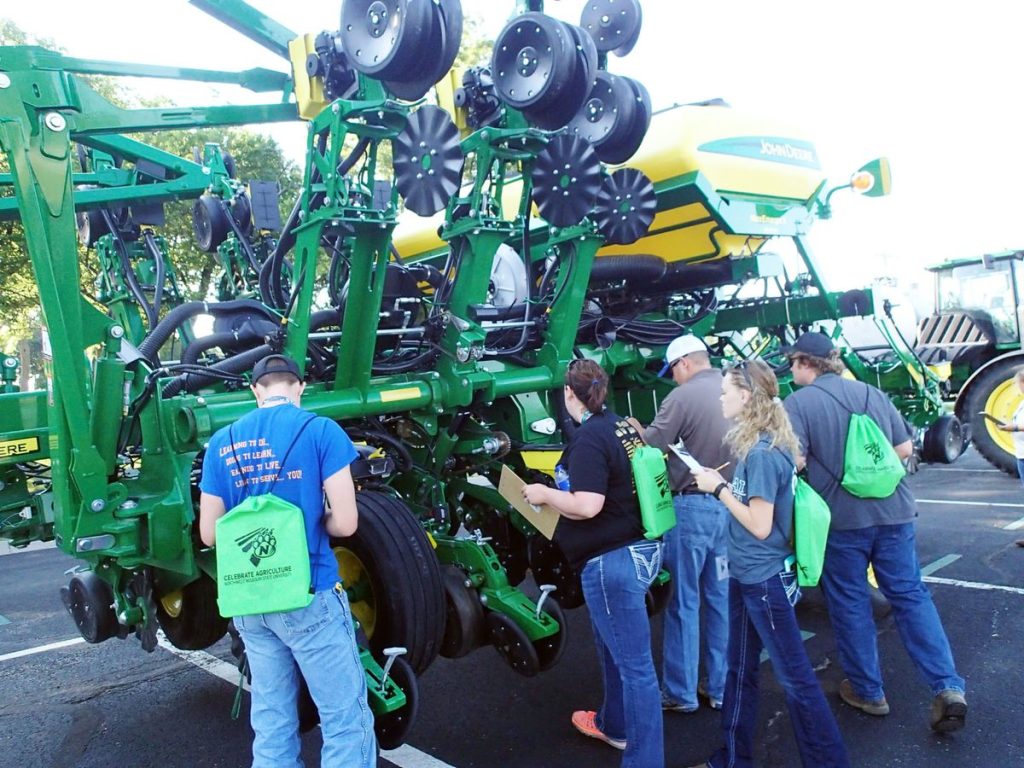
Students participating in this week’s Precision Agriculture Summer Academy at Northwest Missouri State University check out a John Deere 1975 MaxEmerge planter Wednesday morning in the parking lot west of College Park. MaxEmerge is a proprietary John Deere technology that allows farmers to achieve precise seed depth and row spacing under widely varying field conditions.
Some of the most advanced “precision farming” technology around has been on display this week at Northwest Missouri State University during a Precision Agriculture Summer Academy co-hosted by Northwest’s School of Agricultural Sciences and Iowa-based AgriVision Equipment Group.
The academy, which wraps up today, is giving 24 high school students and 12 ag teachers from across Missouri and Iowa a chance to attend sessions led by Northwest faculty and AgriVision staff while gaining hands-on experience with various John Deere implements.
In addition to taking ag courses in high school, the students, who were competitively selected, are all members of either FFA or 4-H.
Equipment on hand during the three-day workshop included a state-of-the-art model John Deere 1795 planter equipped with Deere’s MaxEmerge technology, which allows farmers to achieve precise seed depth and row spacing under widely varying field conditions.
Rod Barr, director of Northwest’s ag school, said during Tuesday’s opening session that he expected the academy to have an impact well beyond the students and high school instructors invited to attend.
“Your teachers are going to be able to take stories from this academy back to class,” Barr said. “and our hope is that they will use you as part of the resource pool.”
Barr began the session by asking students to define “precision agriculture,” an umbrella term for an expanding arsenal of practices that utilize global positioning system technology and data analysis tools to boost productivity and increase yields.
He then offered a definition of his own by quoting 20th century soil conservation pioneer Hugh Hammond Bennett, who said, “Use every acre within its capability, and treat it according to its needs.”
While that has been a maxim for farmers for decades, Barr said, the digital technology revolution has changed the equation in a major way, largely by giving producers access to data they’ve never had before.
Taking a golf course rangefinder from his pocket, Barr said that many precision agriculture techniques work in much the same way. Just as the rangefinder can tell a golfer which club to select, then store that information for future use, so precision farming technology can tell farmers how much fertilizer is needed where, how much moisture is in the soil, and what kinds of pesticides should be applied.
Whereas compiling such data was once largely a matter of educated guesswork involving entire fields, Barr said, electronic soil sample probes, GPS mapping, aerial drone photography, and other tools now offer farmers the chance to evaluate their land acre by acre, and in some cases meter by meter.
“The key,” he said, “is data, and it’s a big, big deal.”
Also helping lead this week’s academy was Mark Ford, AgriVision Equipment Group’s director of organizational development.
AgriVision is a John Deere farm and consumer equipment dealer with 10 locations across southern Iowa, and Ford said that precision farming, and the profound tech know-how it requires, is redefining what it means to be a farmer in the United States.
“John Deere estimates that within five to 10 years it will be considered a technology company (as opposed to an implement manufacturer),” Ford said, “and we’re already seeing that.”
The advent of tractors and other field machines with GPS capability, he said, has enabled producers to accurately control such variables as field speed, seed spacing, and fertilizer volume for maximum efficiency, which allows them to save on fuel, materials, and — most importantly — time.
While time is perhaps a farmer’s most valuable resource, Ford said, it is also “often abused the most because that’s what they’ve got the most of.”
Of all precision farming tools, he said, global positioning is perhaps the key technology, since it drives such key capabilities as auto-steering and field mapping.
Auto-steering means that crops can be planted, cultivated, and harvested with remarkable efficiency, while mapping is a key element in the increasingly common practice of writing field “prescriptions.”
Such a prescription is basically a recipe that includes the amount and kind of fertilizer to be applied, the kind of spraying that needs to be done, the amount and type of seed to be planted, and other factors.
Aside from making farms more profitable, and giving farmers more time and improving their quality of life, Ford said precision farming is also creating new professional opportunities for young people in ag’s rapidly expanding tech sector.
“We don’t have mechanics anymore,” he said, “They’re service technicians. You have to understand all of the displays and diagnostics. These are smart machines.”
Ford added that learning opportunities like the Precision Agriculture Summer Academy are vital to the training of a new generation of farmers and industry professionals capable of moving production agriculture to the next level.
It’s important, he said, to see precision farming technology in action, and to use one’s hands as well as one’s brain.
“Not everything you learn is going to be in class or from a book,” Ford said. “You’re going to be out there troubleshooting in the field.”
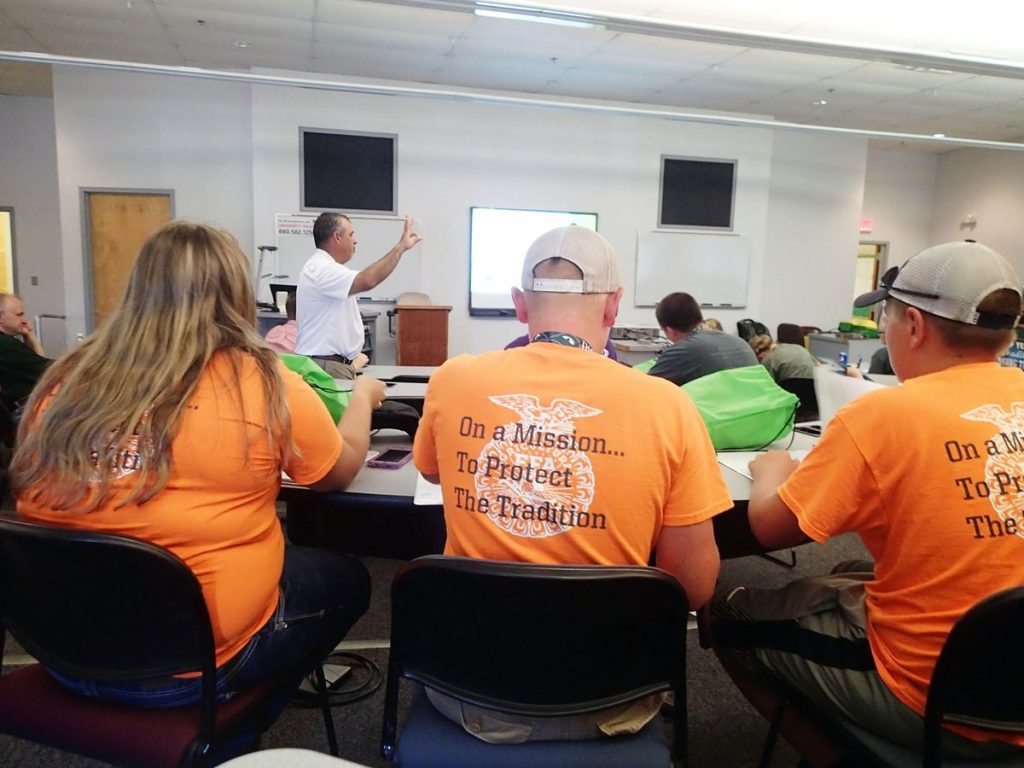
TONY BROWN/DAILY FORUM
A group of high school agriculture students wearing FFA T-shirts listen to a presentation Tuesday by Rod Barr, standing, director of the School of Agricultural Sciences at Northwest Missouri State University. The lecture kicked off a three-day precision agriculture workshop on campus this week covering such topics as geographic information systems, auto-steer technology, field mapping, and data collection and analysis.