
CASPER: Helping first-responders help others
TONY BROWN/DAILY FORUM
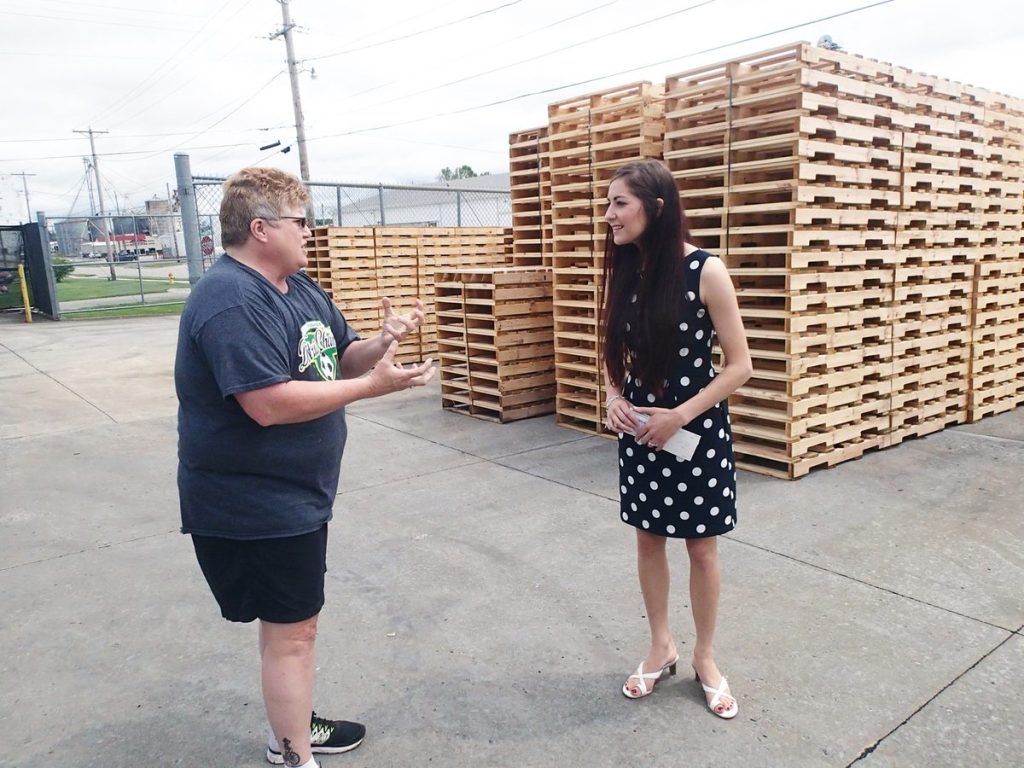
Nicki Samson, left, general manager of the NoCoMo Industries sheltered workshop, speaks with Maryville Public Safety dispatcher Caitlin Kinman about CASPER, a program designed to provide police officers and firefighters with information needed to communicate with and assist people who have developmental disabilities and other special needs. Kinman joined Samson Friday for a tour of the workshop’s fabrication, woodworking, and recycling operations.
A 911 call comes in to Maryville Public Safety, for say a structure fire or a car wreck, and police officers, firefighters, or both are dispatched to the scene.
Once they arrive, however, they encounter someone involved in the incident — and perhaps in distress — who can’t speak, or who appears not to understand what officers are saying, or who exhibits anxiety, fear, and erratic behavior.
Police may react as if the person is under the influence of alcohol or drugs, or seek to forcibly restrain them.
But what they don’t know is that the “subject” is hearing impaired, suffers from heightened anxiety, or has a cognitive or developmental disability. Perhaps he or she is coping with autism, or fragile X syndrome, or expressive language disorder.
What if officers knew about the person’s condition beforehand? And what if they had some special training on how to communicate with and respond to folks who face these kinds of challenges? Would such knowledge and training enhance their ability to act appropriately and better ensure the person’s safety and well being?
Well, that’s the idea behind CASPER, a Maryville Public Safety program currently being organized by Caitlin Kinman, a member of the department’s dispatch staff. The acronym stands for Communication Awareness and Safety Procedures for Emergency Responders
Kinman said she got the idea for CASPER after spending time with family friends who have an autistic child. She said she began to realize that in a crisis some people with special needs may react in ways that pose a danger to themselves or others.
Someone with an anxiety disorder, for example, might seek to hide in a closet or under the bed during a house fire rather than fleeing the structure. Alerting firefighters about the person’s condition beforehand could potentially save a life.
So how does CASPER work?
Kinman said the core of the system will be a database containing information provided by individuals and families who voluntarily enroll in the program.
Members complete a CASPER Club information form by supplying a physical description, photograph, contact information, the type of disability or condition, and possible reactions.
Is the person, for example, apt to wander off without telling anyone where they are going? Do they have a favorite hiding place? Are they unusually sensitive to lights, loud noises, or being touched? Do they have a “meltdown” behavior or emotional triggers, and if so what are they? Are there any effective calming strategies?
All of that information, Kinman said, will be retained by MPS in a secure file and entered into a username- and password-protected database programmed to interface with the city’s 911 system.
When a CASPER member or family makes a 911 call, a notice will appear on the dispatcher’s computer screen so that the file can be accessed and first-responders advised that special actions or precautions may be required.
In addition, CASPER members will be asked to fill out a vehicle card containing essentially the same information and keep it in their glove compartment, which is generally one of the first places first-responders look when working an accident.
Kinman has also designed small signs to be displayed on vehicles and residences that read, “Stop, assess, approach. A member of the CASPER Club may be on board or reside here. Lights, sounds, or touches may have an effect on this individual. Please contact Maryville Public Safety Dispatch for more information.”
On paper, CASPER looks like a great idea, but putting it into practice, Kinman admits, is going to take a lot of work as well as some money to cover the costs of materials, data entry, and training for police and fire personnel.
So she’s in the process of making the rounds to Maryville’s service clubs and civic organizations in order to describe her proposal and ask for donations.
Already on board is NoCoMo Industries, which operates a local sheltered workshop, and whose board of directors approved a $500 donation to help get CASPER off the ground. The money was taken from private enterprise contract income rather than state tax revenues that, along with contract funds, help support workshop operations.
“I am over the top excited about this,” NoCoMo General Manager Nicki Samson said Friday while giving Kinman a tour of the workshop’s fabrication, woodworking, and recycling operations. “This is a project that needed to happen a long time ago.”
Kinman said implementing CASPER will allow dispatchers to provide first-responders with the kind of information needed to keep more people out of harm’s way, including some of Maryville’s most vulnerable citizens.
“We want everyone in our community to feel safe,” she said. “I think this is going to help people rest easier at night, and let them know that Maryville Public Safety is on their side, that we’re here to help.”
Kinman added that once CASPER is launched she sees possibilities for expansion, possibly through a “CASPER Silver” program tailored for older people suffering from Alzheimer’s disease and dementia.




