Lawmakers sum up session’s hits, misses
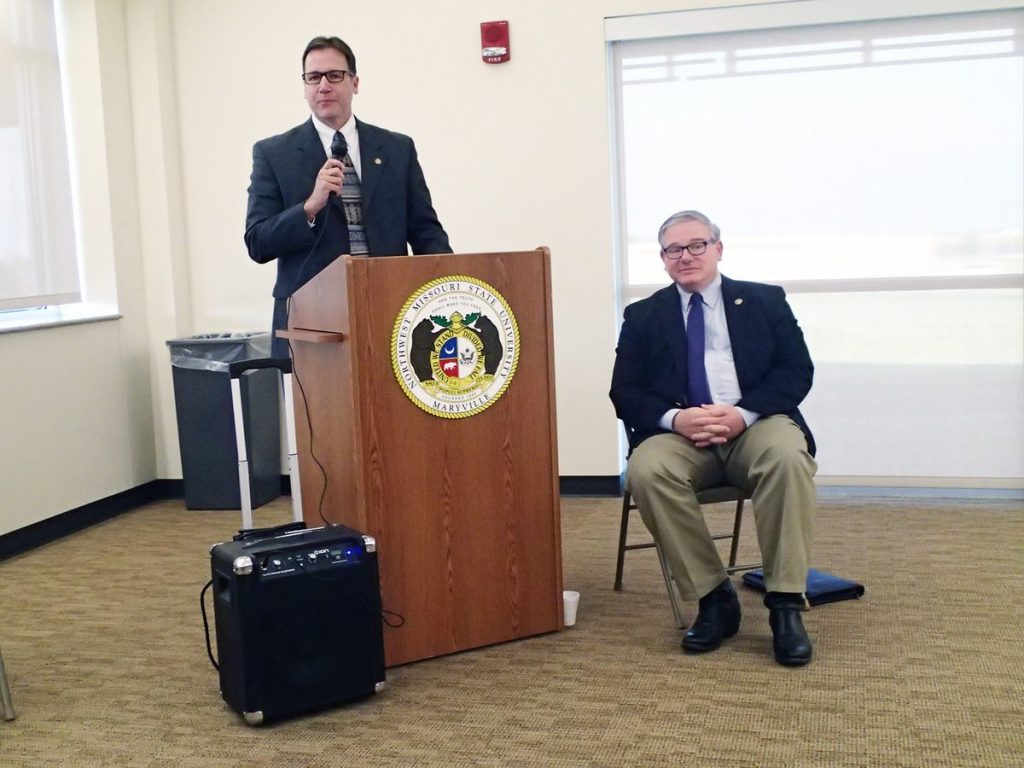
TONY BROWN/DAILY FORUM
State Rep. Allen Andrews, standing, and state Sen. Dan Hegeman appeared before local business and civic leaders Thursday during the annual post-session Legislative Coffee hosted by the Greater Maryville Chamber of Commerce. A good part of the discussion revolved around the lack of progress lawmakers made this year on such issues as increased funding for highways and 911 service.
The two lawmakers representing Nodaway County in the Missouri General Assembly addressed a small gathering of local leaders and businesspeople on Thursday during the annual post-session Legislative Coffee hosted by the Greater Maryville Chamber of Commerce.
Sen. Dan Hegeman, R-Cosby, who represents the 12th Senate District, and Rep. Allen Andrews, R-Grant City, who represents the 1st District in the House of Representatives, spoke and answered questions for about 40 minutes on a range of issues, including transportation spending, education, and 911 funding.
At times, the dialogue appeared to focus more on what the Legislature didn’t do than what it accomplished.
That may have been because, during a presidential and gubernatorial election year, lawmakers tend to shy away from landmark bills and big initiatives.
Again in 2016, the General Assembly failed to come up with a way to significantly increase funding for the state’s highway system, rejecting a proposal to add about 2 cents per gallon per year to Missouri’s motor fuels sales tax over the next three years.
The measure would have raised the fuels tax from 17.3 cents to 23.3 cents a gallon in 2018 and tied future increases to the inflation rate.
Hegeman said he opposed the measure because it was designed to gradually bump up the tax rate while staying below the cap set by Missouri’s Hancock Amendment, which limits state revenues and expenses to a percentage of personal income.
Hegeman said he understands that the state’s roads and bridges need help, but insisted that the Legislature should not impose a major tax increase without voter approval, even if the hike falls within the Hancock restrictions.
Addressing another transportation issue, Hegeman said there appears to be increasing support among urban lawmakers for reducing the number of miles of roadway the Missouri Department of Transportation is responsible for maintaining.
In reality, he said, that would mean turning over ownership of rural lettered routes to counties, or even abandoning such roads altogether.
Hegeman said he and other rural senators are committed to using all means at their disposal, including the filibuster, to keep any such proposal from moving forward.
In addition to highway funding, Hegeman and Andrews said the Legislature also declined to address the need for increased 911 revenue as more people move to cellphones, and income from landline fees continues to fall.
Missouri is the only state in the country that has failed to enact some sort of cellphone tax or surcharge to help pay for 911 service. Voters have twice rejected such a tax in statewide elections.
Hegeman said there was some debate in the Senate this year about allowing individual counties to collect cellphone user fees, but that the proposal went nowhere.
On other fronts, Hegeman and Andrews both underscored their commitment to legislation designed to boost economic development and aid small business, and Andrews noted that lawmakers were able to move the so-called “Get Big Government Off My Back Act” to Gov. Jay Nixon’s desk.
The bill extends for five years, a package of tax incentives for small businesses, and specifies that enterprises with fewer than 50 employees can claim a $10,000 tax deduction for each job they create that pays above their county’s average wage.
Such businesses can claim a $20,000 deduction if they provide at least half of their employees’ health coverage.
Moving on to education, Hegeman said he believes it has become increasingly difficult to steer bills affecting schools through the legislative process due to a “tug of war” between lawmakers who want state revenues spent for public education only, and those who believe that many programs, such as the A+ Schools scholarship initiative, should apply to private institutions as well.
The A+ expansion made it through the Legislature this year as part of a bill that also requires high school students to pass the same civics exam taken by immigrants seeking U.S. citizenship.
Of course, the major education bill passed this year had to do with the foundation formula — the system used by the state to figure the amount of basic aid due each public school system.
Lawmakers added $71 million to formula spending this year but also limited the growth of the state’s “adequacy target,” a per-student dollar estimate that determines how much money schools should receive.
When the current foundation formula was created in 2005, the Legislature included a 5 percent cap on adequacy target growth. But lawmakers dropped that limit in 2009 in hopes of receiving more revenue from riverboat gambling and lottery proceeds.
The gambling windfall failed to materialize, and lawmakers found themselves more than $400 million short of funding the foundation formula at 100 percent, so they simply lowered the target.
Restoring the cap reduced the formula gap to around $70 million, which Hegeman said gives lawmakers “a reachable goal — a goal that we can strive for.”
After blasting the Legislature in the media for scaling back its formula obligations, Nixon, a Democrat, vetoed the measure, but the heavily Republican Legislature overrode the veto the following day.
Missouri’s total K-12 budget is approximately $3.3 billion.
As for higher education — a priority for a pair of lawmakers whose districts include Northwest Missouri State University — Hegeman and Andrews noted that core funding for the state’s colleges and universities increased by 4 percent, or about $37 million.
In addition, both men worked together during the session to secure $1 million in capital funds that will be used to make urgently needed repairs to Northwest’s landmark Administration Building.
In April, the Northwest Board of Regents approved a $3.3 million emergency expenditure for the Administration Building after a number of structural deficiencies were uncovered. The state contribution relieves part of that burden.
Stacy Carrick, Northwest’s vice president of finance, said that most of the problems involved worn-out window lintels as well as weakened gables likely damaged in a catastrophic 1979 fire.
Hegeman said putting together a higher education spending package was especially difficult this year due to the desire of some lawmakers to punish the University of Missouri for its response to racial unrest.
“Some people have been determined to dog-pile on MU,” he said, “and that cast a shadow on higher education everywhere in the state. But I think we’ve put that behind us and are moving forward.”