Study indicates hunger needs in Nodaway County
By JENNIFER DITLEVSON HAGLUND Staff writer
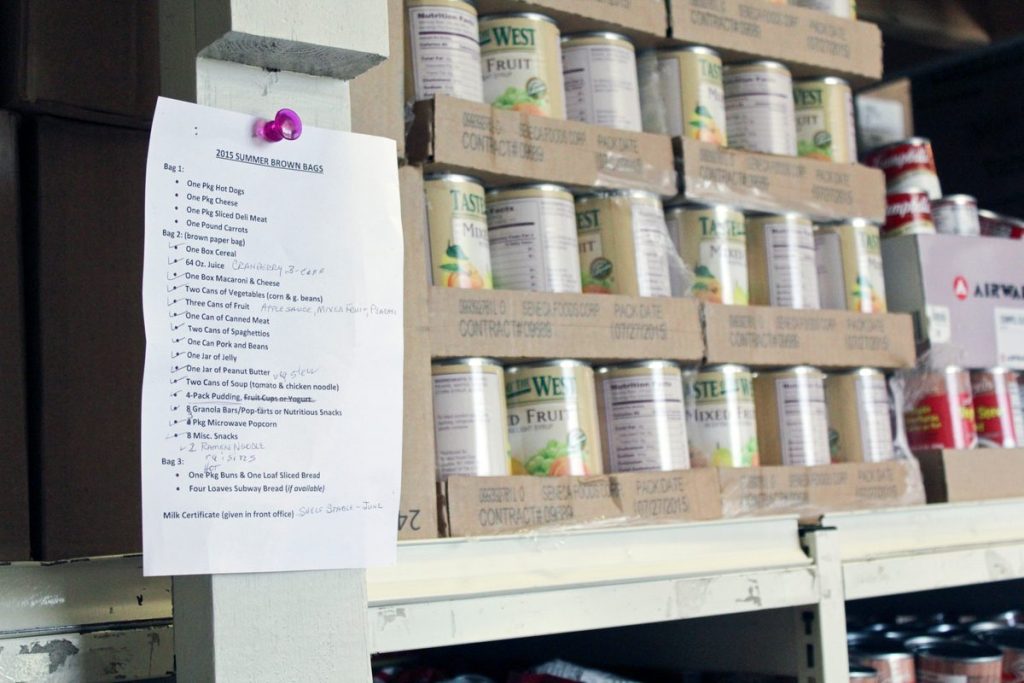
At The Ministry Center in Maryville, volunteers are preparing for the end of the school year, which marks the beginning of the food pantry’s Summer Brown Bag program. The summer project runs from June through August to provide meals for children who participate in the Backpack Buddies program during the school year. This assistance is in addition to the amount of food items the family already receives.
According to a recent report from the University of Missouri’s Interdisciplinary Center for Food Security, Missouri households are hungrier than they’ve been in decades.
The research shows that Nodaway County is no exception.
The 2016 Missouri Hunger Atlas is an interactive map that accounts for participation in government assistance programs for food, household incomes, and health hazards in all 114 Missouri counties and the City of St. Louis.
In Nodaway County, 19.4 percent of individuals classify as “food uncertain,” compared to the state average of 16.4 percent. That three percent point difference puts Nodaway County in the “very high need” category.
Approximately 9 percent of individuals in the county are “food uncertain with hunger,” which also classifies as very high need.
Feeding America, a nonprofit network of food banks across the United States, compiled nationwide 2014 food insecurity data showing that Nodaway County has approximately 4,570 people with food insecurity. That is about 20 percent of the county’s population.
Chad Higdon, executive director of Second Harvest in St. Joseph, said food insecurity is complicated because so many factors contribute to the definition.
“It could be seniors skipping medications to buy food,” Higdon said. “It could be people paying gas, rent, or mortgage instead of buying food.”
Overall, even though Nodaway County ranks very high in food insecurity, its level of need is only average among other counties in the state.
The Hunger Atlas, however, designates the county’s performance in addressing the need to be “very low.” Performance indicators for the study included participation in the Supplemental Nutrition Assistance Program; the National School Lunch Program; food bank distributions; and the Women, Infants, and Children Program.
Higdon speculated that the county’s rating could be because The Ministry Center in Maryville is the only food pantry in the county.
Merlin Atkins, who has worked with The Ministry Center for more than 20 years, said, however, creating one central location was intentional.
Before The Ministry Center opened in 1999, Atkins worked in a food pantry that served the community from a church basement. People were coming in three and four times a month for food because there wasn’t enough space to store and distribute larger quantities.
“I’ve been in a number of communities where it’s not centralized, and it was much less efficient,” said the Rev. Jonathan Mitchell, who is the chairman of The Ministry Center’s board of directors.
Mitchell said that having multiple locations could be problematic because each place would be vying for volunteers and resources.
“The drawback to having one location is that transportation can be an issue,” Mitchell said. “A lot of times, we have two families coming in one car.”
Atkins said that even though the Nodaway County’s sole food pantry is located in Maryville, so are the grocery stores closest to several rural communities throughout county.
Without grocery stores nearby, residents of Skidmore, Maitland, Graham, and Ravenwood have to drive about 20 minutes to buy food.
That is one reason why people in need in these areas begin to make choices between food and other commodities and services, according to distribution center volunteers.
Authors of the Hunger Atlas noted in their summary that areas in northern Missouri in particular are experiencing increases in poor rural and elderly populations. Of the 6,817 individuals The Ministry Center served during 2015, there were 846 elderly. Last year, volunteers delivered nearly 500 Commodity Supplemental Food Program boxes to these seniors.
Atkins said getting to people who live in rural areas can be difficult, but it’s harder to get through pride to reach people.
“And we still have a lot of that around here,” Atkins said.
Mitchell and Atkins considered the sources of hunger and food insecurity in Nodaway County, but those are issues of macroeconomics that one food pantry can’t control.
“In national politics, urban poverty is very hot, but rural poverty isn’t,” Mitchell said. “They’re two very different situations with different solutions.”
Despite earning a very low performance rating of the Hunger Atlas, the food bank Nodaway County is reaching out.
Atkins said The Ministry Center has seen a 75 percent increase in its participation in the last 10 years.
Mitchell said this could be due to the high quality of goods the pantry gives, and all the success of word-of-mouth among people who use the services.
“It’s not just about food,” Mitchell said. “It’s about treating people with respect.”
Throughout the school year The Ministry Center provides Backpack Buddy meals, a supplemental weekend feeding program for children who qualify for free and reduced lunches. Every Friday, children receive breakfast, lunch, and a snack.
The Brown Bag Summer Program runs June through August for children from 4 to 17 to cover meals during summer break. CSFP senior boxes include 30 pounds of prepackaged food that volunteers often deliver to homebound individuals.
The Hunger Atlas placed local participation in the Supplemental Nutrition and Women, Infants, and Children programs “very low” and “low,” respectively. Staff members at the Nodaway County Health Center were unavailable for comment regarding this issue at the time of publication for this article.
County school district participation in the National School Lunch Program, however, ranks well above the state average, recorded at 82.5 percent. Atkins attributed that participation level to having proactive faculty and administration.
“They do more than their part about getting students into the program,” Atkins said.
The Ministry Center food pantry is located at 971 S. Main St, and the Nodaway County Health Center is located at 2332 S. Main St.