Elementary students tour university pellet plant
JESSICA ALLEN/DAILY FORUM
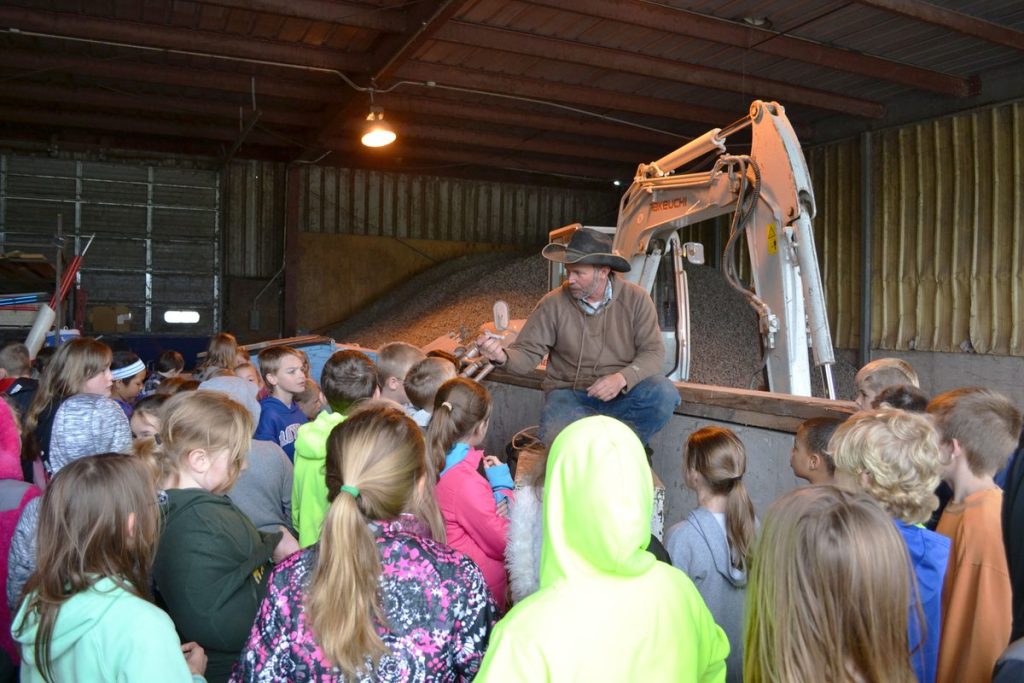
Recycling supervisor Chris Redden explains to elementary students the process of grinding waste paper into dense pellets that are then burned as an energy source to heat and cool campus buildings at Northwest Missouri State University.
Less than a week after Earth Day, elementary students from Eugene Field and Jefferson C-123 schools spent a morning learning about recycling at Northwest Missouri State University.
The field trip was organized by the Northwest Missouri Regional Council of Governments, a regional planning commission that consists of Atchison, Gentry, Holt, Nodaway, and Worth counties.
The students began the day with a program at Northwest’s performing arts center put on by Eco-Troubadour Stan Slaughter, who uses music to teach students about environmental challenges and how to “go green.”
Slaughter is a Kansas City-based artist and educator who helped create Kansas City’s first Earth Day celebration.
Following the performance, students went on a walk to view and learn about a few of Northwest’s 130 different species of trees.
Northwest was named the official Missouri Arboretum by the Missouri Legislature in 1993 and is home to more than 1,700 trees.
Eugene Field third grade teacher Jennifer Swink said the tree walk fit in well with a recent unit on plants and ecosystems.
The tree walk ended at the Northwest pellet plant and recycling center where the students got a first hand look at what happens to recyclables after they leave a home.
Recycling supervisor Chris Redden, who has worked at the center for 10 years, explained the process of how waste paper is ground into a fine fluff and turned into compact pellets, which are then burned as an energy source to heat and cool campus buildings.
Waste paper is collected from businesses, the hospital, schools, and the community drop-off. The center also collects plastics, glass, aluminum, and wood to be recycled.
Redden demonstrated the process of sorting the plastic on a conveyor belt before it is baled, sold, and shipped to Omaha, Nebraska. Each bale of plastic weighs between 300 and 500 pounds.
Redden added that although the process at the center is considered the first stage of recycling, as the bales are sent elsewhere to be melted and reused, he considers the consumer to be the true first stage of the process.
“The first stage needs to be you,” he told the students.
Redden also pointed out a dumpster full of non-recyclable material, all of which had accumulated before noon: “If you’re going to recycle, make sure it’s recyclable.”