Storm warning: County braces for tornado season
Anthony Brown
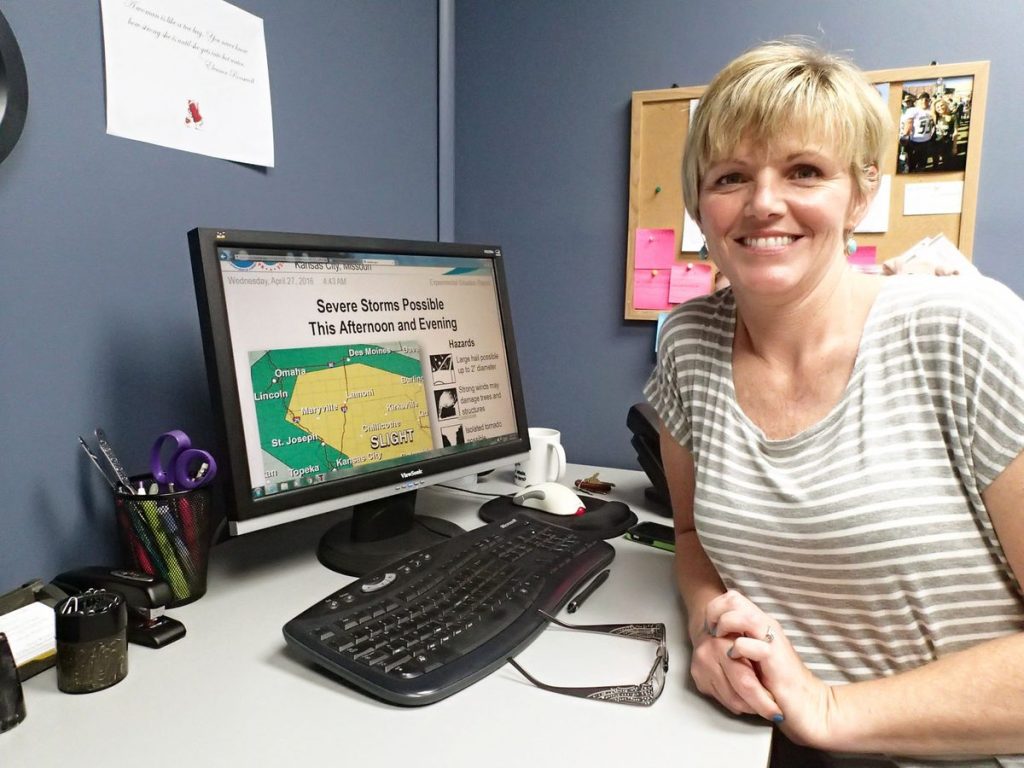
Nodaway County Emergency Management Director Christy Forney says preparing disaster plans and assembling emergency shelter kits are two basic ways families can get ready for the spring severe-weather season. She adds that signing up for text-message services like TextCaster is an excellent way to stay abreast of warnings and alerts issued by both the National Weather Service and local authorities.
No doubt about it, the spring severe-weather and tornado season has arrived.
Except for some heavy rainfall and lightning, Nodaway County mostly dodged the bullet as powerful storms ripped through the Great Plains and parts of the Midwest on Tuesday and Wednesday. But there’s no guarantee that Mother Nature will overlook the Maryville region during her next big blast.
According to the Associated Press, this week’s series of storm cells produced hail as big as grapefruit in northern Kansas, while winds approaching hurricane force — 74 mph — raked communities from Nebraska to Missouri to Texas.
Uprooted trees, downed power lines, and roof damage were reported in parts of Texas and Oklahoma.
Locally, the National Weather Service was calling for more rain beginning on Friday and continuing through the weekend.
But since the likelihood of April and May showers in northwest Missouri — along with the possibility of severe weather and tornadoes — should come as no surprise to anyone, it only makes sense to be prepared.
Christy Forney, the county’s emergency management director, said Wednesday that families and individuals can take a number of steps to make sure they stay safe on those ominous days when the air grows heavy and still and thunderheads darken the sky.
The first and most basic action, she said — whether for families, schools, or businesses — is to put together a plan so that everyone knows what to do and where to go when catastrophic weather threatens.
Forney said the plan doesn’t need to be complex or lengthy, but that at a minimum everyone should understand when and how to take shelter and where to meet after the event is over.
Assembling an emergency kit is a good idea as well. Such kits should include bottled water, a battery-powered or hand-cranked radio, flashlights, spare batteries, a first-aid kit, and non-perishable food.
Other kit items that some folks might not think about include copies of insurance policies, ID documents, and bank account records, along with some cash — both bills and change — stashed in a portable, waterproof container.
While being prepared for a storm is essential, it may be even more important to know that severe weather is on the way, and Forney said the advent of digital communication and social media — both Maryville Public Safety and the Nodaway County Sheriff’s Office have Facebook sites — have made accessing warnings and advisories faster and easier than ever.
One commonsense precaution is signing up for TextCaster, a free local text-messaging service provided by NorthwestCell and available through the City of Maryville’s website at www.maryville.org by clicking on the E-Notification button.
Forney said TextCaster is a good resource because it allows users to receive National Weather Service alerts at the same time as police, firefighters, dispatchers, and other emergency personnel. She said the system is especially effective for younger people, many of whom are glued to their smartphones but rarely listen to radio or watch television.
For older folks on the 20th century end of the digital divide, Forney said traditional media still does a good job of issuing weather warnings, but that it’s important to stay close to the radio or TV while keeping a “weather eye” out for deteriorating conditions.
She added that, when it comes to warnings, one misconception may be the function of storm sirens, which in Nodaway County are activated whenever a tornado or other dangerous storm poses an immediate threat.
Such sirens, Forney said, are intended primarily to warn people who are outside that they should take cover immediately. Those already inside who wait for the sirens to go off before heading for the basement may never hear them, she said.
In Maryville and surrounding communities, Forney said, storm sirens are activated whenever a “confirmed funnel cloud” is spotted by law enforcement or any of a number of trained storm spotters, a group that includes both city firefighters and volunteer members of rural fire protection districts.
Sirens may also sound if tornado activity in the immediate area is indicated by Doppler radar.
Forney said the decision to sound sirens usually falls to her, Maryville Public Safety Director Keith Wood, or Sheriff Darren White, but that other emergency personnel, including dispatchers, have the authority to make the call if no one else is available.
It is not, however, a step taken lightly, since one of the big problems people like Forney have encountered in the digital age is the “cry wolf” syndrome.
While better technology has led to more accurate forecasting, it has also increased the number of storm warnings issued. When, as inevitably happens, a destructive storm fails to materialize, people begin to take the warnings for granted.
A “cry wolf” response on the part of some Joplin residents is thought to have boosted the death and injury toll during a massive 2011 tornado that claimed about 160 lives and injured more than 1,100 people.
Maryville and Nodaway County authorities try to be consistent in issuing storm warnings, said Forney, nevertheless admitting that “no matter what we do, someone is unhappy.”
But inflicting a little inconvenience, she said, is a small price to pay for keeping as many people as possible out of harm’s way.
“When you hear them (the sirens),” she said, “we mean business.”
For more information about putting together a family disaster plan and otherwise preparing for severe weather, go to www.ready.gov.