Demographic requirements pause restaurant development
JIM FALL/DAILY FORUM
Attracting additional restaurant choices to Maryville is one of the city’s goals for economic growth according to former Mayor and now city council member Renee Riedel, who also co-owns Carson’s Sports Grill on the west side of the downtown square.
In public presentations earlier this year, former Maryville Mayor, now city council member Renee Riedel said bringing more restaurants to the area is one of the city’s goals for economic growth.
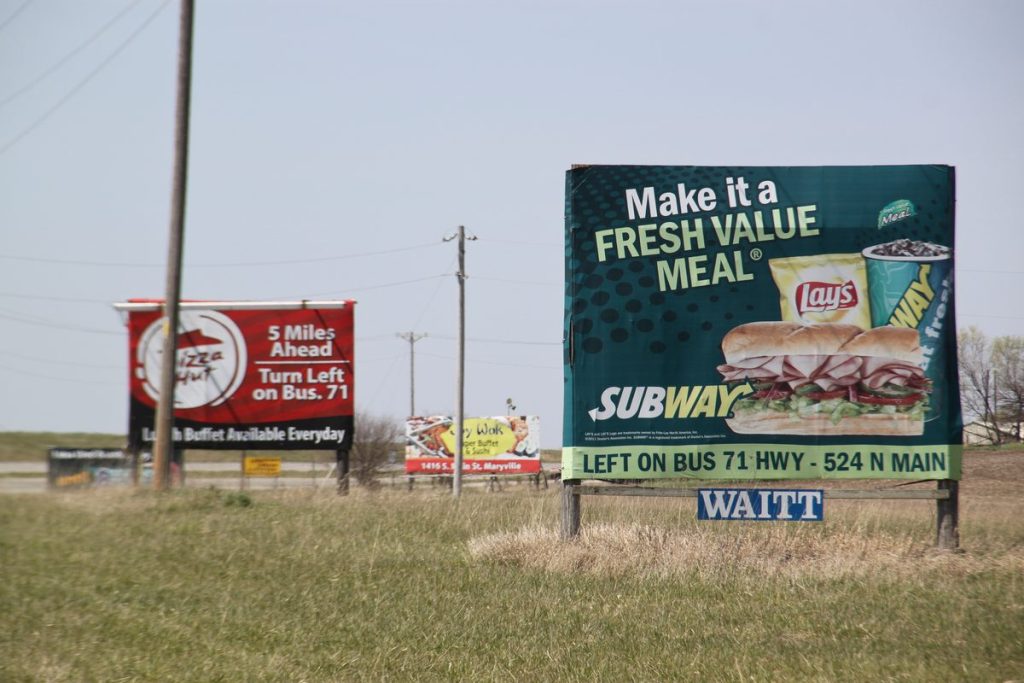
In recent years, Maid-Rite and My Favorite Muffin started businesses in Maryville and left, but others such as Jimmy John’s have built a broad enough local customer base to stick around. Pizza Ranch recently opened, and Huddle House and El Maguey have announced joining the list of restaurant offerings in town.
Riedel, who co-owns Carson’s Sports Grill, said that there are definitely opportunities for even more franchises and small, family-owned restaurants to build their business in town.
“On game days, sometimes people are waiting for an hour outside Carson’s to be seated, and then they’re waiting for an hour to receive their food,” Riedel said.
This problem isn’t due to service but to being filled to capacity.
Bringing restaurants to town, however, requires just the right conditions. Franchises, in particular, usually require much more than an opportune spot.
“In general, we start by looking for economically vibrant communities of the right size that are receptive to growing with new businesses,” said Greg Vojnovic, who is the Chief Development Officer for Arby’s.
Vojnovic’s statement doesn’t specify what “the right size” actually means. He said once the company identifies these areas, Arby’s wants a 20- to 40-year real estate investment commitment.
Before planting a franchise in a location, companies consider a number of factors.
“We look at the attributes and profiles of our most successful restaurants and try to identify trade areas with similar characteristics,” said Vojnovic.
According to Nodaway County Economic Development Director Josh McKim, Maryville frequently falls on the outer edges of demographic requirements for Arby’s and Wendy’s. Those aren’t the only businesses the NCED is working with, but they are the most well-known names.
“We meet them just barely, and that hampers [the process] some,” said McKim.
Fast food chains collect and consider data regarding population, median income and education levels, and number of households.
McKim said franchises aren’t turning down Maryville, but they’re waiting to make a commitment.
“It’s not a ‘no.’ It’s a ‘not yet,’” said McKim. “That’s what we’re facing with a lot of chains.”
Maryville’s economic development teams do their homework, too. Using gap analysis, economic developers compare market capacity with market supply. If there is additional capacity within a retail segment that has a specific retail target, they look to fill that space.
McKim said they typically only pursue chains that they know Maryville can meet. Yet not all restaurants that locate in Maryville are the direct result of marketing efforts.
Site considerations also include whether or not a potential site has visibility from the roadway, traffic flow, and access from both directions.
“There aren’t a lot of commercial spots available,” said McKim. “And the ones that are tend to be farther south on South Main St.”
In a forum in March, Northwest Missouri State University students asked Riedel and City Council Member Rachael Martin about adding more restaurant choices within walking distance of the campus.
Northwest students have Einstein Brothers, Chick-Fil-A, and Zen Asian in the J.W. Jones Student Union, and Starbucks at the BD Owens Library. Business hours for these locations run irregularly, depending on the time of year.
Commercial zoning and a contract with Aramark, the university’s food service provider, keep restaurants from locating on or very close to campus. Reworking zoning is possible.
Without changing zoning, however, the area around the downtown square is probably the closest to Northwest that restaurants can get.
Although university students have expendable income, McKim said their median income isn’t always enticing enough to pull more franchises to the campus area. He said some smaller, locally-owned businesses might fare better on the courthouse square.