Geocaching provides entertainment, education
By JESSICA ALLEN Staff writer
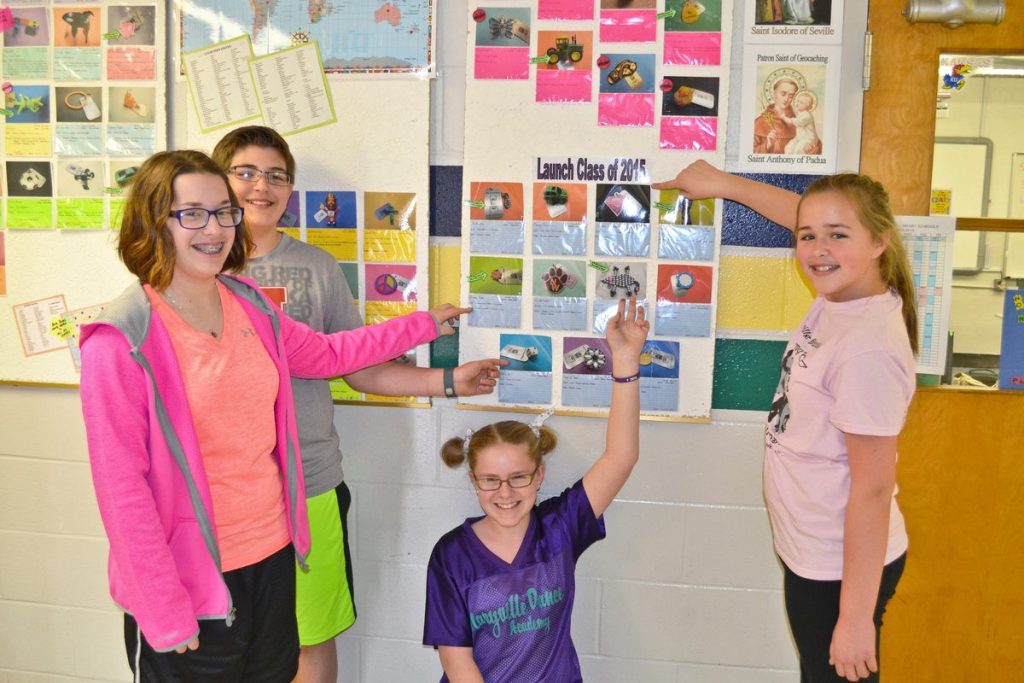
Sixth grade students in Cheryl Cornell’s technology class at St. Gregory’s School point to information cards for their Travel Bugs, small trinkets that are hidden in geocaches with the purpose of traveling to as many locations as possible. Pictured from left are Anna White, Carson Kempf, Maggie Graham, and Kirsten Bull.
In a town this size, it can be easy to complain about a lack of things to do.
Maybe we’re just not looking hard enough.
For those who feel the urge to get out of the house on one of those pleasant Missouri spring days, geocaching may just be the answer.
Geocaching is a real-world, outdoor scavenger hunt that, according to Geocaching.com, boasts 15 million participants worldwide.
Included in the millions of adventurers are Maryville residents Cheryl Cornell and Sandy Wood.
“My husband and I heard about (geocaching) when it was still very new in Washington state,” said Cornell. They have been geocaching for around 12 years, since the activity first began gaining popularity.
The caches are essentially containers—of varying shape, size, and appearance—that are hidden anywhere from in trees to under benches in both urban and rural areas.
They can be as small as a film canister or as large as a shoebox or bucket, and may be clearly visible or camouflaged to blend in with their surroundings.
Wood, who learned about geocaching from Cornell, said some caches can be especially difficult to find.
“One cache was a bolt on a piece of farm machinery,” Wood said. “That one took us three tries to find.”
“We also enjoy the challenges such as finding a geocache in every county in Missouri,” she added.
Adventurers of all ages can sign up for a free account on Geocaching.com and begin the hunt by typing in their location and choosing a cache from a list that includes the distance to the treasure, its size, the difficulty of finding its location, and the last time it was found.
The activity requires access to a handheld GPS or a GPS-capable computer or mobile device, as each cache is outfitted with a set of coordinates to help the hunter locate it.
Cornell said she and her husband originally bought their son a GPS for geocaching because of his love for the outdoors.
Now, however, advances in technology have made it even easier to participate.
“It has experienced a boom in the last four or five years because you used to have to have a GPS, but now you can just download an app on your smartphone,” Cornell said.
Most caches contain a logbook to record the names of everyone who finds it. Those that are large enough may also contain “knick-knacks” for trading.
After discovering a cache and signing the physical logbook, treasure seekers can also log their find online and leave messages of advice to other users.
Cornell, who is the technology instructor at St. Gregory’s School, has also implemented geocaching in her curriculum.
She said the activity helps students learn about latitude and longitude, geographic information systems, and how to interact appropriately in online communities.
Her students utilize a part of geocaching called Travel Bugs.
“They’re like dog tags with a tracking number that you can attach to a trinket like a Matchbox car or a Beanie Baby,” Cornell said. “You give it a mission, maybe something like visiting farms around the world, and you leave it in a cache.”
According to Geocaching.com, the Travel Bug then “becomes a hitchhiker that is carried from cache to cache” while its journey can be tracked online.
Cornell’s students create and send out their Travel Bugs in sixth grade and, as long as the Bug stays active, they track them until they leave St. Gregory’s after eighth grade.
Even after students move on to high school, Cornell continues to record the states and countries each Bug visits as long as it continues moving.
One Travel Bug, launched in October of 2007, has visited over 15 countries all throughout Europe and was moved as recently as March 30 of this year. Another Bug has made a stop in each of the 50 states in the U.S.
Cornell and her husband have logged over 1,200 finds in the last 12 years. She said they like to look for caches wherever they go and have even taken trips as far away as Texas for the purpose of geocaching.
By far their most distant find was in Budapest, Hungary, which they found while visiting their son.
But one does not have to travel out of state, or even out of town, to participate.
According to Geocaching.com, there are over 200 hidden treasures within 10 miles of Maryville itself.
“We have our own caches hidden around Maryville,” Wood said. “We especially like to hide ones where you can hike, or ones that have an interesting twist.”
She added that it is a fun group activity, as it helps to have more eyes helping with the search.
“It also makes us think and problem-solve,” she added.
For both Wood and Cornell, perhaps the greatest allure of geocaching is the chance to get outside and explore.
“We enjoy geocaching because it gets us out in the community and nature and takes us to places we never would have known about,” Wood said.