Sewer seal effort nears completion
By TONY BROWN Staff writer
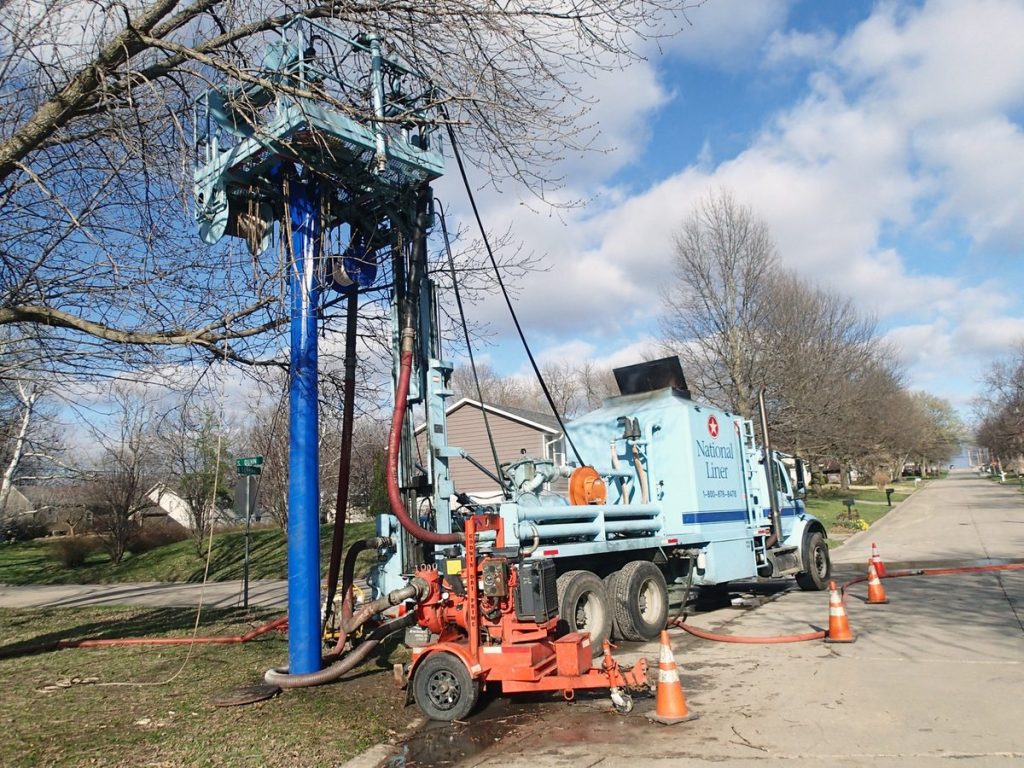
A Visu-Sewer truck forces super-heated water through a sewer line that has been coated with a felt-like material designed to prevent storm water inflow into aging clay pipe.
You haven’t seen any new buildings going up or streets repaved yet this spring, but one of the City of Maryville’s largest and most important capital projects of 2016 is nevertheless nearing completion — all of it underground.
For the past several weeks a company named Visu-Sewer, based out of Pewaukee, Wisconsin, has been rehabilitating about 22,000 linear feet of clay sanitary sewer pipe beneath the streets of Maryville in an effort designed to decrease the volume of storm water infiltration.
Plugging sewer leaks — something engineers refer to as inflow and infiltration — has become a major issue for the city since the completion of a new $13 million mechanical wastewater treatment plant.
Unlike the old lagoon system, mechanical treatment means that treating every gallon of sewage requires electricity. So keeping the volume of effluent to a minimum is essential.
But digging up thousands of yards of aging clay sewer mains would be prohibitively expensive, so for a number of years the city has used pipe-lining technology to plug the inevitable leaks.
It’s a fascinating process, but one that is a little difficult to visualize.
Imagine a sock pulled over your arm wrong side out. That’s the felt-like pipe-lining material. A blast of water is then used to unroll the “sock” down your arm — that is the sewer pipe — so that all the cracks and crevices are sealed.
After the pipe is lined, hot water or steam is forced through, which turns the felt into a solid, waterproof coating. Then a robotic saw, guided by a small camera, rolls through the pipe and cuts out the portals connecting the sewer main to individual houses.
It’s an expensive process, but not nearly as costly as digging up old sewer lines and replacing them.
Local residents may have noticed the Visu-Sewer trucks around town this spring. And homeowners along affected streets have been “tagged” with regard to sewer service interruptions lasting from two to three hours.
But, city officials say, any inconvenience is a price well worth reduced sewage treatment costs.
This year’s municipal budget allocates more than $570,000 for sewer main lining, which does not include a manhole-lining project embracing 139 manholes at a cost of $160,000 set for later this spring.