Divided council approves zoning request
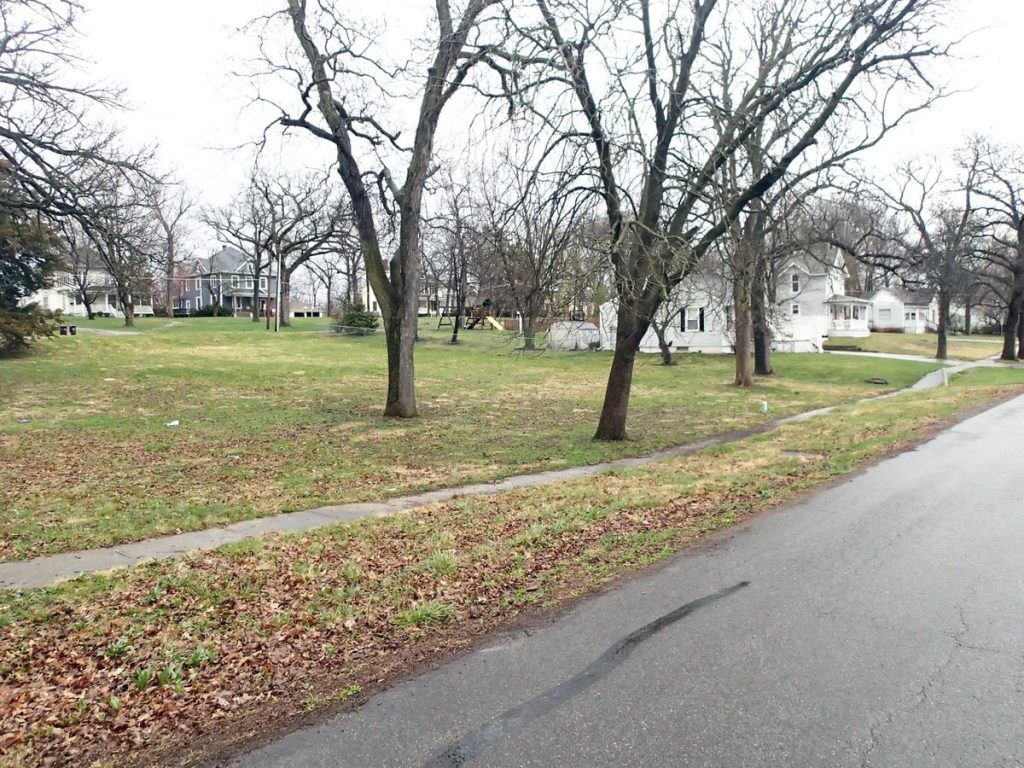
TONY BROWN/DAILY FORUM
A 132-foot by 132-foot vacant lot at 121 North Avenue was re-zoned by a divided Maryville City Council this week in favor of the landowner who wants to build a duplex there. The request was opposed by a number of area residents who fear the new R-2M zoning will infringe on the neighborhood’s single-family residential character.
A long-running residential zoning debate on the north end of town was settled this week in favor of the applicant when the Maryville City Council voted 3-2 to re-zone a vacant parcel of land at 121 North Avenue just east of North Main Street in order to allow for construction of a new duplex by local businessman Chris Burns.
The re-zoning from R-2 single family to R-2M, a low-density designation that allows duplexes but not apartment buildings, was opposed by a number of neighborhood residents, a half-dozen of whom spoke against the proposal at Monday’s City Council meeting.
Burns’ latest re-zoning request, the third since 2013, was approved earlier this month by the Planning and Zoning Commission, which acts as an advisory board to the council.
The first request was rejected by the council, and a second attempt earlier this year was denied by the commission, which cited a “technicality” having to do with mandatory mailed notifications to neighboring homeowners.
Gina Davis, who lives at 127 North Avenue, spoke in opposition to the re-zoning before the council this week, describing her neighborhood, which contains both owner-occupied and rental houses, as a primarily a single-family area “where kids can drive their bikes up and down the street.”
Davis argued that there was “no lack” of rental properties in Maryville, and that the lot in question was better suited to the construction of a single-family residence.
She urged the council to “keep the people in mind who have lived here all their lives, and who want this to be a nice city.”
Another neighbor, Jane McGary, who lives at 107 Lawn Avenue, said she objected to an “income-based” property being constructed in a part of town where most residences are owned by the people who live in them.
“A duplex is always rented,” McGary said. “It’s always an income property. It can never be somebody’s home.”
Other neighborhood residents said they feared the presence of a duplex would lower property values.
According to municipal records, Burns originally asked for the lot, which measures 132 feet square, to be zoned R-3, a multi-family designation that allows apartments.
Burns’ property adjoins rental housing to the west along North Main Street, which is zoned C-1, a category that allows for restricted commercial activity.
During the most recent Planning and Zoning discussion, city Code Enforcement Officer James Wiederholt said the R-2M classification complies with the “low density residential” designation called for in the city’s comprehensive plan and will act as a buffer between the single-family neighborhood to the east and the commercial zone to the west.
On Monday, City Manager Greg McDanel, without making a recommendation one way or the other, noted that the lot is big enough for construction of two small single-family homes and would probably be eligible for Revitalizing Maryville 2016, an incentive program that waives construction permit fees for developers who build single-family homes.
McDanel said construction of two duplexes on the site is unlikely due to off-street parking requirements.
Though the property in question is small in size, the debate divided a City Council that rarely casts a split vote.
Mayor Renee Riedel, who favored re-zoning, described the governing board as “a progressive council that promotes growth,” adding that, “This is an opportunity for growth.”
Councilman Jerry Riggs countered that Burns knew the property carried an R-2 zoning designation when he bought it and was now requesting that rules governing development in the neighborhood be changed.
“I’m not sure there’s anything progressive about that,” Riggs said.
Councilwoman Rachael Martin, who sided with the three-member majority for approval, said that Burns’ request had been approved by the Planning & Zoning Commission and came to the council bearing that panel’s recommendation.
“I feel like to rehash this every time is a waste of our time and theirs,” Martin said.
In accordance with procedure, the re-zoning ordinance was read once prior to the start of Monday’s discussion, with Martin making a motion for passage that was seconded by Councilman Tim Shipley.
Following citizen remarks and debate by the council, Riedel called the question and the measure passed with Shipley and Riggs voting no and Councilman Jason McDowell, Riedel, and Martin voting yes.