Speakers shine light on assault
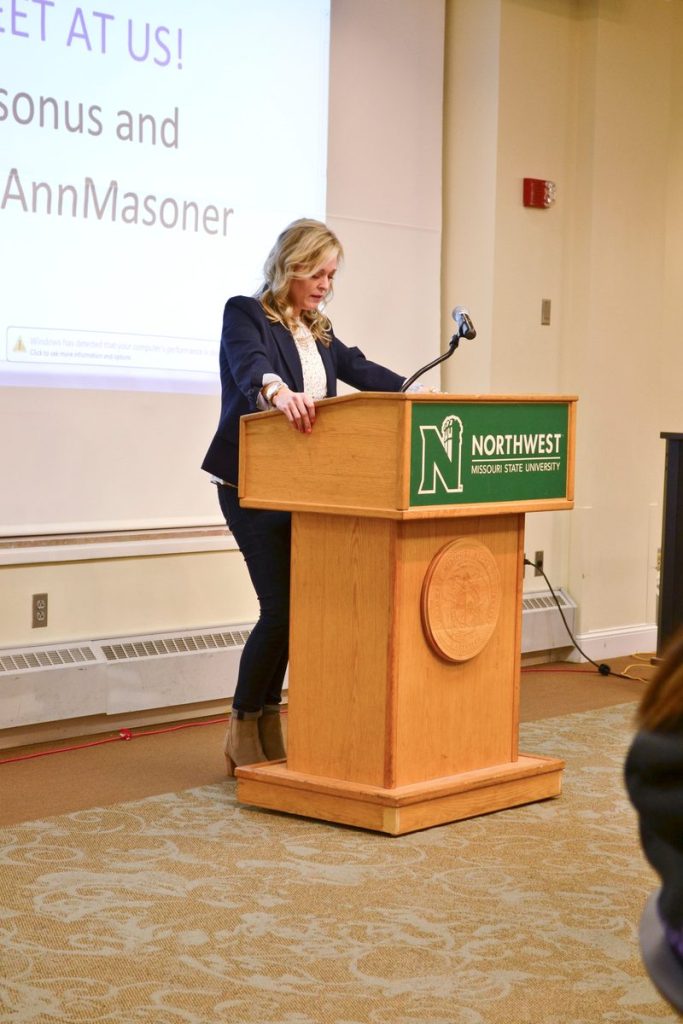
JESSICA ALLEN/DAILY FORUM
Kerry Ann Masoner, a 1998 Northwest Missouri State University Graduate and Tri Sigma Sorority alum, speaks about her friendship with the late Karen Hawkins and about how college students today can help put an end to sexual assaults on and around campus.
“It is a brutal and emotionally charged story.”
These words, spoken by Kerry Ann Masoner at the beginning of her speech Thursday evening, ring true in many cases of sexual assault.
Masoner, a 1998 Northwest Missouri State University graduate and Tri Sigma Sorority alum, visited Northwest’s campus as part of Tri Sigma’s “Silence the Violence” Karen Hawkins Memorial Week.
“I’m happy to see that after 21 years, you still choose to make a difference in her name,” said Masoner to the large group of students that gathered in the J. W. Jones Student Union Ballroom.
Masoner and Randy Strong, former detective for Maryville Public Safety, were the featured speakers for this year’s Memorial Week, which was created to encourage students to take a stand against sexual assault.
Karen Hawkins, a Maryville native, Northwest student, and Tri Sigma member, was sexually assaulted and murdered in Maryville in April 1995.
The tragedy deeply affected many on campus, including Masoner, who was her “little sister” within the Tri Sigma sorority.
But Hawkins’ death also opened the door for discussion about a topic that Masoner believes has been shrouded in shame and secret for far too long.
“Karen’s untimely death brought about a conversation I had never anticipated,” said Masoner.
She and several other women gathered to talk shortly after it was confirmed that Hawkins had been killed.
Masoner decided it was time to disclose her own story of sexual assault. She was shocked and angry to discover that two other women in the room had been victimized as well.
“I didn’t speak about my experience because I thought really strong women got through things, they moved forward, they didn’t dwell on the past,” said Masoner.
But she found that the assault dramatically changed her self-image.
“I lost every part of me,” she said. “My vision of myself shattered into a million little pieces. It caused me years of unmentionable pain.”
Masoner and other Tri Sigma members began the Karen Hawkins Memorial Walk as a way to speak out against sexual assault.
“We wanted to openly demand that the sexual assault of women at Northwest end,” said Masoner. “Everyone came with the message that we will not stand for this. We will not enable, cover up, or engage in any action that degrades women’s precious bodies.”
A survey conducted in 2015 by the Association of American Universities estimated that around 23 percent of female undergraduate students have experienced some form of unwanted sexual contact.
However, only between five and 28 percent of these incidents were ever reported to officials, often because victims felt embarrassed or believed nothing would be done about the incidents.
“Sexual assault numbers only go down when there is direct and defined actions that protect women, and most importantly, when campus men start talking about what unwanted and unconsented advances mean and demand zero tolerance in their dorms and houses,” said Masoner.
She also encouraged students to take part in a new movement called “It’s On Us,” which asks anyone, college student or not, to take a pledge to help end sexual assault.
Both Masoner and Strong, a detective who investigated Hawkins’ death, thanked Tri Sigma for continuing to remember and honor Hawkins’ memory, as well as bring awareness to sexual assault on campus.
On Tuesday evening, Strong presented details of the case that was his first homicide investigation as a detective.
He warned that in many instances, victims are assaulted by people they know, as was the case with Hawkins.
Strong, who admitted he still gets emotional when thinking about the case, encouraged his audience to take action if they encounter evidence of an assault.
“Find it in your heart to intervene, but don’t put yourself at risk,” said Strong. “If you ever know of any domestic violence or see something that’s just not quite right, give a phone call to the authorities.”
Masoner believes that college students have the power to help dissolve the stigma of shame that many victims feel and to create a safer environment for all students.
“I am hopeful that young and impressionable students will hear your message very clear coming to Northwest,” said Masoner. “’Not here, not on our watch’.”