Prescribed burning: It pays to have a plan
TONY BROWN/DAILY FORUM
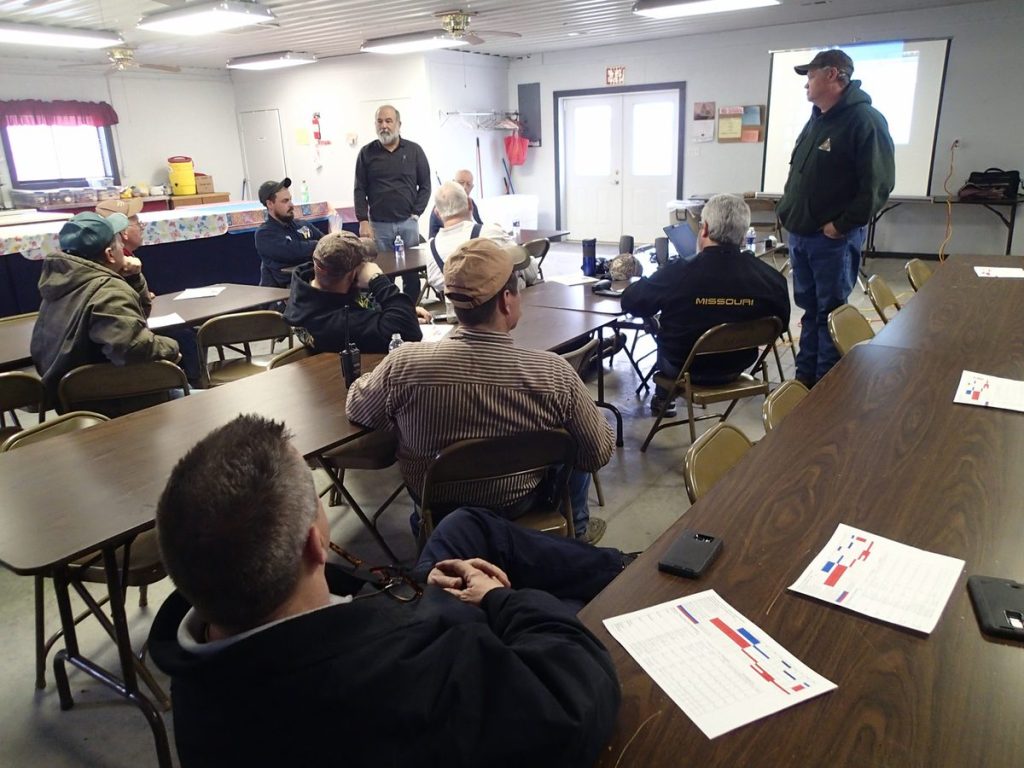
Bob Kelly, standing left, an agriculture business specialist with University of Missouri Extension, and Kendall Coleman, right, a private lands biologist with the Missouri Department of Conservation, address a group of landowners and Maryville firefighters last week in Grant City during a workshop on prescribed burns, which are often used by landowners to kill off invasive plant species while encouraging biological diversity and wildlife habitat.
For northwest Missouri landowners who own pasture, prairie, or brush-covered acreage, spring is often burning season.
And while burning off large tracts of land can produce significant advantages for wildlife and plant diversity, it can also be a dangerous and destructive business when done at the wrong time for the wrong reasons using the wrong methods and equipment.
In an effort to make sure landowners get it right, a couple of experts from the Missouri Department of Conservation and University of Missouri Extension presented a workshop last week in Grant City that covered the basics of when, where, and how to conduct a prescribed burn.
The presenters included Kendall Coleman, a veteran MDC private lands biologist and Bob Kelly, an Extension agriculture business specialist.
Those attending the two-hour presentation included Capt. Phil Rickabaugh, supervisor of the Maryville Public Safety fire division, MPS firefighter Shaun Wiederholt, Bryan Williams of the Maryville Department of Public Works, and volunteer Maryville firefighter Brad Sullivan.
Wildfires that start off as controlled burns are an annual problem for rural fire protection districts in Nodaway County, and Rickabaugh said one thing landowners can do to help is to let local fire departments know when and where they plan to burn.
Conducting a burn is not a one-person operation. It requires a team effort and a lot of preparation. A written plan and efforts to keep firefighters in the loop in case something goes wrong are essential, Rickabaugh said.
“You hit the nail on the head,” Rickabaugh told Coleman, who stressed the importance of getting the word out about a planned burn. “Just notify us.”
But letting firefighters — and your neighbors — know when and where a burn is going to happen is just one of the steps required to ensure that burn day goes off smoothly and safely.
Coleman said the most common mistake landowners make is failing to prepare, a process that includes everything from paying attention to the weather to procuring enough people and the right equipment.
If things are done right, he said, “usually a burn should be pretty boring.”
Perhaps the most essential pre-burn chore, Coleman said, is the preparation of adequate firebreaks.
There are several types of firebreaks, including such natural barriers as creeks and streams, but by far the safest and most effective is a bare strip of soil created with a disk or plow.
Other firebreak techniques include closely mowed strips of vegetation that keep the fuel load to a minimum and “wetlines,” which are created by moistening vegetation with high-volume water sprayers.
A fourth method employs backpack blowers and rakes to remove litter and expose soil. Such firebreaks are usually created in wooded areas or across short distances where larger breaks are impractical.
If the burn area contains woody plants, such as cedar trees, close to the firebreak, the best option is to cut the plants down and drag them to the middle of the area or remove them entirely.
Aside from prepping the burn area, landowners must also complete a written burn plan. Such plans are required for burns on acreage enrolled in the U.S. Farm Service Agency’s Conservation Reserve Program, or CRP, and are usually prepared with the assistance of a professional.
Coleman is designated by MDC to write such plans for landowners in Harrison, Gentry, and Worth counties. His colleague, private lands biologist Jim Pierson handles the chore in Nodaway, Atchison, and Holt counties.
Plans include a map of the burn site as well as a description of the area’s vegetative cover and fuel load, burn objectives and timing, acceptable weather conditions, equipment and personnel needs, possible hazards, and procedures to report and suppress the fire if it gets out of control.
One essential piece of suppression gear, Coleman said, is a 100- to 300-gallon water supply, often a tank hauled by a four-wheeler or other all-terrain vehicle and equipped with a pump and sprayer
While the plan is essential, Coleman said, so is some basic knowledge about how fire behaves and how it can be controlled. The key variable, he added is weather.
Windy days and periods of low humidity are not good times to burn, he said, explaining that optimal conditions include winds of between 5 and 15 mph and humidity between 30 and 50 percent. That means, in this part of the country, most burns should happen in the morning or early afternoon.
Landowners also need to beware of dense cloud cover and other climatic conditions that can inhibit smoke dispersal as well as winds that can blow thick smoke across roads and highways. Crewmembers, and even law enforcement, should be dispatched to stop traffic in the event motorist visibility is obscured.
In addition, fire crews must be properly dressed in long pants, long-sleeved shirts, and hats made of 100 percent cotton or other natural fibers. Synthetic fabrics, such as nylon, melt when exposed to flame and can cause severe burns. Leather gloves are also essential, but should not be oil-tanned.
Hard hats are recommended, especially in wooded areas, and the best clothing of all is made of Nomex, the flame-resistant fabric used for firefighter turnout gear.
Finally, landowners seeking to conduct prescribed burns should expect the unexpected. Fire can behave in strange ways.
Burning near high-line power poles, for example, can create deadly arcs of electricity transmitted from the cables to the ground via conductive carbon molecules in smoke.
“That’s rare,” Coleman said, “but it can happen. People have died that way.”