Teacher shortage affecting area schools
FILE PHOTO
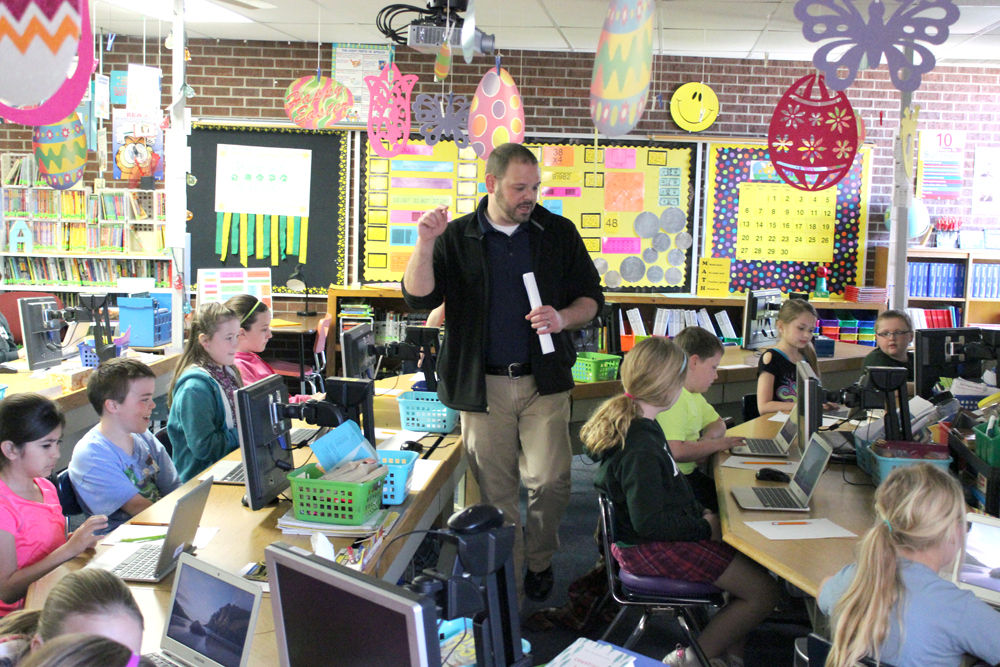
Joe Alley instructs Eugene Field Elementary School students about how to use their Chromebooks. Small schools in rural areas of the United States often struggle to find enough teachers to fill vacancies. Maryville R-II District is the biggest in Nodaway County, but according to Superintendent Becky Albrecht, there have been some positions for which she’s received very few or no applications.
With enrollment in teacher preparation programs declining over the past few years, it’s becoming harder to fill teaching positions in rural areas.
Superintendent of South Nodaway R-IV District Johnnie Silkett said the district hasn’t faced shortage problems yet, but that doesn’t mean he hasn’t been thinking about it.
“It’s one of my biggest concerns,” Silkett said. “If some of our teachers leave or retire, I don’t think we can find somebody to replace them.”
James Simmelink, who is the superintendent of North Nodaway R-VI, said the district struggles to find replacements.
“Typically we’ve only had a couple applications each year and sometimes we have to go searching for applicants,” said Simmelink.
Simmelink, Maryville R-II District Superintendent Becky Albrecht and West Nodaway R-I District Superintendent Shannon Nolte said it is especially hard to fill positions in specialized areas such as upper-level math and science.
Superintendent Karma Coleman said that the Nodaway-Holt R-VII District initially began seeing shortages in math and science teachers, but it has become an issue in other departments such as language arts and foreign languages.
Coleman said Nodaway-Holt is also facing a turnover of almost the entire staff due to retirement.
“It’s not an option not to fill positions,” said Coleman. “But that sometimes means that our teachers are not always totally certified in every area.”
According to the U.S. Department of Education, teacher shortages are a nationwide problem. New York, Texas and California have seen significant dips in enrollment in teacher-prep programs for the last five years.
According to Silkett and Jefferson C-123 District Superintendent Tim Jermain, one possible reason for the shortage in Missouri could be the state’s revised certification standards that are supposed to better prepare teachers for the classroom.
Candidates in Missouri education programs must complete and pass the Missouri General Education Assessment. The MoGEA includes four subtests in reading comprehension and interpretation, mathematics, science and social studies, and writing. All of these tests cost money beyond college tuition.
“It’s a really rigorous path,” Albrecht said. “It’s amazing the hoops they have to jump through.”
The changes, Silkett said, were made in order to strengthen the workforce, but he’s worried it might have unintended consequences.
“We might be getting teachers who can test well but not know how to relate to kids,” Silkett said.
“Teaching is part art, part science,” Jermain said. “And you’re not going to know how well someone is going to do until they’re in the classroom.”
Northwest Missouri State University’s teacher placement days used to bring job candidates to the schools in the area, but according to Jermain, participation is not what it used to be.
Most of the superintendents supposed that top graduates are choosing careers with higher starting salaries.
“Prospective teaching candidates are pursuing other degrees because the respect and pay is not as great in teaching,” Coleman.
Simmelink has a few theories about additional factors that may play a part in the struggle to attract teachers to rural areas.
For one, many young teaching graduates simply do not want to live so far from a larger city because of the lack of commercial and entertainment options.
“They’re looking for jobs in Kansas City, St. Louis, or Colombia,” said Simmelink. “They don’t always look in our neck of the woods.”
In addition, smaller school districts may not be able to offer a competitive salary, although Nolte, Albrecht, and Coleman said their districts do their best to offer insurance benefits that are comparable to larger schools.
“In a smaller population area it’s harder to generate funding, even versus areas like Maryville and St. Joseph,” said Nolte. “There is a smaller tax base and less revenue, and I think that affects the number of applications.”
Even with a lower salary, some teachers are asked to carry a greater load. While larger schools usually have multiple teachers in each department, many rural schools have one teacher covering a greater variety of classes.
“Teachers in bigger areas have fewer irons in the fire as far as teaching load,” said Simmelink. “There is more of a responsibility that comes with teaching at a small school.”
If getting teachers into rural areas weren’t difficult enough, administrators also handle the task of getting them to stay.
Jermain said he’s lost teachers to the Kansas City area. If they’d had the choice, he said, they would have remained at Jefferson, but they needed higher salaries to meet the needs of their household.
Despite some of the struggles of small, rural schools, Jermain said there are advantages that people don’t always consider. For example, he said, teachers get more one-on-one time with students because of smaller class sizes, which allows them to identify student needs and be more effective educators.
“Hopefully, Jefferson sells itself once they get here,” Jermain said. “I think small schools like Jefferson are a great place to be.”
Nolte agrees that intangible perks such as a positive workplace atmosphere can entice teachers to choose — and stay with — smaller schools.
“We can control the culture and climate of our school,” said Nolte. “Some teachers are willing to give up a higher salary for a good environment.”
The lower cost of living is another factor that may encourage teachers to choose a small town over a larger city.
Coleman said Nodaway-Holt has been combating the shortage of teachers by offering online classes to help meet students’ needs. In addition, administrators are considering the possibility of sharing teachers with other area schools in the future by way of Skype or other virtual classroom opportunities.
Silkett said South Nodaway isn’t there yet, but he said he wouldn’t be surprised if that will be in the near future.
Coleman also stressed the importance of professional development once a teacher has been hired.
“One key to having quality teachers and sustaining them is to train and coach them within the district,” said Coleman.
Jermain said adding prestige to the job through career ladder, which offers increased pay according to teachers’ years of service and education level, might also encourage candidates to choose a smaller district.