Student firefighters train to answer the call
TONY BROWN/DAILY FORUM
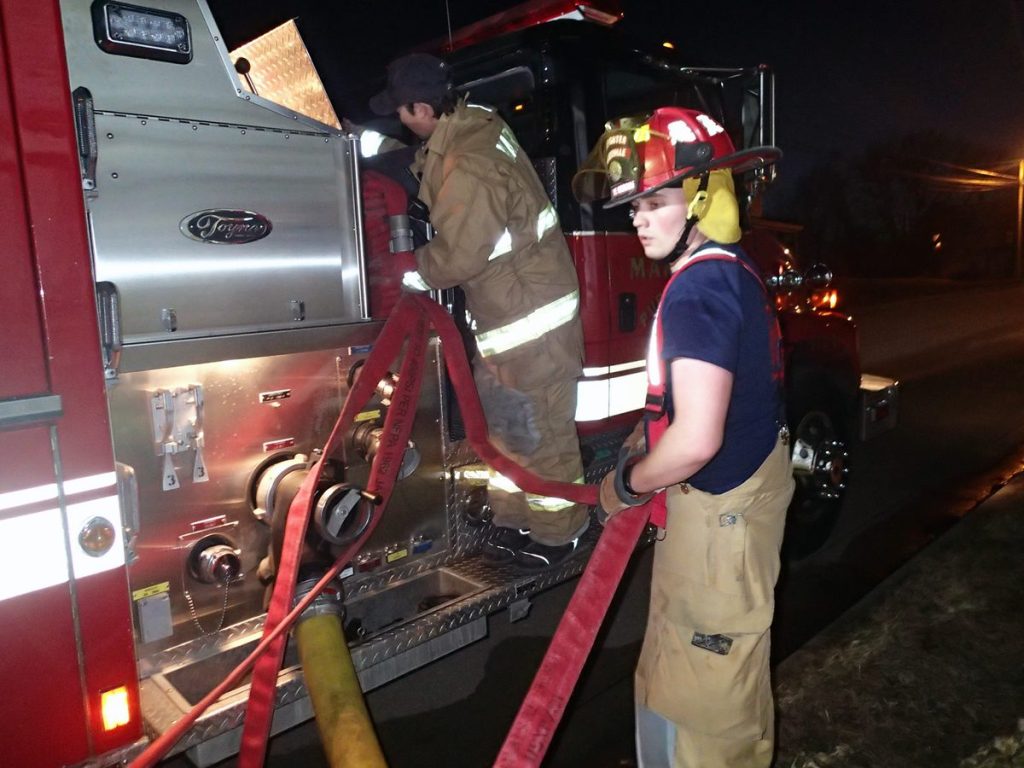
Student firefighter Brandon Thomas helps repack a hose during a structure fire simulation last week on East Thompson Street in Maryville. Thomas, who wants to be a trauma nurse on an ambulance crew, is one of several Northwest Missouri State University students enrolled in a recently established firefighting course.
Talk about fire drills. This one had everything except the flames.
Eleven students in Northwest Missouri State University’s newly created firefighting course rolled up to a vacant house on East Thompson Street on Thursday evening, then pulled on full turnout gear and got to work.
The course is offered as part of the university’s Emergency and Disaster Management degree program in cooperation with Maryville Public Safety’s fire division, which provides students with the equipment needed for hands-on training.
In return, MPS and Polk Township firefighters can take the course tuition free.
Instructor Angie Jones, a veteran Polk Township firefighter who teaches a similar class at the Hillyard Technical Center in St. Joseph, said the course, now in the second semester of its first year, attracted 11 students, six of whom were already MPS/Polk volunteers.
The remaining five students, all of whom have progressed far enough to receive firefighter certification through the Missouri Division of Fire Safety, have joined the local fire-protection cadre as well, meaning the course is serving as a recruiting mechanism as well as a training ground.
Using a condemned two-story house during last week’s session afforded students a chance to practice a variety of skills and techniques — everything from hose and ladder deployment to search and rescue.
After executing a “minuteman hose load” carry — in which firefighters drape a large section of hose across their shoulders then pay it out as they advance towards the fire — the students took turns ascending a ladder propped beside a second-story window and bringing the hose to bear.
It’s tricky stuff. While clinging to both ladder and hose, the firefighter must “lock in” by crooking his or her leg through the ladder treads then bracing against the force of a high-pressure stream of water.
Jones said a proper leg lock ensures that firefighters remain on the ladder even if they fall backward.
“Of course,” she adds, “That’s probably going to break your leg.”
As the exercise progressed, the students formed into small groups, each with a specialized task. Some served as pump operators while others made up the “interior attack team.” A third unit was held in reserve as the “rapid intervention team,” firefighters assigned to come to the rescue if one of their comrades is injured or trapped.
The climax of last week’s training session consisted of filling the house with simulated smoke as the students entered the structure in order to search for and “rescue” a life-size mannequin planted inside.
As she put the class through its paces, Jones kept up a steady stream of chatter, shouting out both instructions and encouragement.
“Twirl it around in there,” she told Erin Keith, a Northwest student from Maryville, as Keith tried to direct a jet of water through a small second-story window. “Be aggressive going into that window. Be aggressive moving (the hose nozzle) around.”
Keith had a little trouble at first, since the storm-window pane kept sliding down over her arms. She tried to raise the pane back up a couple of times but to no avail.
“Pull it off,” shouted Jones. “Rip it off of there,” which Keith did, using her heavily gloved hand to shatter the glass and tear the aluminum frame away from the wall.
While Jones directed the activity in and around the “burning” house, her fellow instructor, Kim Campbell, who works as a civilian firefighter and emergency medical technician at the Rosecrans Air National Guard Base in St. Joseph, supervised a drill in which students raced to roll and unroll fire hoses.
Campbell also explained the function of hose clamps and jackets, heavy steel devices used to shut down water flow in the event of a rupture or protect hoses from being crushed or bent.
A former student of Jones’ at Hillyard, Campbell has been a professional firefighter for two and a half years. And like a lot of people in what can be a very dangerous profession, she really likes her job.
“It’s not about the money,” she said, “and it’s not about glory. But I like the action and being able to help others.”
Campbell also finds satisfaction working as a trainer and watching students gradually master a complex battery of lifesaving skills.
“It’s like a light bulb,” she said of students’ reactions as they gradually come up to snuff, “And when it clicks there is that look of pure satisfaction that they give you.”
One of those students, Brandon Thomas, is typical of many of today’s young firefighters in that he is working to combine skills associated with several professions into a single portfolio.
A 2011 Savannah High School graduate, Thomas started college with the intention of becoming an emergency medical services trauma nurse assigned to an ambulance crew.
That’s still the plan, but he’s decided to add firefighting as a second skill set, both because he enjoys it, and because the two career fields are not unrelated.
Also, there’s just something about being a firefighter.
“I’ve been thinking about it ever since I saw ‘Backdraft,’” Thomas said, referring to the 1991 movie starring Kurt Russell about two brothers serving as firemen in Chicago. “I’ve wanted to be a firefighter ever since. I love doing this kind of stuff.
“It’s high intensity, high pace, and it’s also having a brotherhood in front of you and behind you at all times. It’s knowing you can rely on them, and they can rely on you.”
TONY BROWN/DAILY FORUM
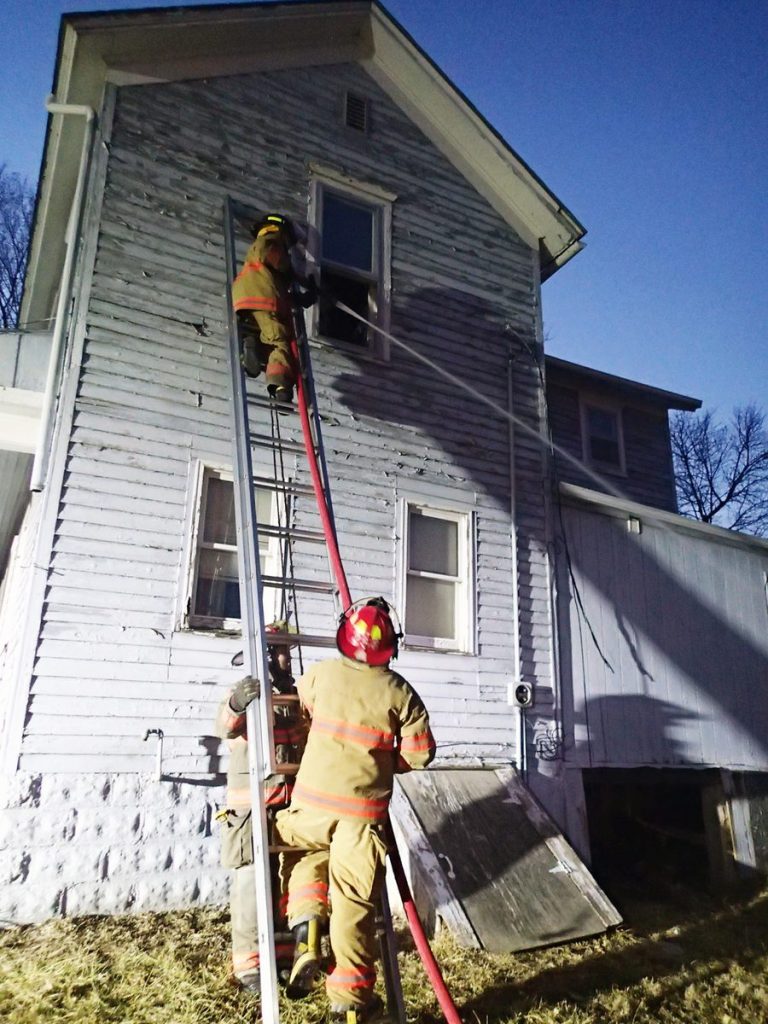
Northwest Missouri State University student Erin Keith tests her fire hose while standing atop a ladder during a firefighter training session last week in Maryville. Keith is enrolled in Northwest’s Emergency and Disaster Management program and recently earned her state firefighter certification.
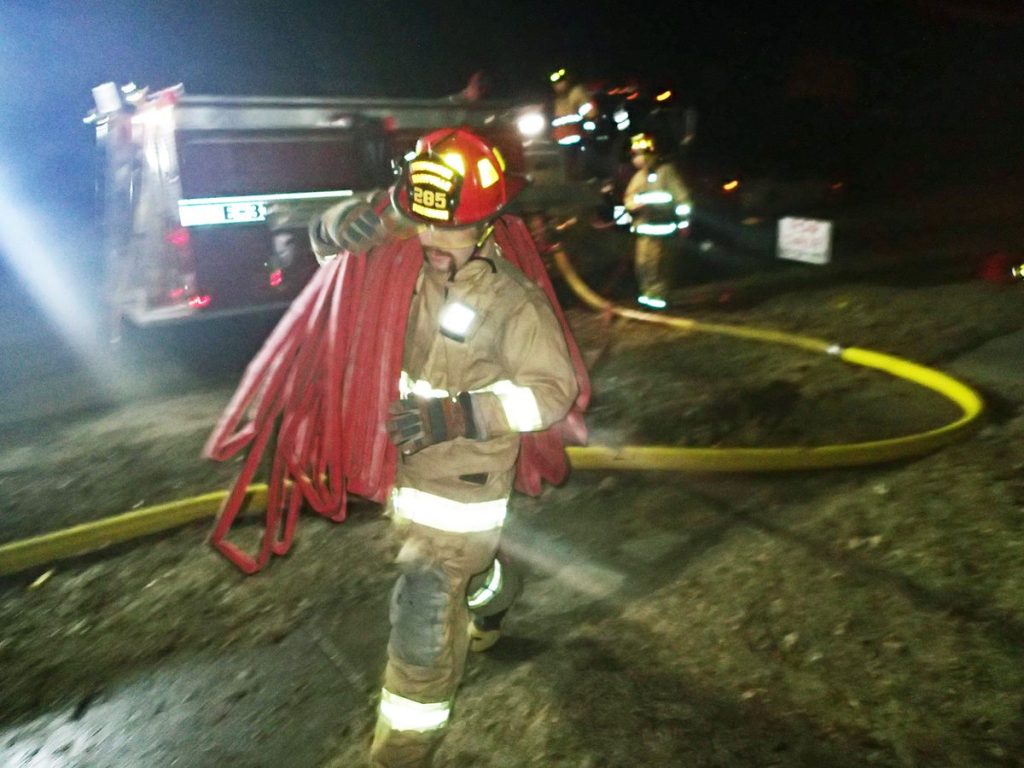
TONY BROWN/DAILY FORUM
Maryville firefighter Thomas Shiffett executes a “minuteman hose load” carry during a recent training session for students enrolled in Northwest Missouri State University’s firefighting course. Local firefighters are allowed to take the course tuition free because equipment used during training is loaned by Maryville Public Safety.
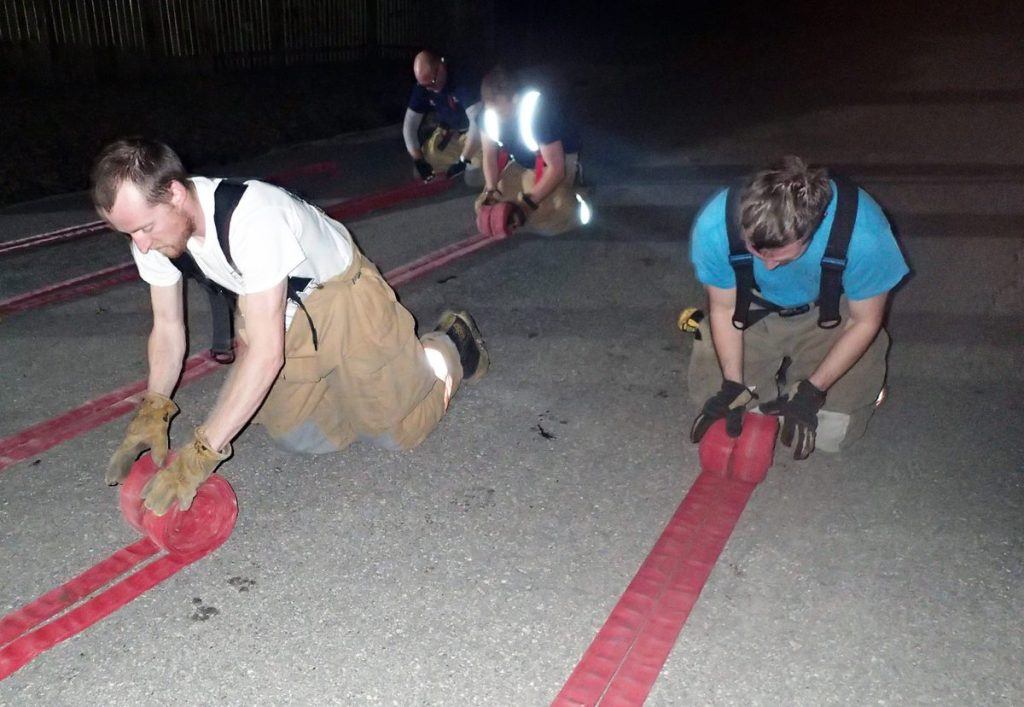
TONY BROWN/DAILY FORUM
Brady Willis, left, and Mike McVinua practice rolling hoses last week during a training session for students enrolled in a Northwest Missouri State University firefighting course. Both Willis and McVinua currently serve as volunteers with the Maryville Public Safety fire division.
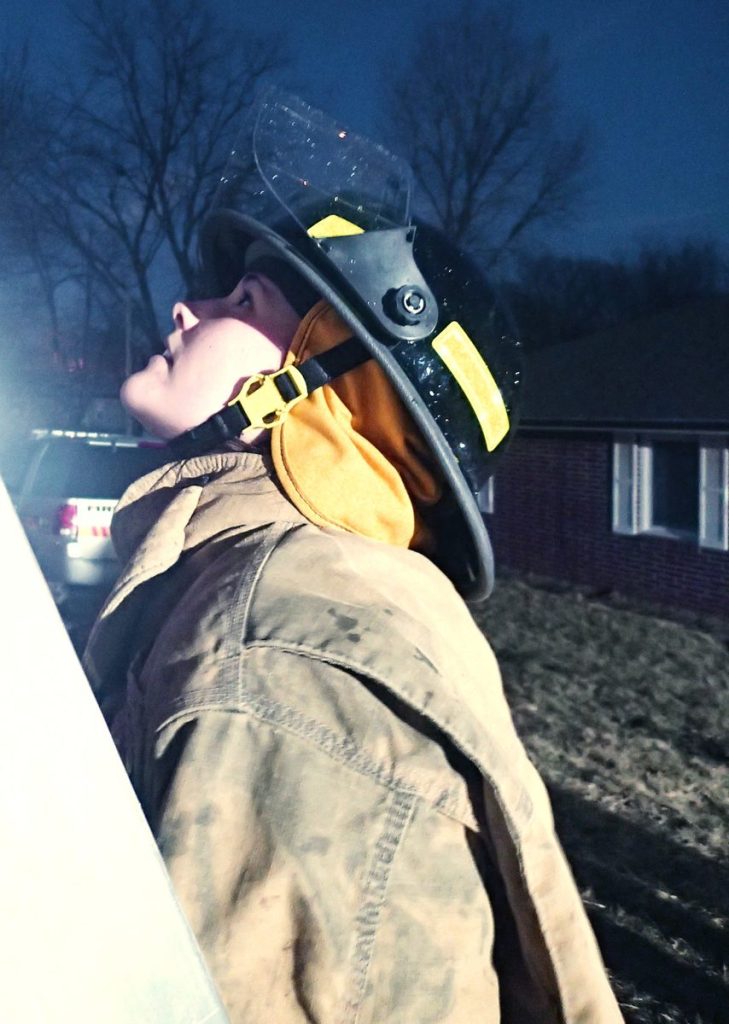
TONY BROWNDAILY FORUM
Erin Keith steadies a ladder for a firefighter comrade during last week’s structure fire simulation on East Thompson Street in Maryville.
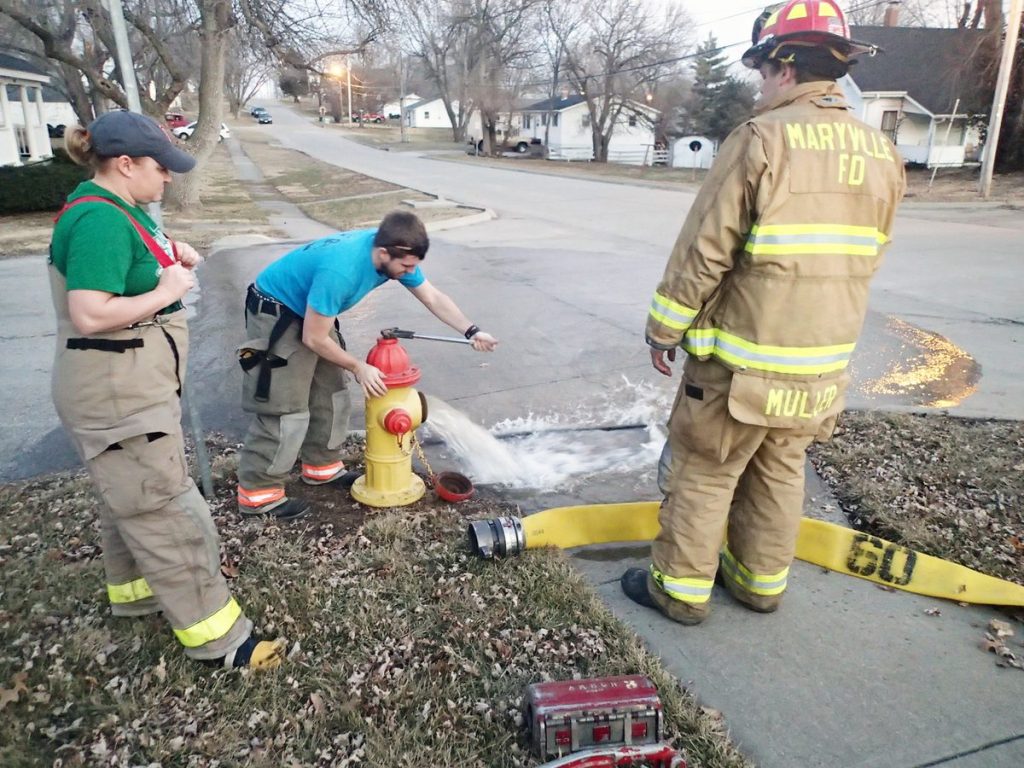
TONY BROWN/DAILY FORUM
As instructor Kim Campbell, left, looks on, firefighter Mike McVinua opens up a fire hydrant at the beginning of a structure fire simulation last week in Maryville. The session was part of a firefighting course offered for the first time this year by Northwest Missouri State University.
TONY BROWN/DAILY FORUM
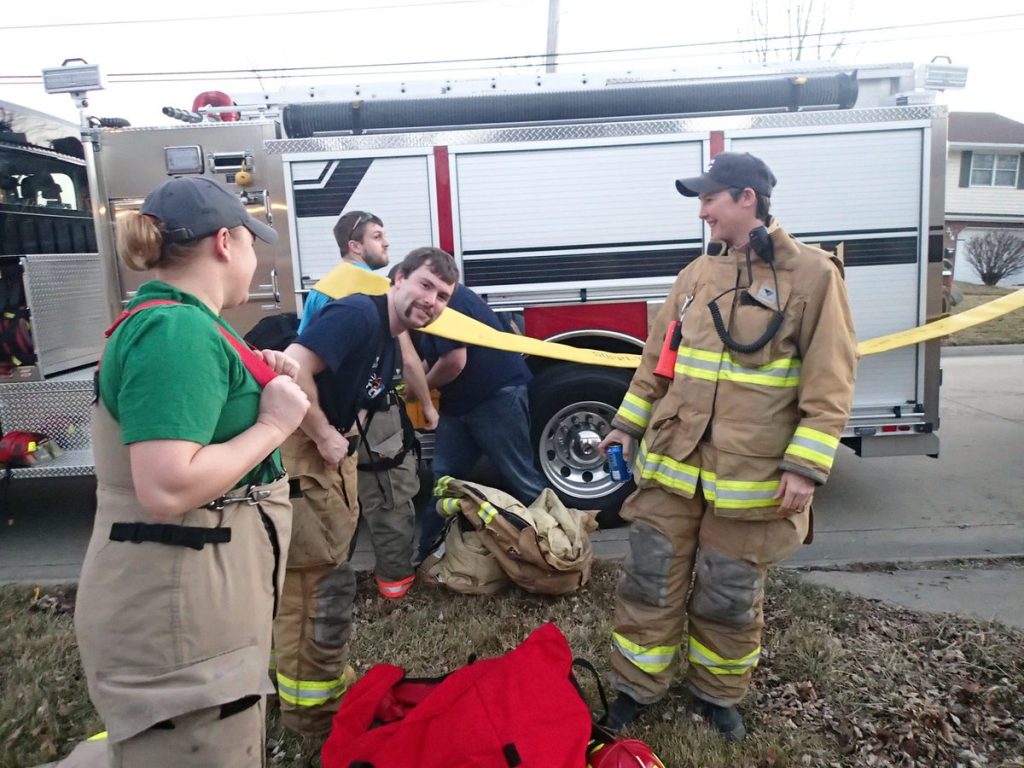
Instructor Angie Jones, right, looks on as a group of firefighters prepares to participate in a structure fire training session Thursday that included hose and ladder exercises along with a search and rescue drill. Jones teaches firefighting courses for both Hillyard Technical Center in St. Joseph and Northwest Missouri State University.