A lesson in leadership, Royals style
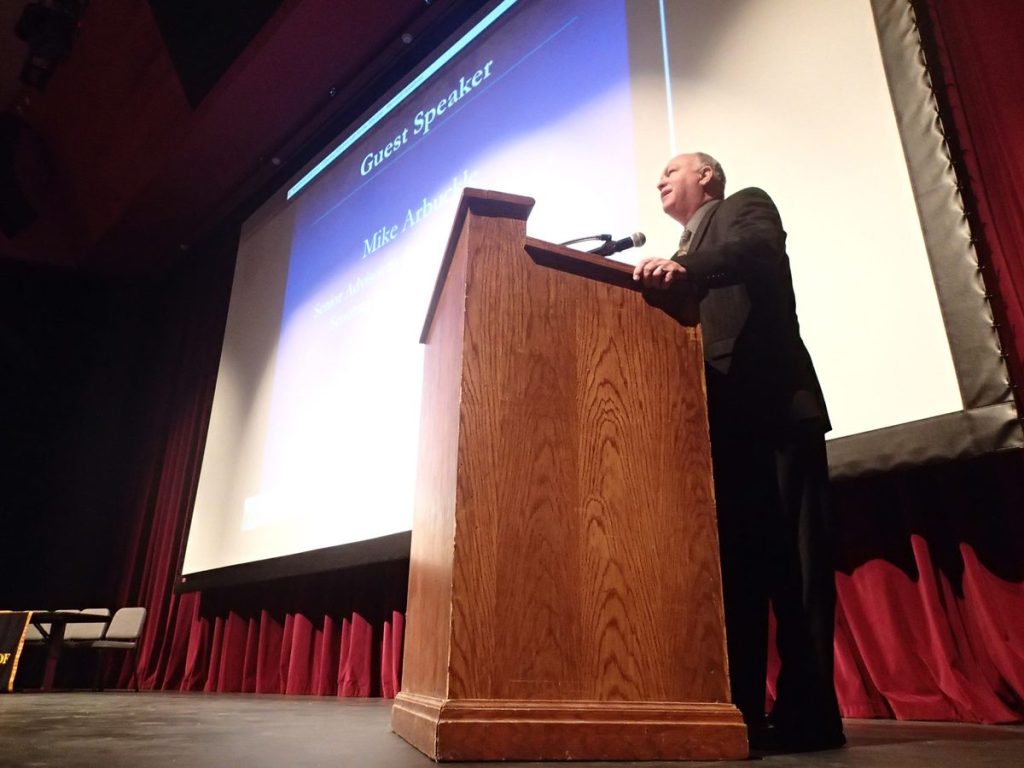
TONY BROWN/DAILY FORUM
Mike Arbuckle, senior advisor to the general manager/scouting and player development for the Kansas City Royals spoke Tuesday to more than 750 high school-age FBLA members at Northwest Missouri State University. Over the course of 36 years in professional baseball, Arbuckle said he has observed four basic traits held in common by effective leaders: earning the respect of others, setting a positive example, displaying an exceptional work ethic, and going “all in” when it comes to working toward success.
More than 750 high school students belonging to Future Business Leaders of America chapters across northwest Missouri received some solid advice this week from a proven winner about what it takes to succeed.
Mike Arbuckle, senior advisor to the general manager/scouting and player development for the World Series champion Kansas City Royals, delivered the keynote address during Tuesday’s FBLA District I Conference on the campus of Northwest Missouri State University.
Teens in attendance represented 38 FBLA chapters from all over the region. Following Arbuckle’s address, the young people spent the rest of the day at Northwest participating in business-themed workshops and competitions.
Arbuckle, who joined the Royals organization in 2008 after stints with the Philadelphia Phillies and Atlanta Braves, titled his speech “Good Leaders — A Key to Success on the Baseball Diamond and in Life.”
The native northwest Missourian is no stranger to Northwest, having earned a bachelor’s degree in education there in 1972.
A native of Trenton, 95 miles southeast of Maryville, Arbuckle also graduated from North Central Missouri College and holds a master’s degree in secondary education from the University of South Alabama. He was a 1969 draft selection by the St. Louis Cardinals.
During his front-office career, Arbuckle has led or participated in the scouting, signing, and development of 75 major leaguers, including 11 All-Stars, two National League Most Valuable Players, two National League playoff MVPs, two Rookies of the Year, three Gold Glove winners, and one World Series MVP.
In his remarks Tuesday, Arbuckle told the students that leaders are created in two ways, by “designation” — in effect by being given the job — and by “affirmation.”
Leaders who emerge by affirmation, he said, are able to “make other people want to follow them” by creating a culture in which all members of a team or organization willingly work toward improved performance.
Arbuckle broke down his theory of leadership into four basic traits, using members of the 2015 Royals roster as examples.
First baseman Eric Hosmer, he said, exemplifies the ability to earn respect on the playing field through his character and discipline.
Hosmer, Arbuckle said, comes to the ballpark with the same determined attitude every day, regardless of how the team is doing or how he himself is playing or feeling.
“It doesn’t matter if he went 0-for-4 yesterday or 4-for-4,” Arbuckle said. “He’s the same every day, and he produces.”
After earning respect, Arbuckle said, the second key to effective leadership is creating a good example. In this respect, he said, Royals catcher Salvador Perez has few peers.
“He’s the Energizer bunny,” Arbuckle said of Perez’s tenacity and endurance behind the plate, “and he won’t let anybody have a bad day.”
Arbuckle added that effective leaders like Perez “are energy givers, not energy takers” and motivate those around them to think positive as well.
Thirdly, he said, leaders must be willing to work as hard as they can in order to achieve success while inspiring others to offer their best as well.
On the Royals, Arbuckle said left fielder Alex Gordon is noted for constantly giving his all in terms of preparation and practice, whether by shagging endless flies or sharpening his skills in the batting cage.
“Alex might not say 100 words in a week,” Arbuckle said, “but his work ethic is absolutely off the chart. … It’s beyond reproach, and the players respect that.”
Finally, Arbuckle said, good leaders go “all in” in pursuing the goals of their organization.
In talking about this fourth quality, he recalled an early mentor with the Atlanta Braves organization who overcame partial paralysis caused by a stroke in his determination to recruit and develop the best players possible.
“I realized that it was simply impossible to outwork him,” said Arbuckle, adding that the takeaway in his own career was learning the importance of “showing people that you believe in what you’re doing.”
When Arbuckle first came to the Royals, he said, he soon realized the organization was suffering from a number of weaknesses.
Too many people, he said, were less interested in winning than in putting up numbers good enough to get them a spot with a stronger organization.
“We had leaders,” he said, “but they weren’t good leaders. There was too much ‘I, I, I and me, me, me.”
The climb back to the top of the baseball world after 30 years, Arbuckle said, required a change in culture in which players were encouraged to “maximize their abilities and achieve all they can achieve” in pursuit of a common goal — playing winning baseball.
“Hard work is fine,” he said, “but hard work with a purpose can be fun.”