
County acquires new election technology
TONY BROWN/DAILY FORUM
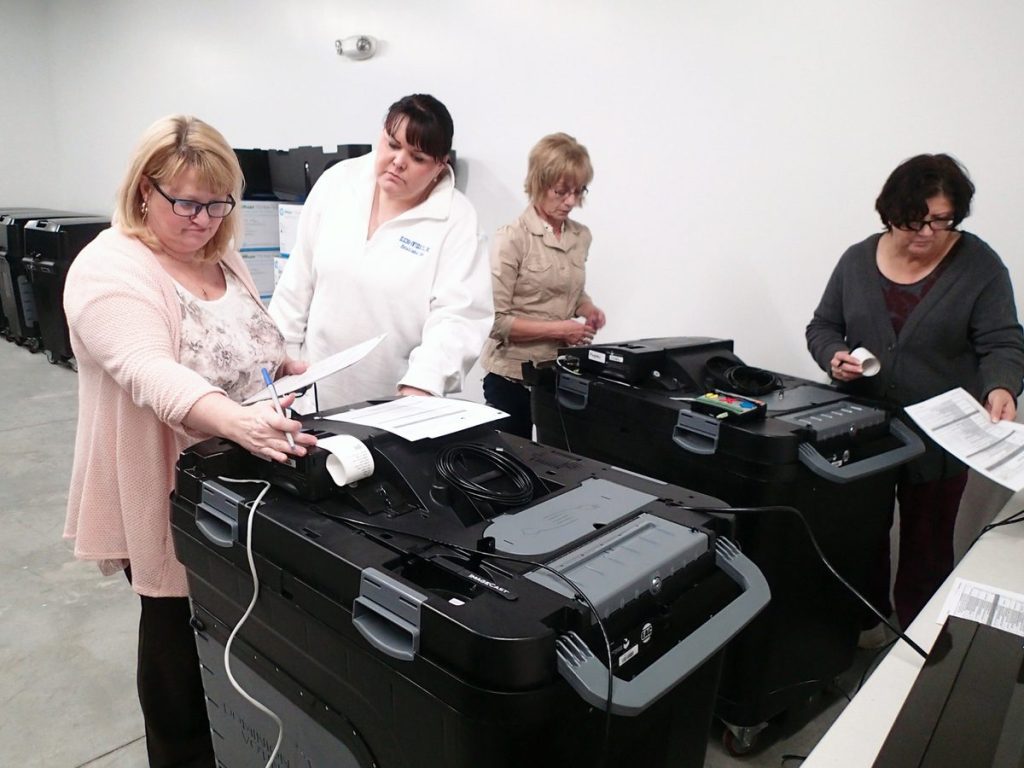
Nodaway County Clerk Karen Leader, left, checks out one of her office’s new automated vote counters earlier this week in the basement of the Nodaway County Administration Center. Trainer Melissa Nibert. left center, of the Elkins-Swyers Co., and Deputy Clerk Lorraine O’Donnell, and clerk’s assistant Julie Farnan, right, also received instructions on the new machines.
When Nodaway County citizens vote on March 15 in the first of this year’s four elections, they may notice something a little different about their polling places.
Earlier this week, Nodaway County Clerk Karen Leader and her staff received training on how to set up and operate 19 new ImageCast Precinct automated ballot counters recently purchased from Colorado-based Dominion Voting.
When attached to their ballot-storage drums, the shiny black machines stand about waist high, and aside from their dark color voters won’t notice much difference between the new devices and the electronic vote counters deployed for years on Election Day in Maryville and Nodaway County’s 15 townships.
But for Leader and her team, consisting of Deputy Clerk Lorraine O’Donnell and assistant Julie Farnan, the devices offer a number of new-tech features that should make tabulating ballots easier, faster, and less prone to errors.
According to Dominion representatives, the machines offer touch-screen controls; high-resolution scanning of each ballot; automatic detection of fraudulent ballots; a multi-feed detector that keeps the counter from accepting more than one ballot at a time; and dual memory cards that provide redundancy in case one of the cards is lost, damaged, or corrupted.
The machines are also equipped with a battery backup that can keep them running for up to four hours in the event of an Election Day power failure.
As with the old machines, voters will still enter a booth and mark paper ballots, then deposit those ballots into a feeder slot on top of the vote counter. The only difference for most people will be that instead of No. 2 pencils, they will use felt-tip markers.
Some citizens however — those who are visually impaired, arthritic, or who face some other condition that keeps them from filling out a traditional ballot — will have a different experience.
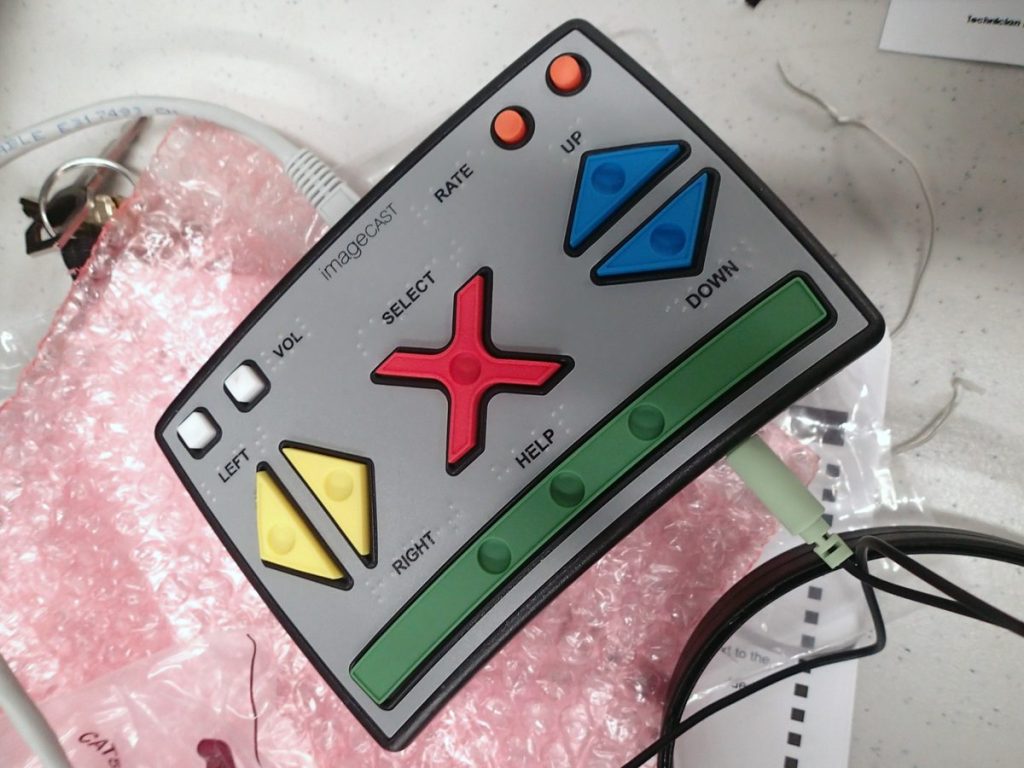
Each of the vote counters comes with a Hewlett-Packard OfficeJet printer that connects to a hand-held device called an audio tactile interface. The interface looks a lot like a computer game controller with large, colorful buttons marked in Braille.
Voters use an ATI by entering a voting booth, putting on a pair of headphones, and pushing the buttons in accordance with spoken instructions. The device records their choices and produces a marked ballot via the printer.
Leader said the system ensures that all voters, including those with a disability who in the past required direct assistance from an election official, will now be able to mark a truly secret ballot.
The acquisition of such technology by governmental entities, like the clerk’s office, charged with administering elections, is a requirement under federal regulations that mandate implementation of the devices by 2017.
Leader said the county recognized that the compliance deadline was approaching and budgeted accordingly.
Cost of the vote counters, printers, and ATIs totaled $108,000.
Most of that sum came from local taxpayers, although Leader said the county was able to obtain a $12,000 grant through the Missouri Secretary of State’s Office to assist with the purchase from Elkins-Swyers Co. in Springfield.
Elkins-Swyers staff member Melissa Nibert was at the County Administration Center this week to help Leader set up the machines and provide training in their operation.
The counters will be used for the first time on March 15 during the presidential primary election, which has generated considerably less interest locally than the municipal election to be conducted on April 5 when a number of school board and city council races will be decided, along with two sales-tax measures designed to fund operations and development at Mozingo Lake Recreation Park.
Presidential hopefuls filing in Missouri include Democrats Hillary Clinton, Henry Hewes, Roque “Rocky” De La Fuente, Bernie Sanders, Keith Judd, Willie L. Wilson, Martin J. O’Malley, John Wolfe, and Jon Adams. Republicans in the race include Chris Christie, Jeb Bush, Ben Carson, Donald J. Trump, Marco Rubio, Ted Cruz, Rick Santorum, Carly Fiorina, John R. Kasich, Rand Paul, Jim Lynch, and Mike Huckabee.
Libertarian candidates include Austin Petersen, Steven Elliott Kerbel, Rhett Rosenquest Smith, Cecil Ince, and Marc Allan Feldman.
According to the Missouri secretary of state’s office, write-in votes are not permitted in the primary, where votes are cast in accordance with party designation.
In 2014, Gov. Jay Nixon signed legislation that set Missouri’s presidential primary date on March 15 instead of Feb. 2. The measure was intended to assure compliance with national Republican and Democratic party guidelines that penalized states for holding early primaries by restricting delegate numbers.
In order to avoid delegate penalties, the Missouri GOP treated the February 2012 primary as a non-binding election, relying instead on caucuses to determine which candidates their delegates would support at the national convention.
Missouri’s Democrats stuck with the primary results.
The combination of required new technology and a separate presidential primary in March, plus a municipal election in April, a regular primary in August, and a general election in November, means that politics is costing Nodaway County taxpayers a lot of money in 2016.
In addition to paying nearly $100,000 in local funds for vote counters, Leader has set aside a total of $136,000 for four elections: $25,000 for the March 15 presidential primary, $30,000 for the April 5 vote, $36,000 for the Aug. 2 primary, and $45,000 for the Nov. 8 general election.
Add in postage, office supplies, training, computer fees, a required voter-registration canvass, and other expenses, and Nodaway taxpayers are on the hook this year for more than a quarter-million dollars in election-related expenditures.
TONY BROWN/DAILY FORUM
This Braille-marked audio tactile interface, which operates something like a computer game controller, allows voters with visual impairments, severe arthritis, or other disabilities to mark ballots largely unassisted and in secret. Nodaway County voters will have access to such devices beginning with the first election of 2016 on March 15.




