City approves Mozingo conference center architect
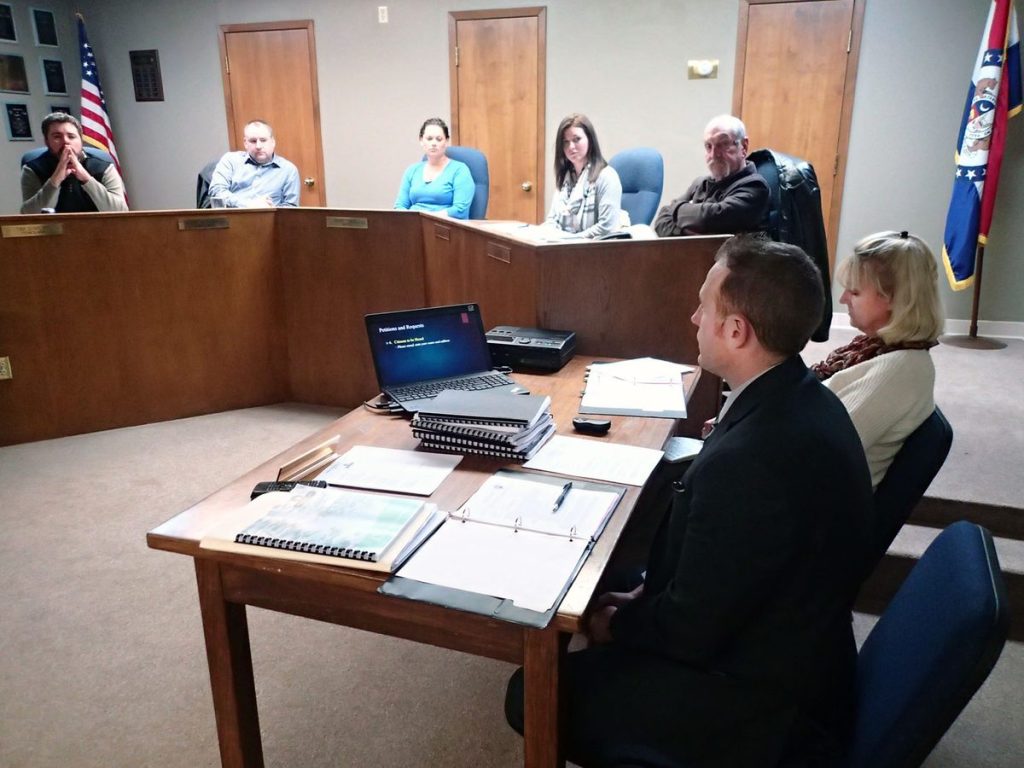
TONY BROWN/DAILY FORUM
City Manager Greg McDanel, foreground, describes to the Maryville City Council this week what he sees as the advantages of hiring an architect to design a proposed $4 million conference center at Mozingo Lake Recreation Park prior to voter approval or rejection of a sales tax that would provide revenue to service construction debt. Also pictured from left are council members Tim Shipley, Jason McDowell, Mayor Renee Riedel, Rachael Martin, and Jerry Riggs. Seated beside McDanel is City Clerk Sheila Smail.
Call it the power of one.
During what was supposed to be a quick, end-of-the-year session to take care of some routine — though expensive — business this week, the Maryville City Council found itself on the hot seat thanks to a series of probing questions from a single citizen speaking from the nearly deserted council chamber gallery.
As expected Monday, the council approved a contract with Wertzberger Architects of Marshalltown, Iowa, for the design of a proposed $4 million conference center at Mozingo Lake Recreation Park to be constructed in conjunction with a privately developed hotel.
In the end, the measure passed on a unanimous 5-0 vote, but not until after detailed questioning by Doug Stickley of Maryville, who voiced concerns about, among other things, the city’s plan to hire an architect for the center prior to the April 5 municipal election.
The election is crucial to the center’s future, since voters will be asked to approve or reject a new eighth-of-a-cent sales tax that would be used to service construction debt in the form for certificates of participation financing over 20 years.
Stickley told the council he had no particular ax to grind with regard to development at the city-owned park and reservoir, but that paying the architect’s $220,650 design fee, which could include another $10,000 for “alternate” geotechnical services and landscaping plans, prior to the election seemed premature.
“I enjoy Mozingo,” Stickley said. “I like to golf, and I like to fish, and sometimes I like to just walk around in the woods.”
However, Stickley said that as a taxpayer he wanted to “see my money spent responsibly, and I would like to see it spent frugally.” He also said hiring a conference center architect before voters decide whether or not they want to pay for the facility was “an unwise expenditure in my opinion.”
In addition, Stickley questioned the proposed size of the center, which is to include a banquet hall large enough to accommodate up to 500 people.
He said he knew of few, if any, functions held in Maryville large enough to require such a facility, and asked why the city would build a conference center “for events that may or may not materialize.”
Another of Stickley’s remarks questioned the wisdom of tearing down the existing Mozingo Lake golf course clubhouse, built only 20 years ago, which the center is to replace.
Finally, Stickley asked if it was sound policy to build the center using revenue from a sales tax that city officials estimate will generate only $240,000 annually, an amount that is $72,000 shy of the $312,000 required to pay off $4 million in certificates-of-participation debt over the requisite 20 years.
City Manager Greg McDanel explained that the city is proposing to fill the gap with funds currently earmarked for servicing existing concrete cart path debt at the Sechrest 18 golf course, an obligation totaling just over $100,000 a year that ends in 2017.
However, Stickley wondered if such an approach wasn’t “robbing Peter to Pay Paul.”
With regard to Stickley’s other concerns, McDanel said delaying conference center planning until after the election could cost the city quite a bit of money, since Wertzberger is also designing the proposed hotel for Boulders Inn & Suites of Denison, Iowa, and has offered the city a significant discount if the two projects move forward at the same time.
McDanel said Boulders is working with a group of private investors, some of them local, who have offered to refund $100,000 in design fees to the city if the hotel and conference center are built in conjunction with one another. The deal has yet to be formalized but has reportedly been agreed to in principle.
Normally, McDanel said, a project like the conference center would carry about $400,000 in design fees, or 10 percent of the total construction cost. Proceeding immediately, he argued, conceivably brings that price tag down to around $130,000, but only if the city acts now.
On another front, the city manager said planning for the conference center has been under way for about five years, and that completion of the facility is a key goal set forth in a pair of long-range master plans compiled for Mozingo and the city as a whole.
“It’s going to have to be designed some time,” said McDanel, explaining that if voters reject the sales tax the plans will remain on hand until other funding becomes available.
With regard to the conference center’s size, McDanel said the hope is that a hall with a 500-person capacity will attract events to Maryville currently held elsewhere. He said Mozingo currently receives about 100 requests a year for weddings and receptions that frequently cannot be accommodated.
But the city manager’s primary concern appeared to be what he sees as a chance to significantly save on design costs, an opportunity, he warned, that may not return.
“I’m not sure you’re going to be able to design a conference center for $130,000 in the future,” he said.
Several council members weighed in on the discussion, including Councilman Jerry Riggs who conceded that Stickley raised “a very valid point” about hiring an architect before voters had a chance to decide on the tax proposal.
However, when it came time to vote Riggs joined his four council colleagues, including Councilman Tim Shipley, who said moving forward with center design before the election was “worth the risk.”
Councilman Jason McDowell described the architect’s fee, which is included in the city’s current budget, as “the next step toward getting to that reality which is the conference center” after years of planning.
Shipley expressed a similar view.
“You’ve got to do some legwork before you get the shovels out and go to work,” he said.