Turning violence into lessons learned
Jennifer Ditlevson Haglund
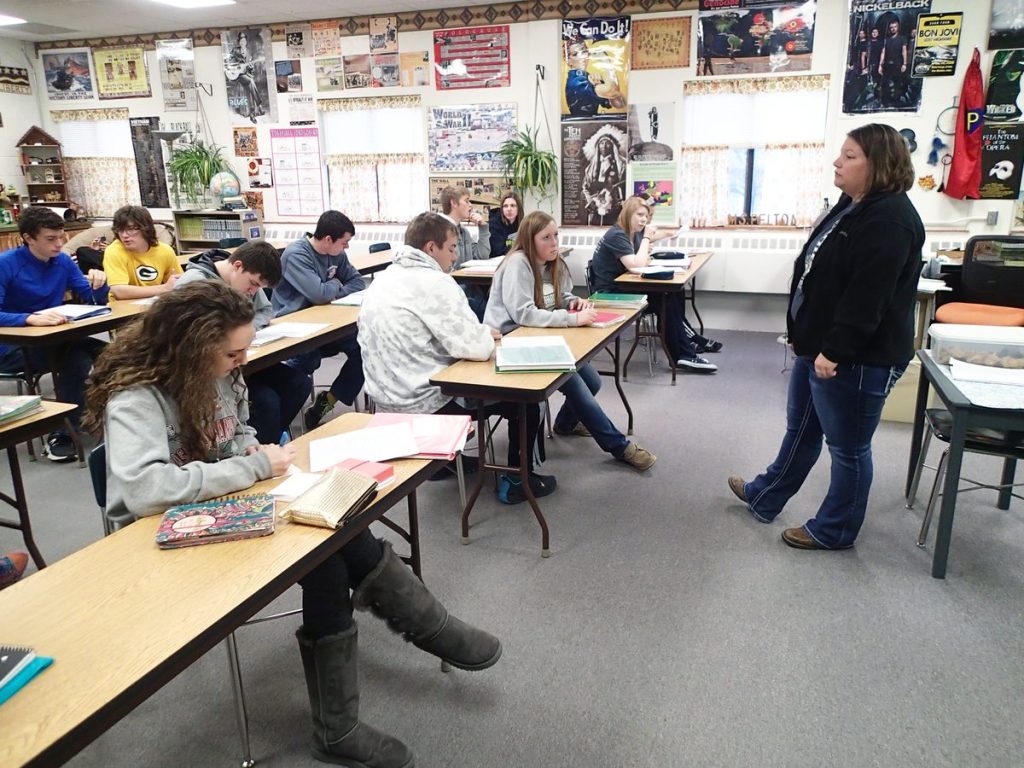
Teacher Catrina Pelton speaks to her honors world history class Monday at Maryville High School. Pelton said she encourages open, honest discussion about world events among her students, even when the topics discussed touch on culturally, racially, and politically divisive issues and situations.
Over the last five weeks, grim news about violent events such as the Paris attacks and mass shootings in San Bernardino, California, and at a Planned Parenthood clinic in Colorado Springs, Colorado, have circulated through the news media and social networking sites.
While young people, like everyone else, are watching and listening to these reports, their teachers are finding ways to get students talking about rational responses to violence and terror.
Catrina Pelton, a Maryville High School instructor for 10 years, teaches German history and the Holocaust along with honors classes in world history, American history, and Western civilization.
Pelton said she believes most of her students are interested in current events, and as she teaches she said she seeks to provide context while urging students to understand history in terms of their current environment.
“I like to relate it to things going on currently, and that might spark a discussion,” she said.
Some students may not be especially vocal about their concerns or opinions, but Pelton gains insight to how they are feeling by reading their journal assignments.
“That way they have an avenue for expressing what they want to say (and) what they think, but also it gives them a way to stay semi-anonymous,” Pelton said.
Seniors taking Western civilization, she said, tend to be more openly opinionated because most have been in her classes for four years. They know her teaching style, and that she tries to get students to see different points of view.
“There are times when we have to remind them that everybody can have their own opinion, and it doesn’t necessarily have to be yours,” Pelton said. “I’m a huge fan of playing devil’s advocate. I might jump into the conversation with a comment that is not my personal belief, but it’s a side that they need to consider, and that opens up a whole other discussion.”
Creating a safe space for lively discussion about sensitive topics can mean that the conversation continues outside of class.
“Sometimes it follows them out the door,” Pelton said.
Seniors Gage Grispino and Clayton Powell said they’re always talking about current events, particularly the 2016 presidential election and violence in Syria.
“There are actually a lot of people our age who are educated and interested. It’s not just something we talk about in one class and move on,” Grispino said.
The students acknowledged that differences in opinion about politics or morality can get personal.
“Just because an issue is a sticky issue, and there are a lot of slippery slopes and dangerous assumptions people can make with a certain issue, that doesn’t mean you shouldn’t discuss it,” Grispino said. “If anything, that means you should discuss it and put more care into it.
“If you avoid talking about issues just because they’re nasty and divisive and they really challenge who you are as a person, you’re not doing your job as an American citizen or as a person.”
Powell added, however, that he thinks it’s important to notice one’s surroundings before making comments.
Grispino, too, acknowledged that misunderstandings can occur when people believe their opinions are correct and should prevail to the point of verbal or even physical conflict.
According to Bayo Oludaja, a professor in Northwest Missouri State University’s School of Communication and Mass Media, people work through differences best by taking time to learn about others and building relationships.
Oludaja said he challenges his students to get to know people of different races, cultures, and nationalities who hold varying political viewpoints.
“I try to tell the students that they need to take interest in people as people,” said Oludaja, who teaches intercultural communication.
He added that when his students start talking about big events in the news, the opportunity arises for a teaching moment.
“I tell them, particularly in my intercultural communication class, that I want them to relate the concepts from the pages of the book and see how they relate to where they are today.”
Over the past 20 years, the growth of Northwest’s international student population has inspired Oludaja and other faculty members to find ways to incorporate global perspectives across curricula.
Also, Oludaja said, getting different groups to interact with each other can help facilitate better communication and empathy.
Offering an example, Oludaja recalled working with an Indonesian student.
“When something happens in Indonesia, I don’t think of it as a country that’s way out there but a face in front of me because I know someone from there,” he said. “To me, that is very, very powerful.”
After having students report to him about their engagement with people from different backgrounds this semester, Oludaja said the responses were positive.
“That’s a small difference that, hopefully, can have a ripple effect,” he said.
Oludaja said he would like to see the relationship between the Maryville community and the university continue to grow in such a way that each benefits from the other. And he is floating the possibility of minority and international students from the university visiting area schools in order to share information about themselves and their backgrounds.
Oludaja, who is from Nigeria, has himself presented cultural artifacts and talked about his life with area elementary students.
“Children are pretty transparent,” he said. “It was refreshing to engage with them that way.”
Oludaja said it’s one thing to read about a culture in a newspaper or see something on TV and another actually to talk with someone from another country.
Seeing how people act as individuals, he said, can set them apart from stereotypes.