Exhibit highlights county’s violent past
Jennifer Ditlevson Haglund
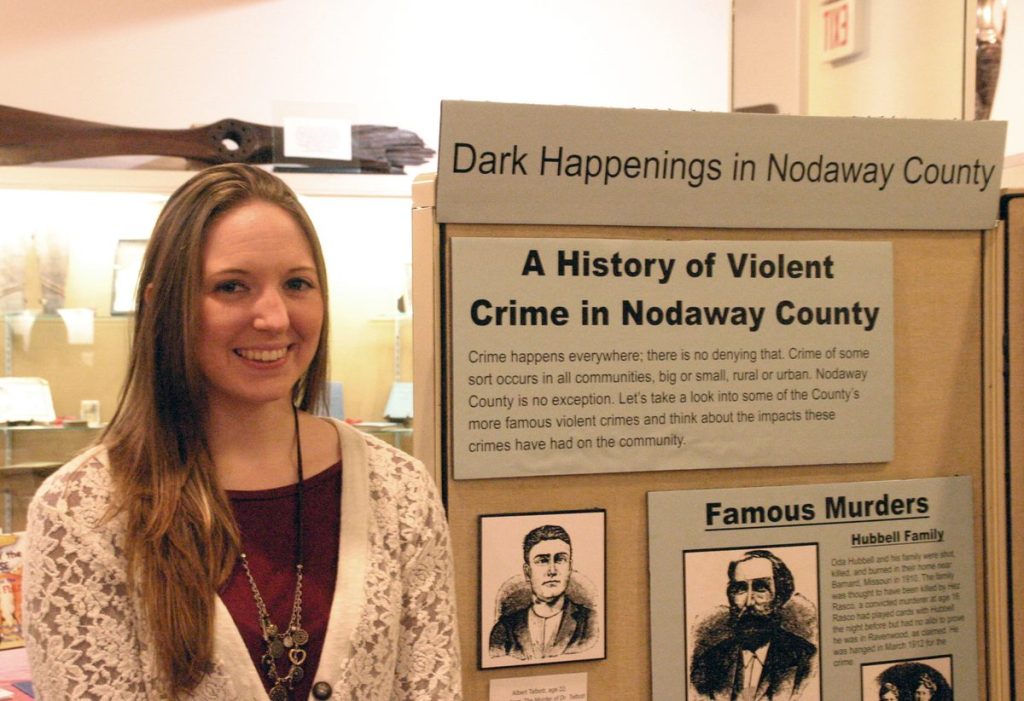
Northwest Missouri State University history student Catherine Gast stands beside part of her senior seminar project, which was on display Saturday at the Nodaway County Historical Society Museum. The exhibit revisits crime and criminals associated with the Nodaway County area and will be available for public viewing when the museum reopens in March following its winter hiatus.
Before closing for the winter on Saturday, the Nodaway County Historical Society Museum at First and Walnut streets added an exhibit featuring notorious crimes and criminals from the region’s past.
The exhibit was unveiled during a season-ending bake sale and coffee break that also included a book signing by several local authors with a portion of the proceeds going to support museum operations.
Writers on hand included Larry Anderson, Susan Cronk, Sue Nothstine, Irene Alexander, Jason Offutt, and Bob Bohlken.
Northwest Missouri State University senior Catherine Gast created the crime display as a part of her senior seminar project. Gast studies public history at Northwest and has researched a variety of topics for other museum exhibits on such topics as farming during World War II, medieval holidays, high school classes, and former Northwest president Robert P. Foster.
Gast’s most recent project grew out of a search for answers to questions she had growing up in Burlington Junction.
Like many local residents, Gast said that as a girl she heard a lot about the 1981 murder of Ken Rex McElroy in Skidmore and the 1931 lynching of Raymond Gunn in Maryville but didn’t really know a lot about the people and circumstances involved.
“I always had a personal interest in it,” Gast said. “This was my senior project, so I couldn’t just pick something random.”
In addition to presenting information about the Gunn lynching and McElroy murder — which was never solved — the exhibit provides facts about the lynching of Charlie Stevens, known as “Omaha Charlie,” in 1884 at what is now Beal Park.
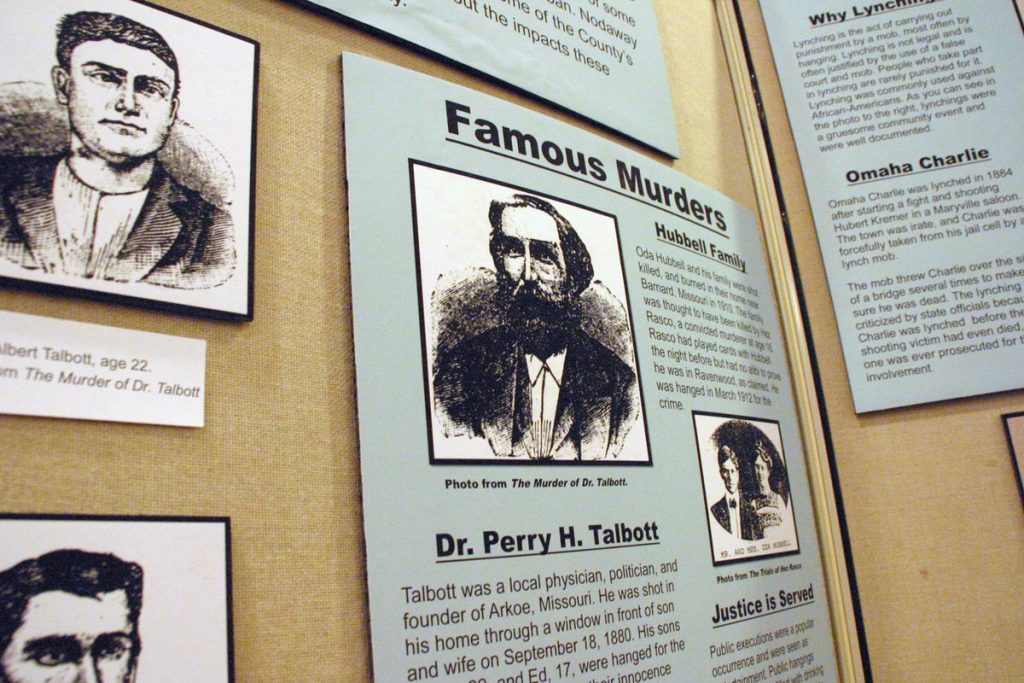
Gast also delved into the Nodaway County murders of the Hubbell family in 1912 and Dr. Perry H. Talbott in 1880.
During her research, Gast consulted several print resources, including “In Broad Daylight” by Harry N. MacLean and “The Trials of Hez Rasco” and “The Murder of Dr. Talbott” by local author Janet Hawley.
She said that reading a former Northwest student’s thesis, “Maryville to Mobville: The lynching of Raymond Gunn,” deepened her appreciation for scholarship.
“It’s kind of a sore subject to some people, but it’s part of our county’s history,” said Gast, who noted that the lynching raised uncomfortable questions about local attitudes toward race.
While working on the project, Gast said she asked fellow students if they had experienced racism in Maryville, and if they viewed the town’s history as an indicator of current realities.
Gast said most of the people she spoke to didn’t see much of a connection, even if they had experienced prejudice in some way.
Cathy Palmer, who coordinates museum displays for the society, said she was impressed with the professionalism of Gast’s work.
“Catherine put a lot of work into it,” she said.
Palmer said she thinks the new exhibit could serve as a means for starting conversations about the Nodaway County community that aren’t necessarily easy to hold.
“It offers us an avenue to talk about the seamier side of the county in a polite way without wanting to hurt anyone’s feelings,” she said.
Gast’s exhibit contains a series of questions directed toward viewers asking them if they know of these crimes and if learning more about them could impact their perceptions of safety.
Gast said she doesn’t plan to collect any data from the responses, but she did choose to post them because she wants people to consider the legacy of violence.
“We need to accept the past so the future doesn’t repeat any of this,” Palmer said. “And there are still varied viewpoints on these things, too.”
Palmer said the exhibit would be available for public viewing when the museum reopens in March following its annual winter hiatus.
Jennifer Ditlevson Haglund
Pictured is a museum display highlighting details about the murders of Dr. Perry H. Talbott and the Hubbell family in Nodaway County. Northwest Missouri State University history student Catherine Gast created the exhibit under the direction of Elyssa Ford, an assistant professor of history.