Local lawmakers offer pre-session update
TONY BROWN/DAILY FORUM
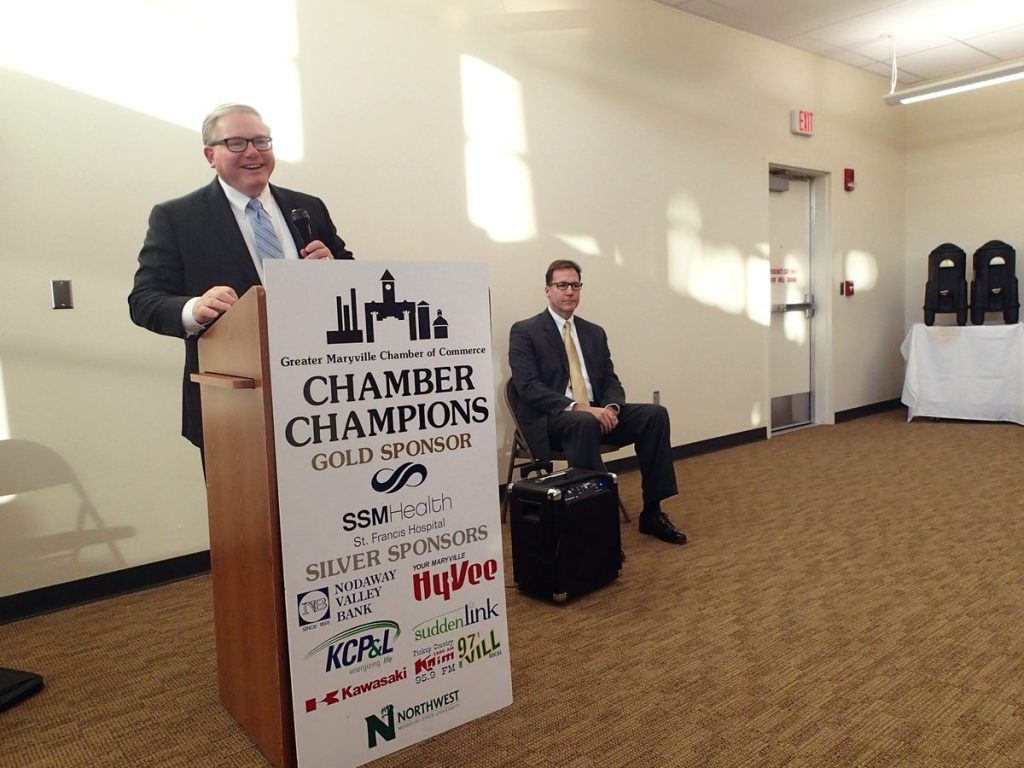
State Sen. Dan Hegeman stands at the podium while state Rep. Allen Andrews awaits his turn to speak Thursday during the Greater Maryville Chamber of Commerce’s annual pre-session legislative breakfast at the Hubbard Center for Innovation and Entrepreneurship. The Republican lawmakers spent about an hour addressing various issues ranging from right-to-work to proposed new funding for higher education.
The two lawmakers representing Nodaway County in the Missouri General Assembly spoke Thursday morning to members of the Greater Maryville Chamber of Commerce during the annual pre-session legislative breakfast hosted by the chamber’s Governmental Affairs Committee.
Sen. Dan Hegeman, who represents 15 northwest Missouri counties comprising the 12th Senate District, and Allen Andrews, whose 1st House District includes Nodaway, as well as, Atchison, Holt, and Worth counties, spoke for about an hour on a variety of issues, including economic development, education, and transportation infrastructure.
Both men are Republicans.
The forum, attended by a group of about 30 local civic leaders and businesspeople, served as a sort of primer on legislative initiatives likely to be proposed when the General Assembly convenes for a new regular session on Jan. 6.
Working from a list of topics submitted by the committee, both lawmakers started out by addressing economic growth and job creation. Andrews took the floor first, and said that progress in both these areas comes down to making Missouri more competitive and simplifying the process required to start a business.
Andrews cited statistics that he said rank Missouri 29th out of 50 states in terms of ease in establishing new companies and recruiting firms from elsewhere. He noted that most surrounding states stand higher on the scale, with Nebraska at No. 2, Iowa at No. 7, and Kansas at No. 17.
A primary reason for Missouri’s apparent lack of competitiveness, Andrews said, is the state’s failure to enact right-to-work legislation, which would prohibit agreements between labor unions and employers governing the extent to which unions can require worker membership and payment of dues.
Andrews noted that most of the states bordering Missouri have right-to-work laws on the books, the sole exceptions being Illinois and Kentucky.
He added that, in his view, local economic development opportunities, such as finding a new occupant for the vacant Energizer battery plant in Maryville, have gone begging as a direct result of Missouri’s status as a so-called closed-shop state.
“That’s the first step in being competitive,” said Andrews of moving Missouri into the 25-state right-to-work camp.
The Legislature passed a right-to-work bill during its 2015 session but was unable to overturn Democratic Gov. Jay Nixon’s veto. And though both Andrews and Hegeman said they see the issue as vital to economic growth and attracting new industry, they also say the proposal is unlikely to move forward in either chamber this year.
Andrews said that’s because no state has ever adopted right-to-work on a Democratic governor’s watch. Since Nixon is barred from seeking a third term in 2016, both Andrews and Hegeman said GOP lawmakers are likely to place the issue on a back burner until after the November election in hopes of replacing him with a Republican successor.
Hegeman said that right-to-work is especially important for rural states like Missouri that are more likely to attract small to mid-size companies leery of being unionized.
“This would be good for the 12th District,” Hegeman said, “But it’s an election year, and I just don’t see it.”
Turning to education, the lawmakers said that while there are always challenges associated with finding more dollars for public schools and state colleges and universities, 2016 is nevertheless shaping up as a fairly good year.
Hegeman said he is virtually certain funding for elementary and secondary education will increase next year, but doubts that Missouri’s longstanding appropriations formula for public schools can be fully funded.
A former House member, Hegeman said he has seen funding formulas come and go, and that it is probably time for the Legislature to come up with a new system that lines up better with current fiscal realities, a process, he said, that tends to happen every 10 or 15 years.
As for higher education, Hegeman and Andrews said they were encouraged by Nixon’s proposal to increase funding for colleges and universities by 6 percent in exchange for a tuition freeze. The performance-based $55.7 million increase, Hegeman said, would bring the state’s higher education budget to just under $1 billion and include $9.2 million in new dollars for programs in science, technology, engineering and mathematics — the so-called STEM fields.
Andrews called the proposed level of higher education spending “historic” and stressed the importance of continued support for Northwest Missouri State University.
“I hope we never forget the importance of this university,” he said, adding that it was important to do whatever is necessary to ensure the institution’s “long-term” sustainability.”
Addressing another legislative perennial, Hegeman and Andrews said they detect little enthusiasm at the Capitol for expanding Medicaid in order to capture additional federal healthcare dollars.
Lawmakers’ refusal to do so has been rooted in Republican opposition to the federal Affordable Care Act, but GOP rhetoric in rural areas has softened somewhat due to perceived fiscal benefits that a Medicaid expansion would create for small-town hospitals.
Nevertheless, Hegeman said, while some Medicaid reform may be possible, there is little enthusiasm for expanding the program.
“It’s not likely to happen in the Senate or the House,” he said.
Moving on to highways and infrastructure, Hegeman said significant new funding for the cash-strapped Missouri Department of Transportation is unlikely unless voters approve an increase in the state’s motor fuels tax or some other new source of revenue.
Hegeman mentioned the possibility of a moderately higher sales tax on tobacco under a proposal backed by the state’s convenience store operators and also floated the possibility of toll roads.
He added that some senators from Missouri’s larger cities are suggesting that MoDOT return lettered farm-to-market blacktops to county ownership.
However, Hegeman said, such a move would likely encounter strong opposition from outstate legislators.
“There will be a fight if that is the path some of our more urban colleagues want to follow,” he said.