Northwest hosts social justice forum
CHRIS ROUSH/DAILY FORUM
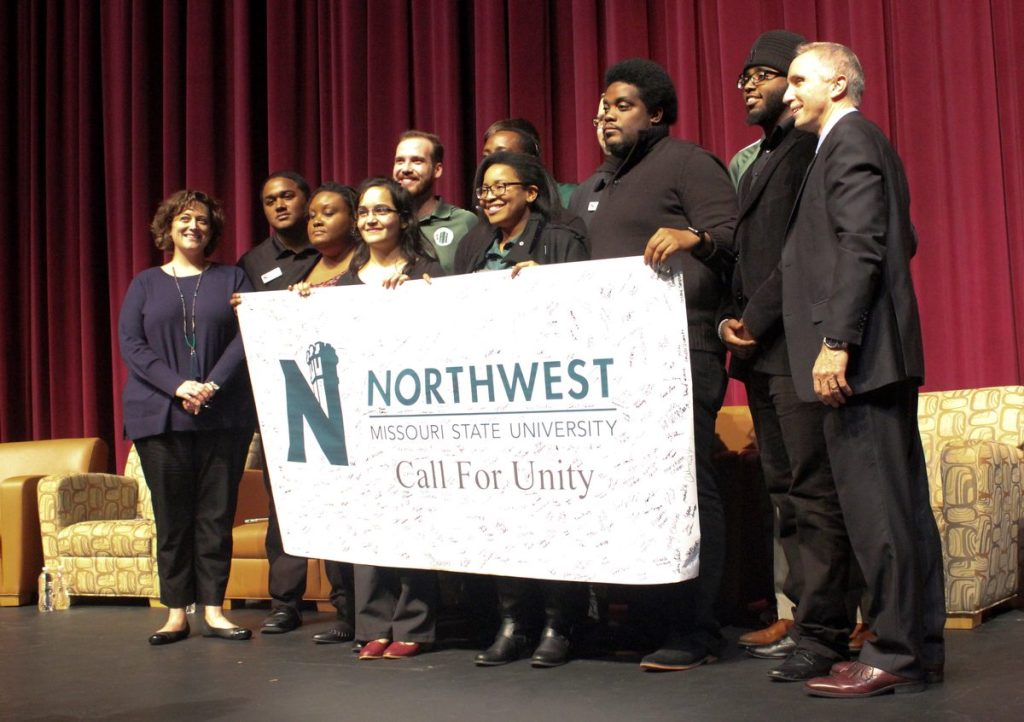
During the Northwest Missouri State University social justice forum on Monday, students and staff took part in a panel discussion and other forms of dialogue that included signing a “unity banner.”
Racial incidents involving both the University of Missouri and Northwest Missouri State University inspired a discussion on social justice, inclusion, and diversity Monday during a public forum held at the Ron Houston Center for the Performing Arts on the Northwest campus.
The large crowd that packed the auditorium for the event included a cross-section of students, university staff and faculty, and community leaders. Northwest President John Jasinski served as moderator.
“What it does is bring our community together, our campus community, students, faculty, staff, community, and we’re very pleased to have the support of our planning team and the students who lead this forum,” Jasinski said.
“The takeaways from this are pretty specific, that we’re all in this together. The bottom line is we think about social justice, diversity, equity, and inclusion.
“You can’t just talk. We can’t just think about ‘oh, good enough is good enough.’ We really need to consider where we’ve been, where we’re at, and especially move forward with actions that are reasonable.”
During the evening a panel of 11 students, faculty, and staff discussed social justice issues they’ve encountered and answered questions from the audience.
The panel included: Hugh Slaton, Student Senate president; Adam McNairy, Phi Beta Sigma Fraternity president; Maximilian Malldorf, Student Ambassador president; Rebecca Lawrence, Title IX coordinator; Korbin Jones, Common Ground president; Alicia Johnson, peer mentor for Student Support Services; Cris Jacobson, Northwest faculty member; James Eiswert, Northwest faculty member; Shawn Dixon, student regent; Steve Bryant, Northwest multicultural student success director; and Sadhana Bhattarai, international student representative.
“I can’t overstate how glad I was to see that everyone on the panel was willing to participate when we reached out and asked them,” Dixon said. “We had so many perspectives that I think it almost helped people realize that the forum is for them too, because someone may live in seclusion and have one view.
“Someone else that lives in a huge city has a different view, and this forum made us realize we can come together and talk about our different views and opinions.
“Overall, we understand that we all will be heard, and we’ll be pushing for that positive change that we’re looking for.”
Each panelist had the opportunity to deliver opening remarks about the state of social justice on campus and in Maryville, and ways in which the community can move forward.
Johnson talked about education being key for the community moving forward. She also said it was OK for people to feel uncomfortable when talking about social justice issues in an attempt to reach outside their comfort zones.
Several members of the audience also expressed the need for openness while working toward positive change.
Dixon, who serves as the student voice on the university’s Board of Regents, said there is no doubt such change is called for.
“The student body understands there’s a problem,” he said. “They’ve just been waiting on someone to tell them to get started on fixing a problem and correct all of the social injustice we see around us.
“We can work toward building a movement on campus that promotes the idea of campus inclusion and building a positive campus climate.”
For his part, Jasinski said the university is making progress, but not enough.
“We have to imbed this in everything we do,” the president said, “so if we think about how long actions will take, some can be done in the near term, but some will take longer.
“But I think the whole point is that we can’t have a one and done, a conversation and say we had an open forum. We have to continue to do this and imbed this in our infrastructure and our beings.”
A student planning team met with Jasinski and the panel Tuesday to discuss the forum and future courses of action.
“I think it’s important for people who weren’t here to understand that it was a forum, and we talked about things that were important to us. But one thing that we can all take away from this is those actionable goals,” Dixon said.
“At the end, I said ‘don’t let this be the last time we see you or hear from you.’ Someone else said we need to be willing to engage in conversations. Our international students talked about the importance of understanding that people have different views.”
“It’s a huge role,” Jasinski said. “I sent out a universitywide communication last week, and I presented seven or eight challenges. One of them was to have the community with us. I talk about the community as a larger community. It’s not just the city, not just the county, or even the region.”
Jasinski said it would be important to continue listening to multiple opinions while setting a course for the future, even if some suggestions prove impractical.
“I think you have to take a step back and understand that you have to under-promise and over-deliver because you don’t want to over-promise and under-deliver,” he said.
“I think we’re going to gather dozens of questions or ideas from the email, the survey, and the notecards. Not all of them are doable or realistic necessarily. But I know this — we can commit, and we will commit, to looking at every single one of them.”
Those with ideas regarding social justice and related issues can email the student planning team at [email protected].