Professor’s book bridges literature, math
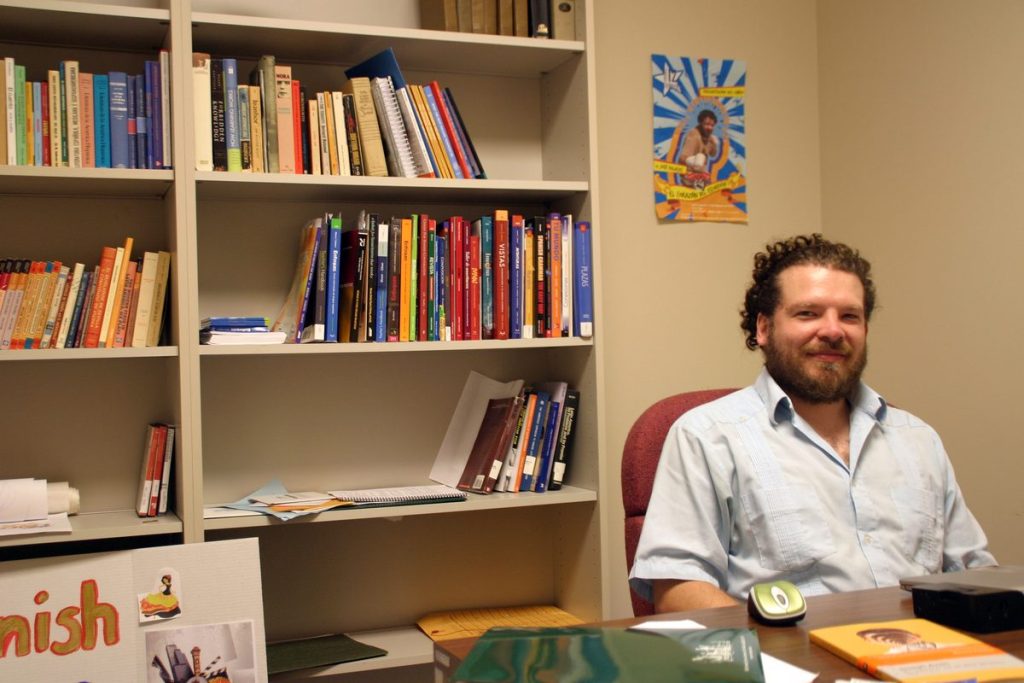
JENNIFER DITLEVSON HAGLUND
José Palacios Perez, who publishes under the name Joseph Avski, recently published his fourth novel, “El infinito se acaba pronto” (“Infinity Ends Soon”). The novel explores the world of two mathematicians, Georg Cantor and Marcos Lyons Pupo obsessed with the concept of infinity.
When people explain themselves, they often describe their dispositions as both technical and organized, or they identify with the creative and broad-thinking types.
Northwest Missouri State University professor and novelist José Palacios Perez never saw such a clear distinction between the sciences and fine arts. A physicist by trade, Palacios said he has always viewed fundamental scientific questions as the basis for art.
“Since I was a child, science and art and literature weren’t really separate in my mind,” he said.
After attending “university” and working as a physicist in Colombia, Palacios received an offer to earn his doctorate in physics in the Netherlands. Palacios said that at that point, he knew if he accepted the offer, he would have less time to write.
That is when he dropped physics to focus on writing.
“I always wrote,” Palacios said. “I was always concerned about literature.”
Palacios cited Jorge Luis Borges as one of his primary influences. Borges, he said, interests him because he wants to write intellectual books full of “mind twisting” and he finds inspiration there.
“And he’s one of the first writers I fell in love with,” he said.
While attending an MFA program in creative writing at the University of Texas at El Paso, Palacios developed the idea for his most recently published book, “El infinito se acaba pronto,” but the project isn’t complete yet. Palacios said that the big idea came to him during the program, but he quickly realized that he couldn’t fit all the concepts and characters into one novel once he started writing. He has projected that he needs to write four more novels within the world of these characters to accomplish his goals.
“I’m always looking for pushing readers to read in a different way,” he said. “I don’t try to be easy, but I don’t have to worry about selling because I have a job.”
Palacios was clear about not wanting to come across as a scientist trying to prove his pedigree through writing. He said he focuses on more philosophical questions he is asking himself as he writes.
“I’m always looking to find a new way to express the concepts to be as accessible as possible,” he said.
When his editor asked him if he would lower the level of math in the book, Palacios said he wanted to keep it as is because readers should be willing to focus on the ideas behind the math.
“Literature, physics, and music really open a new world for me,” he said. “Even in that sense, it’s a spiritual thing for me.”
El infinito se acaba pronto has yet to be translated into English, but Palacios said he has been happy with the translations so far. He said he is capable of writing academic papers in English and reading novels, but writing creatively in English poses a few too many problems for comfort.
Before beginning the MFA program in El Paso, Palacios didn’t know English. He was able to enroll in the program without knowing English because it is bilingual, but learned the language by spending time with people who didn’t know Spanish and watching TV.
In Maryville, Palacios said he finds the environment peaceful enough to keep reading, increasing his 75 books a year to about 100. As a professor in the Department of English and Modern Languages at Northwest, he said he also gets to spend time with like-minded colleagues who encourage and challenge him.