Prayers span world religions
Jennifer Ditlevson Haglund
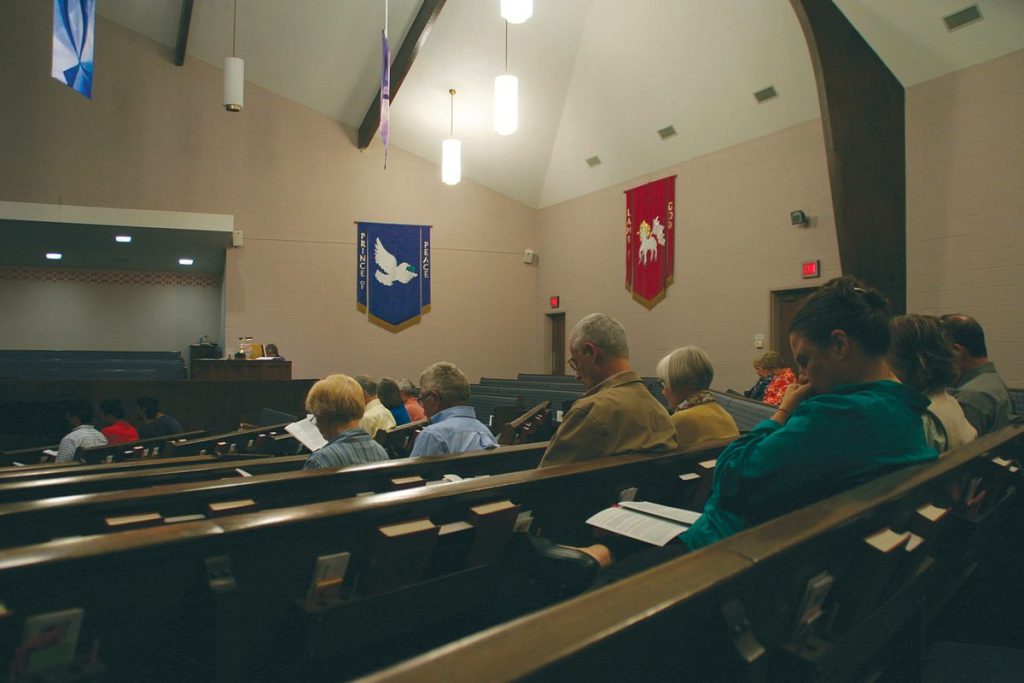
Local residents of various faiths meet at the First Christian Church during Maryville’s second annual International Day of Prayer for Peace Monday night.
People from across numerous faiths joined Monday evening at the First Christian Church in Maryville to pray for peace, both local and global.
The second annual Maryville Community Observance of the International Day of Prayer for Peace took place two weeks later than the official event on Sept. 21. The Rev. Scott Moon, pastor of Maryville’s First United Methodist Church, said organizers chose to delay the date so more faith groups could attend.
“Peace is a bigger issue than a particular theology,” said the Rev. Dale Stewart, who leads First Christian Church.
The International Day of Peace was established in 1981 by the United Nations General Assembly. In 2001, the General Assembly voted Sept. 21 as an annual day of nonviolence and cease-fire. The International Day of Prayer for Peace began in 2004 when leaders of the World Council of Churches collaborated with the United Nations.
Bringing together those who practice different faiths in the Maryville area modeled the solidarity religious leaders at the event wanted to see.
“Because the world seems so at odds, if we can get together, then we’re doing what we’re supposed to,” said the Rev. Jonathan Mitchell, who pastors the First Presbyterian Church.
Interfaith dialogue guided the service. Readings included excerpts from Jewish prophets, the Buddhist Dhammapada, the New Testament, the Qu’ran, and the Hindu Upanishads.
The Rev. Ashok Patet, who is a retired Methodist minister, organized the majority of the readings, using reflections from Martin Luther King Jr. to unite them. King’s readings spanned the need for compassion for enemies, finding love in reconciliation, and prompting conviction in people to speak against violence.
Last year’s service used words from Mahatma Gandhi. Patet said he has prepared other services using ideas from Mother Teresa and Desmond Tutu.
Patet said he was pleased with the service, but that he would like to keep the conversation open among people holding different worldviews throughout the year in the form of discussion groups.
“It’s to share our spirituality, even if you don’t have faith,” he said.
Before Patet lived in the United States, he lived in Mumbai, India, teaching sociology and serving as a chaplain at Wilson College for 33 years.
Once Patet moved to the United States in 2001, he said he witnessed more divisiveness between major world religions than he experienced in India. He blamed media coverage after the 9/11 terrorist attacks for some of the problem.
“We need to make an extra effort to reach out. That is my strong conviction,” Patet said.
At the service, community members shared prayers for those affected by violence such as refugees and children in abusive situations. Several mentioned concern for victims and families of the recent shooting at Umpqua Community College in Oregon.