
Prosecutor analysis focuses on repeat offenders
TONY BROWN/DAILY FORUM
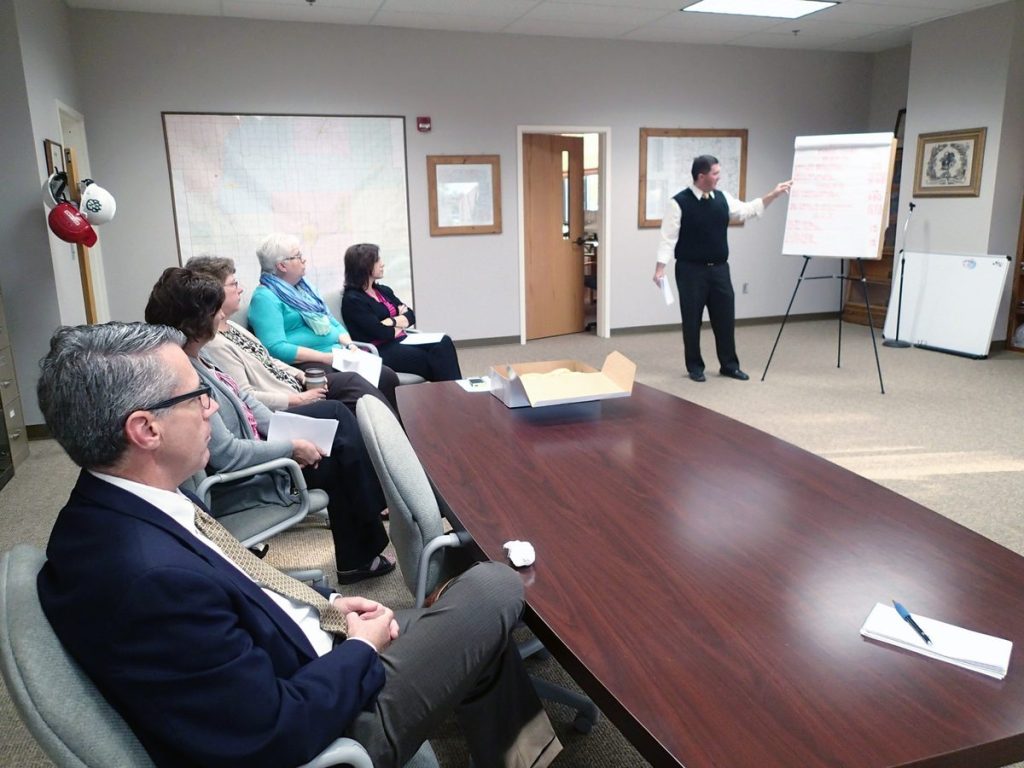
Nodaway County officeholders look on Friday as Prosecuting Attorney Robert Rice, standing, delivers a presentation on county recidivism rates. Rice’s study measured the propensity of criminals between 2011 and 2015 to commit subsequent offenses after being convicted. Pictured from left are associate Circuit Judge Doug Thomson, County Collector-Treasure Marilyn Jenkins, Public Administrator Diane Thomsen, Recorder of Deeds Sandy Smail, and Circuit Court Clerk Elaine Wilson.
Once a criminal always a criminal? Not necessarily, according to Nodaway County Prosecuting Attorney Robert Rice, who on Friday unveiled findings from a recidivism study conducted over the summer by paid intern Will Garza, an accounting major at Northwest Missouri State University.
Recidivism is the propensity of criminals to commit subsequent offenses after being convicted. Garza’s analysis covered the period from Jan. 2011 to the end of June 2015 and addressed four core criminal justice categories: driving while intoxicated, illegal drug possession, domestic violence, and success/failure rates associated with the Nodaway County “drug court.”
Rice, first elected in 2010, is a hardliner when it comes to controlled substances and drunken driving, and has made a point of insisting on at least some jail time for offenders who use illegal drugs or take the wheel while impaired.
However, he is also a strong proponent of drug court, which offers selected offenders intensive treatment and counseling rather than time behind bars.
In summarizing recidivism survey results last week during the county’s quarterly officeholder meeting, Rice said he now believes he has the numbers to back up his assertion that drug court is an effective tool in the battle to wean persistent drug users away from their addictions.
Of 13 drug offenders who graduated from the drug court program during the five-year study period, only two re-offended either by using illegal drugs or committing some other kind of crime, Rice said.
By way of contrast, nine of 15 participants — 60 percent — who failed to complete drug court during the same time frame were subsequently charged with another offense that may or may not have been drug related.
Missourians currently pay around $700 million a year for prisons, with the average cost of keeping an inmate behind bars for a year standing at around $22,000. Rice said Nodaway County’s entire drug court budget is only $15,000, and that funding the program to serve the maximum number of offenders eligible for participation would require at least three times that.
Still, he believes the $50,000 or so needed to expand the program would be a sound investment, since moving offenders through the 12- to 18-month drug court process costs many thousands of dollars less than locking them up.
“I’ll say to my dying day that I want to see drug court fully funded,” Rice told his fellow officeholders.
As currently organized, Rice said, Nodaway’s drug court is reserved for “the worst of the worst,” people who suffer serious addictions and who are willing to commit crimes in order to maintain their habit.
The court, he said, is for most of these people the “only hope of living a sober life.”
While enrolled in drug court, offenders are required to attend three to five sobriety reinforcement meetings a week, submit to urine samples, check in regularly with probation and parole officers, and attend group and individual counseling sessions.
Relapses result in sanctions that can include everything from writing a report, to community service, to spending more nights and weekends in jail.
On other fronts, Rice’s recidivism study showed that nearly 6 percent of all DWI offenders are likely to drink and drive again within a few months of being convicted, but that more than 36 percent are apt to commit an offense of some kind, whether or not the crime is related to consuming alcohol.
Equivalent recidivism rates for possession of controlled substances are 9.77 and 39 percent, while nearly 18 percent of domestic violence offenders repeat their abusive behavior with almost 45 percent being subsequently charged with other crimes.




