Group works to save White Cloud Cemetery
Phil Cobb
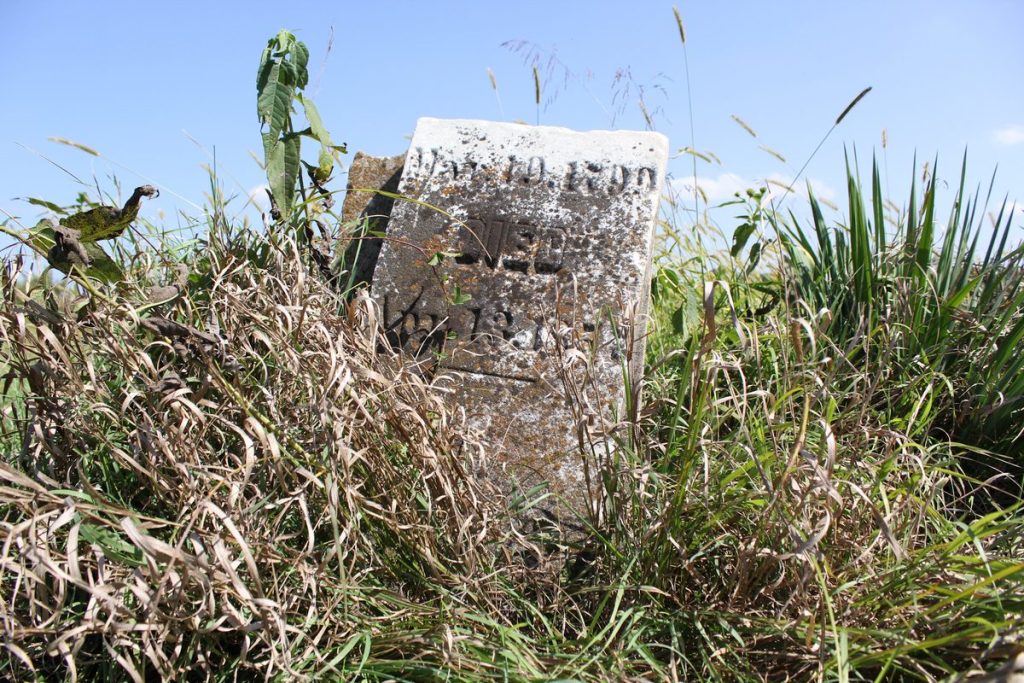
It’s been decades since anyone was buried at White Cloud Cemetery south of Maryville, but the old graveyard remains a treasure trove of local history. Pictured is the stone over what is thought to be one of the oldest graves in the cemetery, apparently erected in the 1850s. Also interred at White Cloud are the remains of Robert M. Heflin of the 9th Missouri State Militia Cavalry, who was buried in in 1864, the year before the end of the Civil War.
Overgrown with weeds and poison ivy, White Cloud Cemetery sits 5 miles south of Maryville just west of Highway 71 along 315th Street.
Records show that no one has been buried there since 1959, and so far as anyone can determine the first White Cloud grave was dug in the 1850s.
At one time, White Cloud Baptist Church stood close by, but the chapel has been gone for more than 80 years.
Joe Bishop of Worland, Wyoming, tried to find the untended cemetery in July on his way to Florida. He was searching for the graves of his great-great grandparents, whom he traced to Nodaway County through Ancestry.com.
Bishop’s directions pointed him toward Arkoe, but he couldn’t immediately locate the burial ground and nearly gave up the search.
It wasn’t until he was traveling homeward that he found the cemetery with some help from Letha Marie Mowry, Sylvia Whaley, and Beth Walker.
“I found it in a pretty sorry state of disrepair,” Bishop said.
Bishop was able to identify the headstones of his relatives, Louis and Burnettie Bishop, and their eldest daughter Eliza Melinda.
Still, he wasn’t happy finding the grounds derelict.
“The experience was very emotional and made me very sad,” Bishop said. “You see, these folks worked their whole life to make my life possible. To see that no one cares about them now hurts.”
Back in Wyoming, Bishop described the situation to his son Jeff Bishop, who is a Scoutmaster. The elder Bishop wondered if anyone might want to fix up the cemetery.
Jeff Bishop listened to his dad’s story, and said he would see what he could do.
After Jeff Bishop contacted the Maryville-area Boy Scouts, the project was eventually pitched to John Campbell, leader of Troop 190 in Conception. Campbell said his Scouts anticipate finishing the White Cloud Cemetery restoration around Memorial Day 2016.
The troop isn’t alone in its efforts. Several local residents had expressed interest in the neglected cemetery but were never able to put together enough volunteers to complete the job.
“I think it’s so awesome that he’s doing that with the Scouts,” Lucille Zimmerman said.
Zimmerman’s late husband John grew up on a farm adjacent to the cemetery, and for several years members of his family mowed the grounds just to keep the place looking respectable. Seven years ago when Lucille and John were walking through the graveyard they saw names on headstones that she recognized.
In the course of her genealogical research, Zimmerman found names that matched her husband’s family tree, particularly the names of her husband’s great-great-great grandparents. She said at first her husband didn’t believe her, but then realized that she’d stumbled onto a piece of his family history.
Finding this information, Zimmerman said, increased her interest in restoring and maintaining the abandoned cemetery.
“I just think graveyards are so important,” she said. “They’re history.”
Zimmerman said her sons Rob and Mick helped Jim Espey mow the perimeter of the cemetery for years. Without them, she said, the cemetery would have been in far worse shape.
Still, they could never get close enough to the stones for heavy duty maintenance.
Walking across the cemetery, visitors can find all kinds of stories. Stones show that several mothers and infants died only days apart, likely due to complications related to childbirth. Other family members died during what were probably periods when illness spread through the community.
Robert M. Heflin of the 9th Missouri State Militia Cavalry was buried in White Cloud in 1864, the next-to-last year of the Civil War.
Campbell said he enjoys cemetery history, having earlier restored Cain Cemetery along with boys from his Scout troop.
“(This is) probably a bigger job because it’s a bigger piece of ground,” he said.
Zimmerman has seen Campbell’s work at Cain Cemetery and expressed enthusiasm for the White Cloud project.
“He did a super job,” she said. “He’s had experience. He knows what he’s doing.”
Campbell doesn’t have any relatives buried at White Cloud that he knows of, but he identifies with Zimmerman’s desire to preserve history.
He became interested in genealogy in the mid-1970s when his family was verifying its lineage in order to qualify for membership in organizations for descendants of those who fought in the Revolutionary War.
“Cemeteries are one of those disappearing things that are a source of information for people when you’re trying to find your ancestors,” Campbell said.
Campbell is preparing the boys of Troop 190 to work collectively on a genealogy merit badge this winter, and he said the cemetery project could help them research their own family histories.
This fall, Campbell plans to work with the troop in clearing the White Cloud grounds. Some of the restoration chores will likely be parceled out in the form of Eagle Scout service projects. Tasks include creating cemetery signage and repairing stones.
Campbell said the troop will have to use heavy machinery to lift stones too large to handle by hand, and Zimmerman said she will be happy to loan any necessary equipment.
Local resident Alice Hersh is also involved in the project and serves as treasurer of the White Cloud Cemetery board. A number of her ancestors, with surnames like to Busby, Espey, and Shinabarger, are buried there.
Hersh, who is currently trying to raise money to fund upkeep once the cemetery is restored, said she would like to find a photograph of the church and wondered if the building’s disappearance and the abandonment of the graveyard are linked.