City water declared safe to drink
TONY BROWN/DAILY FORUM
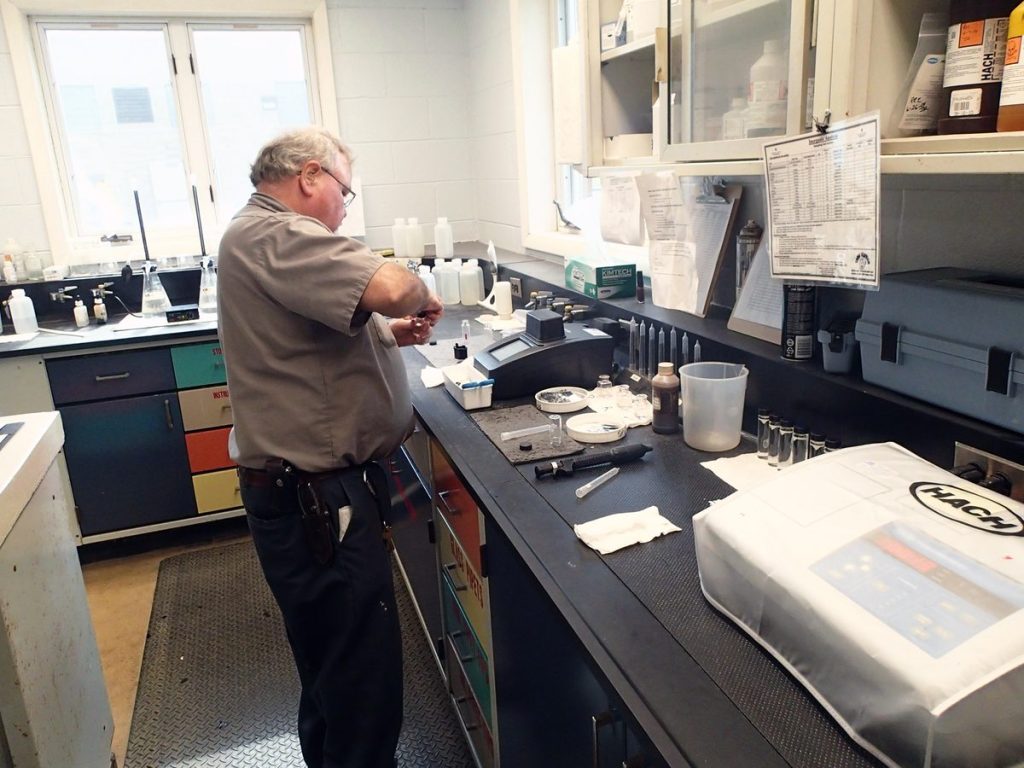
Operator Herman Crumb of PeopleService Inc. performs a chlorine test Wednesday morning at the Maryville water plant. Maryville was placed under a boil-water advisory this week following the discovery of elevated manganese levels in samples taken from Mozingo Lake. PeopleService works under contract with the city to operate both the water plant and municipal sewage treatment facility.
Adopting a policy of maximum caution, Maryville officials opted to extend the city’s boil-water advisory through much of Thursday, even though manganese levels in water samples dropped to acceptable limits on Wednesday morning.
The boil advisory was lifted at 3:40 Thursday afternoon almost exactly 48 hours after being implemented on Tuesday.
Public Works Director C.E. Goodall said he and City Manager Greg McDanel made the decision to extend the advisory until results were available from an additional round of bacterial testing conducted at the Missouri American Water Co. laboratory in St. Joseph.
While testing for manganese, residual chlorine and other measures of water quality is conducted locally by water plant staff, Goodall said the city’s lab is not equipped for bacterial tests, which must be done elsewhere.
Both the city’s water purification and sewage treatment operations are contracted out to a private vendor, PeopleService Inc.
From a regulatory standpoint, Goodall said the advisory could have been lifted Wednesday after the amount of manganese in city water fell below the maximum allowed by the state Department of Natural Resources. But he defended the decision to keep the boil warning in place until the possibility of bacterial pollution was eliminated.
“If we had lifted the boil advisory and then had to put it right back, that would have looked pretty bad,” Goodall said.
Elevated levels of manganese are a problem because the naturally occurring metal combines with chlorine, which the city adds to water in order to kill bacteria. The reaction between the two elements lowers the amount of residual chlorine in drinking water, creating an enhanced opportunity for bacteria to grow.
Boiling water does not get rid of the manganese, but it does kill harmful bacteria.
High concentrations of manganese have been linked to a syndrome affecting the nervous system and are considered especially hazardous to young children and pregnant women.
It is believed elevated manganese levels at Mozingo Lake, the city’s primary water source, were caused by runoff from recent heavy rains that washed soil and rock containing the element into the lake. According to Goodall, at least “two or three” other Missouri cities that rely on surface water recently experienced similar problems.
While it was in effect the advisory was just that, an advisory. There was no requirement for people to boil water.
But the recommendation did have an impact. Bottled water and ice sales reportedly spiked at local stores, and at least one restaurant resorted to serving distilled water.
Store Director Chris Wiltfong said the Hy-Vee supermarket, which operates both a cafeteria and a convenience store coffee bar, served bottled water to customers and used boiled water to make instant coffee rather than brewing ground coffee.
Northwest Missouri State University spokesman Mark Hornickel said the boil advisory had a minimal impact on campus, since most students are away on summer break.
Hornickel said Aramark, the university’s food service vendor, was complying with the advisory, and that students, faculty and staff were urged to avoid drinking fountains and drink bottled water.