County Health underscores fireworks risks
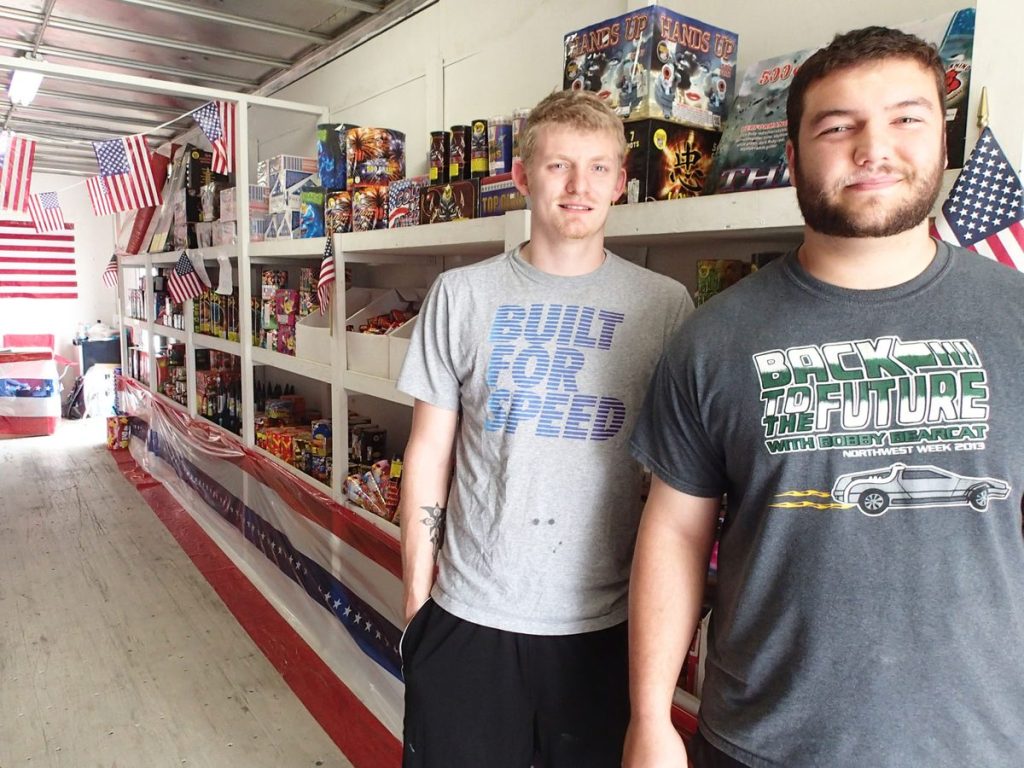
TONY BROWN/DAILY FORUM
David DeBuhr, left, and Zac Bendrick are in their second season of operating the Barely Legal fireworks stand in the parking lot of Stickler Rentals at 2818 S. Main. Though hundreds of families in Nodaway County are expected to purchase and use consumer-grade fireworks this Fourth of July, County Health Center officials are urging those same families to exercise extreme caution, especially where children are concerned.
For thousands of people in Nodaway County, this Fourth of July will be a time for family fun as well as an opportunity to observe the 239th anniversary of the nation’s Declaration of Independence.
And along with eating apple pie and ice cream, watching baseball, spending a day at the beach and lining up for seconds at a backyard barbecue, nothing is quite as all-American on this most American of all holidays as fireworks.
But unlike the other activities listed above, fireworks cause thousands of injuries every summer, many of them serious, a few of them fatal, and most of them involving children and teenagers.
Della Rhoades Watkins, administrator of the Nodaway County Health Center in Maryville, is urging families to exercise every possible precaution as the Fourth approaches in order to stay safe while having a blast on Uncle Sam’s birthday.
Rhoades Watkins cited statistics compiled by the national Safe Kids organization claiming that more than 4,000 children and young people under age 19 are injured by firecrackers and fireworks each year.
The risks and resulting carnage are great enough that the Safe Kids organization and many of Rhoades Watkins’ public health colleagues recommend forgoing home fireworks altogether and instead attending a public display where aerial bombs, starbursts and red-glaring rockets are set off by professionals.
And indeed, with nearly perfect weather forecast for Saturday, a huge crowd is expected to turn out for the annual city-hosted display at Mozingo Lake Recreation Park.
But the odds of a firecrackerless Fourth of July in a town like Maryville, where a lot of kids, and parents for that matter, consider shooting off a few packages of Black Cats to be an unalienable right — along with life, liberty and the pursuit of happiness. — are exactly slim and none.
Backyard celebrations filled with sparklers, cones and Roman candles — stick-mounted rockets are banned inside the city limits as a fire hazard — will proliferate.
So for folks who just have to celebrate Independence Day with a personal bang, Rhoades Watkins is pleading, at a minimum, for a maximum amount of caution.
Among the worst hazards for children, she said, are sparklers, which spew showers of sparks reaching maximum temperatures of around 1,200 degrees.
Sparklers, firecrackers and just about any other kind of incendiary device can and do cause serious burns in addition to blast injuries capable of permanently impairing vision and hearing.
Rhoades Watkins said it is crucial, therefore, for parents who allow children to use fireworks to teach them how to call 911 in an emergency and how to respond in the event clothing or hair catches on fire.
Better yet, replace sparklers with glow sticks, which still light up the night but don’t burn at temperatures hot enough to melt glass.
Further recommendations from County Health include keeping young children away from anything that burns or explodes, always making sure an adult is on hand to supervise fireworks activity, and ensuring there is a bucket of water or easily activated hose available wherever fireworks are being used.
If a firework fails to go off, leave it alone. Do not try to re-light it or examine it in an effort to determine what went wrong. Move to a safe distance, and spray the faulty device with water.
Finally, families and individuals should only buy fireworks labeled for ordinary consumers. Avoid purchasing pyrotechnics packaged in brown paper, which is often an indicator the devices are intended for professional displays and too powerful for neighborhood use.
In addition to the risk of injury, families should also remember fireworks can pose a significant fire hazard.
According to the National Fire Protection Association, more fires are reported in the United States on the Fourth of July than any other day, and half of those fires are caused by fireworks.
In 2010, the NFPA reports, fireworks were linked to 1,100 structure fires, 300 vehicle fires, and 14,000 other blazes resulting in an estimated eight deaths, 60 injuries and $36 million in property damage.
For more information on fireworks safety, call the Nodaway County Health Center at 660.562.2755 or visit www.safekids.org.