Grant brings computing to care homes
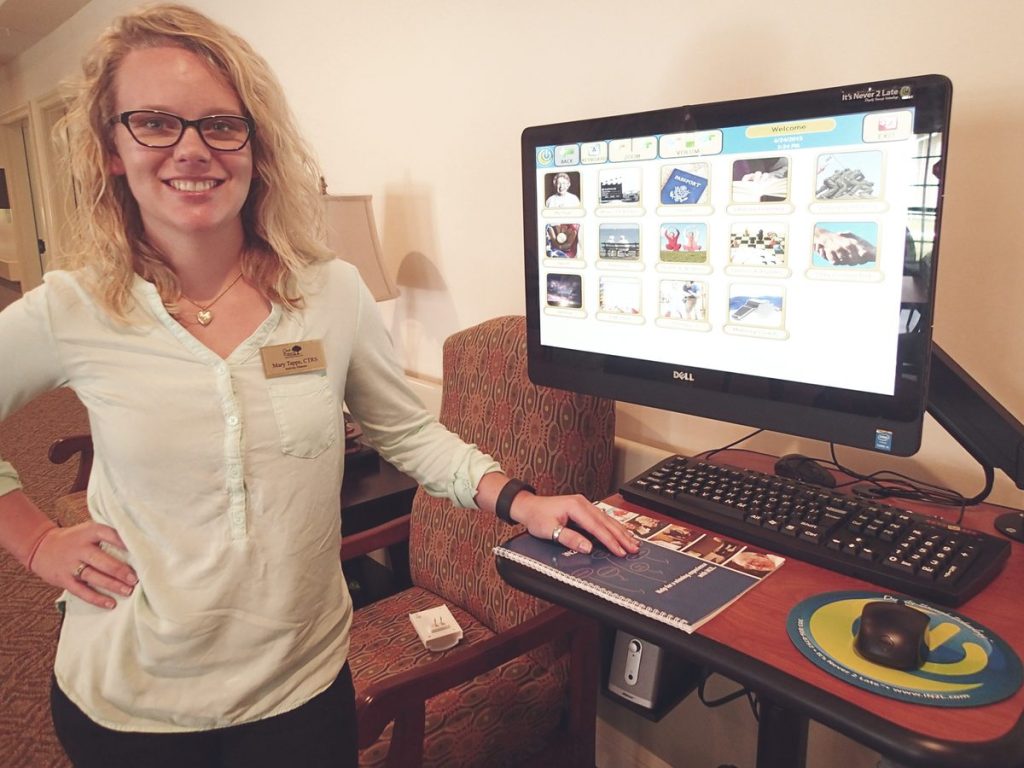
TONY BROWN/DAILY FORUM
Mary Tapps, activity director at Oak Pointe Assisted Living & Memory Care, stands beside an iN2L Mobile Flex large-screen computer that will be available to Oak Pointe residents over the next three months. The ergonomically designed, highly user-friendly unit will then rotate through several local residential care homes as part of an SSM Health Hospice & Home Health Foundation program funded through a grant from the Gladys Rickard Charitable Trust. iN2L — short for It’s Never Too Late – is a company specializing in computer programs and hardware designed specifically for the elderly.
Thanks to a grant from the Gladys Rickard Charitable Trust and an assist from the SSM Health Hospice & Home Health Foundation, local care homes and assisted living facilities are gaining access to technology designed to bring computing and online access to the elderly, including those coping with Alzheimer’s disease and other forms of dementia.
The grant, totaling approximately $50,000, was used by the foundation to purchase a large-screen computer console, several peripheral devices and a couple of tablets specially programed by It’s Never Too Late — or iN2L.
Founded in 1999 by Silicon Valley technology executive Jack York, iN2L offers hardware, programs and interfaces designed to enhance the lives of often computer-shy seniors.
According to iN2L’s Jennifer Robb, who demonstrated the technology to a group of elder care professionals and advocates this week at Northwest Missouri State University, York got the idea for the company after donating traditional computers to assisted living centers in California, only to find that the machines generally wound up dust-covered and unused in closets and storage rooms.
After doing some research, Robb said, York discovered the reason was that most computers simply aren’t designed for folks who lived most of their lives in the pre-digital era.
They letters on keyboard keys are too small, screen icons appear to be symbols from some unbreakable code, double clicking and scrolling with a mouse proves difficult for unsteady hands, and pointing and clicking is an endless frustration for those unfamiliar with the concept of links or “buttons” that look nothing like buttons.
Though internally they work much like any other Internet device, the iN2L computers acquired by the foundation present a completely different set of user interfaces. Touch screens replace mouses, and large, rectangular icons offer photographs and plain English captions that make their function obvious.
Want to call the grandkids? These computers offer both Skype and an old-school “analog” handset that allows folks to listen through one end and talk through the other, just like on a landline. The only thing missing is a dial and Sarah the operator.
Also, instead of clicking on the trademarked icon for Windows Media Player, or some such program, users simply touch a photo of movie reels labeled “Music & Films.” Email and other communication utilities are accessed by fingering an image of two people shaking hands above the words “Stay Connected.”
Personal photo galleries, letters, favorite videos, birthday wishes, music, games, frequently used websites and other assorted stuff is a screen-touch away behind a photograph of the user called, obviously enough, “My Page.”
Nancy Shipley, a business development consultant for SSM Health at Home in Maryville, said iN2L systems deployed elsewhere have proven “life changing” for the residents who use them.
“It’s meeting them at their comfort level and their ability level,” said Shipley, adding that such computers hold the potential for significantly improving quality of life, especially for residents dealing with memory loss.
The machines come equipped with games, brain-teasers and vintage video and musical offerings specifically designed to trigger a fading past while enhancing cognitive dexterity.
Not to mention physical dexterity.
The iN2L Mobile Flex large-screen unit currently available at Oak Pointe Assisted Living & Memory Care in Maryville includes a working set of bicycle pedals that allow residents to exercise while virtually touring quiet country lanes in the south of France or the California wine country.
Another peripheral, a joystick, controls a flight simulator that allows long-grounded pilots to return to the skies.
Or, with just a touch or two, seniors can use Google Earth to zoom in on images of their family home or a grandchild’s new school.
Now that the iN2L gear has arrived in Maryville, Shipley said it will be loaned out on a rotating basis to all six local elder care facilities. She said the hope is that as residents incorporate computers into their daily routines, the homes will eventually acquire iN2L devices of their own, perhaps with the help of additional foundation funding.
Shipley said she believes the possibilities are endless, both in terms of therapy and the simple pleasures of reaching out online to loved ones and the world at large.
“Imagine a grandparent and grandchild engaging together using this technology,” she said, “the memories they could unlock and the stories they could share. They will be able to communicate on a whole new level via this amazing tool and build this bridge between the generations.”