
Council, haulers mull garbage options
TONY BROWN/DAILY FORUM
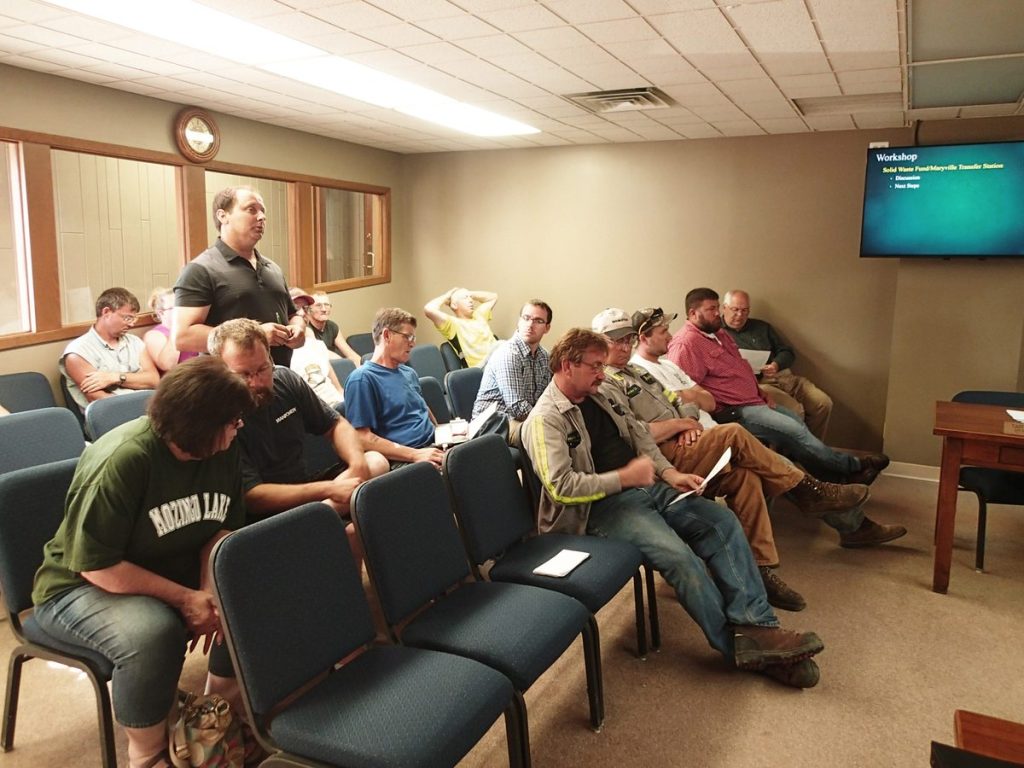
Dennis Porter of Porter Trash Service addresses the Maryville City Council this week during a special meeting called to discuss options with regard to the municipal solid waste transfer station, which is currently operating at an annual deficit of well over $100,000. Porter, whose company operates its own station east of town, suggested Monday that the city close its facility in exchange for a discount on street sweepings disposal and a pledge to keep prices reasonable for other private haulers who would likely transport refuse to Porter’s station by default.
Representatives from most of Maryville’s half-dozen trash-hauling companies met with the Maryville City Council this week in an attempt to find the least painful alternative with regard to the city’s solid waste transfer station, which has been operating at a deficit since a privately operated station opened three years ago several miles east of town.
As the discussion proceeded during a special session prior to Monday’s regular council meeting, the city’s governing board appeared to drift away from what would likely be a poison pill for local family-owned hauling companies — municipalized trash service for local residents and businesses.
Instead, the debate centered on a couple of other options: closing the transfer station altogether or leasing it to a private concern, possibly a consortium made up of the haulers themselves.
Under municipalization, the city would either carry out trash collection itself, excluding private haulers, or, more likely, contract with a single private hauler following the submission of competitive bids.
City Manager Greg McDanel said that a lot of cities comparable to Maryville are going the municipalization route, which would direct all local waste to the municipal transfer station. A city-run garbage operation would also offer customers uniform rates and service and reduce the number of days a week on which collection occurs, since there would be only one hauler covering the city instead of five or six, each with its own schedule.
As a result, garbage cans would clutter curbs less often, and city streets would carry fewer heavy trucks, which city officials have said inflict wear and tear equivalent to thousands of automobiles.
However, there has been strong opposition to municipalization in Maryville ever since the first such proposal surfaced in the mid-1990s, with local haulers and their allies successfully convincing successive councils that the principal of free-market competition was paramount.
The last serious effort to municipalize garbage service in Maryville ended acrimoniously in 2001, when the city abandoned the effort after being faced with a restraining order and subsequent lawsuit.
But with the municipal transfer station at 1860 N. Main — which is supposed to pay for itself through the collection of per-ton “tipping fees” — operating at an annual deficit of well over $100,000 a year, both the council and City Hall staff appear determined to find a solution.
“We’ve got to do something,” Councilman Tim Shipley said. “This has been kicked down the road for 25 years.”
Of the two options broached Monday, the first, closing the transfer station, would likely mean that most haulers would take their refuse to a similar facility opened in April 2012 by Porter Trash Service on Highway 136.
Dennis Porter of Porter Trash attended this week’s meeting and said he was willing to work with both the city and local haulers in order to keep tipping fees reasonable, even though haulers would have few other options other than shouldering increased fuel costs and disposing of waste at facilities in either St. Joseph or Clarinda, Iowa.
“I don’t want to put anybody out of business,” Porter said, “I’m just trying to keep my business going.”
Should his facility become Nodaway County’s only transfer station, Porter said he would offer contracts freezing tipping fees at their current level through 2020. After that, he said, prices would likely increase about three percent due to anticipated higher costs for hauling compacted refuse from the transfer station to distant landfills.
In addition, Porter said he would accept the city’s street sweepings at a discounted cost of $5 per ton over cost. Currently the city dumps the sweepings at its own transfer station, internally charging itself around $20,000 a year, which is in addition to the approximately $110,000 a year used to subsidize the operation from the General Fund.
Chris Mozingo of Mozingo Sanitation indicated that while Porter’s offer might maintain the status quo for a while — both transfer stations charge $48 a ton — he still fears that with no competition prices will inevitably go up.
“2020 is not that far away,” Mozingo said.
Weighing in with a second option that would keep both transfer stations open was Terry Emery of Gene Emery Sanitation, who asked if the city could lease its station to local haulers who would run it for themselves.
Both McDanel and the council indicated this could be a viable option if the haulers, all of whom compete against each other, felt they could successfully work together.
“The last thing anybody up here wants is for somebody to lose their business,” Shipley said.
Neither option, closing the transfer station or leasing it, gets the city completely off the hook with regard to its solid waste liability. While those measures might eliminate the expense of operating the station, they would also leave City Hall with an existing $30,000 a year fee charged by the Missouri Department of Natural Resources for monitoring the old municipal landfill for gas and groundwater leakage.
The landfill closed under orders from DNR in 2001, and the transfer station was originally conceived as a way of generating revenue to cover the monitoring charges.
Also on Monday, Mayor Renee Riedel and Councilwoman Rachael Martin suggested that the city go ahead and issue a formal notice of its intention to municipalize garbage hauling in two years’ time; not, Riedel said, because it’s going to, but because such a notice is required under state law before action is taken.
Riedel and Martin said it might be wise to start the clock ticking on municipalization now just in case, as in the past, all other efforts fail.
Councilman Jerry Riggs countered that the move was premature, and that issuing the notice could wait a month or two while municipal staffers continue talking with haulers and preparing a recommendation with regard to closing or leasing the transfer station.
In the end Riedel’s and Martin’s suggestion was put to a vote and defeated three to two with council members Riggs, Shipley and Jason McDowell opposed.
As the discussion wound down, Sharon Mozingo, Chris Mozingo’s mother, made a final plea for the council to consider the interests of Maryville’s family-owned haulers.
“These are lives,” she said, “businesses that have employees. We have always stood behind the city, and now we think it’s time for the city to stand behind us.”
A City Hall decision to take over garbage service and contract with a single hauler, Mozingo continued, held out the possibility of families losing their livelihoods, probably for good.
“With municipalization, once it’s done, it’s done,” she said.




