
Limited operations begin at sewer plant
TONY BROWN/DAILY FORUM
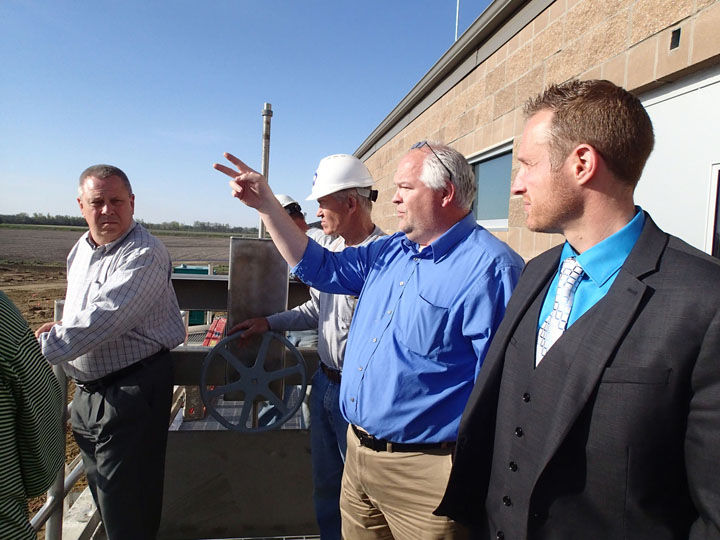
Public Works Director C.E. Goodall, center, gestures while helping lead a recent tour of Maryville’s new wastewater treatment plant for city council members and other municipal officials. Pictured at far left and right are Maryville Public Safety Director Keith Wood and City Manager Greg McDanel.
Despite historically high rainfall totals this spring — a deluge that has damaged fall harvest prospects and set back construction schedules all over northwest Missouri — planned completion of the city of Maryville’s new $13.7 million sewage treatment plant remains on schedule.
And that’s a good thing, since failure to get the facility online by a government-imposed July 1 deadline could result in significant fines imposed by state and federal environmental agencies.
Maryville Public Works Director C.E. Goodall said Friday that the plant is up and running on a limited basis, though the majority of the city’s wastewater is still flowing into nearby lagoons where a combination of bacteria and settling has been used to treat effluent for years.
The way things stand now, Goodall said there should be no difficulty in bringing the new “mechanical” plant online before the end of this month, though the rain has slowed some finish work at the site, such as fence installation.
None of that, however, appears to be a problem as far as meeting the permit requirements set forth by the state Department of Natural Resources, the director stated.
Though timely completion of the plant now seems assured, Goodall said that if the heavy rains continue two of the lagoons will remain in service, but only as a means of storing effluent until it can be channeled into the plant and treated.
After July 1, water from the lagoons will no longer be piped back into the One Hundred and Two River without flowing through the massive new facility first.
Like the lagoons, the plant also relies on a “biomass” of bacteria, which feeds off human waste and transforms ammonia into nitrogen. However, that process will now take place in a massive concrete aeration basin equipped to force oxygen through contaminated liquid, speeding the biological and chemical reactions that transform effluent back into clean water.
The facility also has two large clarifier tanks equipped with metal arms that churn through sewage in order to remove particulates and suspended solids.
During a recent Maryville City Council tour of the facility, Goodall said that water released back into the River will actually be cleaner than untreated water from Mozingo Lake, which serves as the city’s primary water supply.
As for other problems caused by the wet spring, Goodall said his office has received a few reports of water backing up into homes but nothing on the scale of last August, when a late-summer downpour caused flooded basements in a half-dozen residences along Forest Street on the west end of town.
“We’ve had a couple of calls, but nothing like that,” Goodall said.




